Minoxidil
Loniten · Rogaine · Regaine · LDOM
Last updated
At a glance
Overview
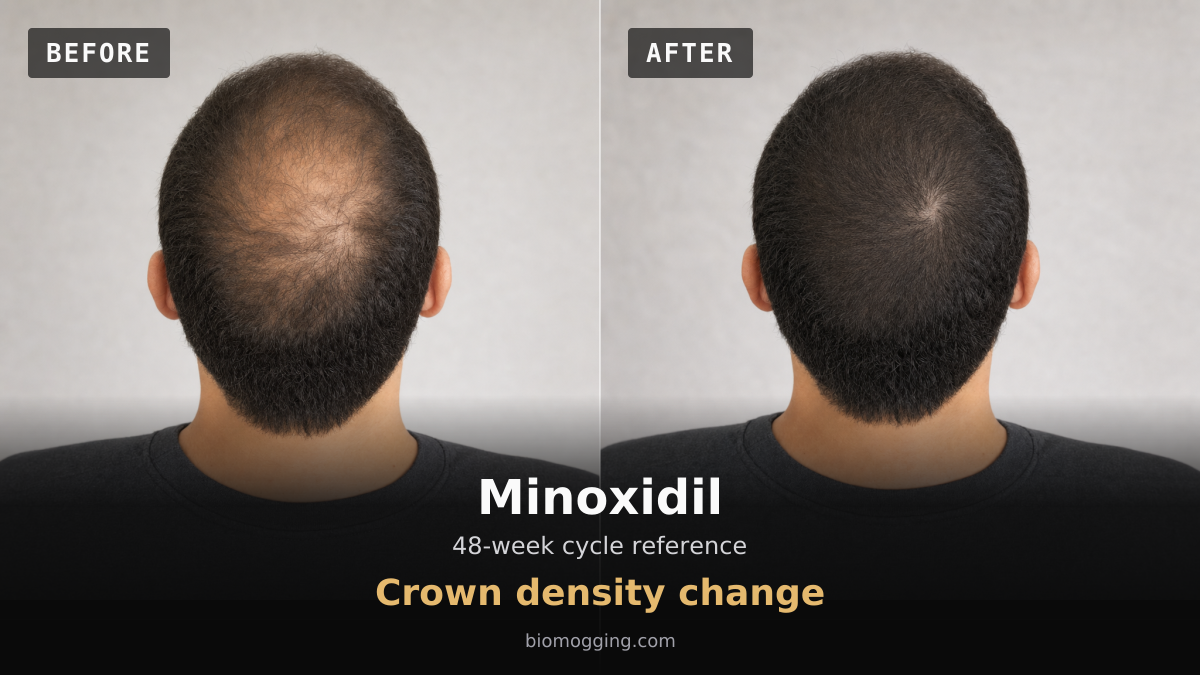
Minoxidil is the most reliable hair-growth driver the looksmaxxing community has. Originally a 1970s oral antihypertensive, its hypertrichosis "side effect" turned out to be the most consistently reproducible regrowth signal in dermatology — which is why it now anchors nearly every serious hair-retention stack, from the natty Norwood-2 holding the line to the blast-and-cruise crowd trying to keep their hairline through a trenbolone cycle.
The mechanism is worth understanding because it dictates how you use it: minoxidil is a prodrug, converted in the follicle by SULT1A1 into its active metabolite, which opens K-ATP channels to shorten telogen, prolong anagen, and upregulate VEGF around the dermal papilla. It drives growth — but it does not stop androgen-driven miniaturization. That's the single most important thing to internalize before you commit: minoxidil is half a stack. The other half is a 5-AR inhibitor (finasteride, dutasteride) or a topical AR antagonist (RU58841, pyrilutamide) to kill the miniaturization signal underneath.
"Low-dose oral minoxidil (LDOM) was associated with a significant improvement in hair density and global photographic assessment, with a generally favorable safety profile." — Gupta et al., Skin Appendage Disorders (2023)
The other thing to know upfront is the commitment. Visible response takes 12–16 weeks, peak response takes 12 months, and gains are maintained only as long as you keep using it — stop for 3–4 months and you'll shed back to your untreated baseline. This is a multi-decade tool, not a cycle.
Below we cover the topical-vs-oral trade-off (and why most serious users run both), LDOM dosing for men and women, the on-cycle protocol for AAS users, microneedling integration, the sulfotransferase responder problem, and how to manage the two side effects that actually matter at LDOM doses — hypertrichosis and edema.
How Minoxidil works
The Sulfotransferase Bottleneck#
Minoxidil itself is biologically inert at the follicle. It's a prodrug that requires conversion to minoxidil sulfate by the enzyme SULT1A1 in the outer root sheath of the hair follicle. This single enzymatic step is the reason roughly 30–40% of topical users are poor responders — if your follicular SULT1A1 activity is low, no amount of 5% foam will move the needle.
"Sulfotransferase activity in the outer root sheath was positively correlated with the clinical response to topical minoxidil, suggesting a role for enzymatic testing in predicting efficacy." — Goren, A. et al. Dermatologic Therapy, 2014
Practical consequence for the reader: if you've run topical 5% BID for 6+ months with standardized photos and see no response, you're likely a sulfotransferase poor-converter. Oral minoxidil bypasses this bottleneck partially — systemic metabolism produces minoxidil sulfate outside the follicle — which is a major reason LDOM often rescues topical non-responders.
K-ATP Channel Opening and the Anagen Extension#
Minoxidil sulfate is an ATP-sensitive potassium channel (K-ATP) opener. In dermal papilla cells, opening these channels hyperpolarizes the membrane and pushes follicles out of the resting telogen phase and into active anagen (growth) phase — while also prolonging anagen duration.
This is the mechanism behind two things every user sees:
- The month 2–8 shed. Dormant telogen hairs get actively displaced as new anagen hairs push them out. The shed is the compound working, not failing.
- The 12-week inflection. Anagen extension means thicker, darker, longer-cycling hairs replacing miniaturized vellus hairs — but only once the new cohort has had time to cycle in.
The same K-ATP mechanism on systemic vascular smooth muscle is what causes the reflex tachycardia and mild edema on oral dosing.
Perifollicular Vasodilation and VEGF Upregulation#
Secondary to the direct K-channel effect, minoxidil drives perifollicular vasodilation and upregulates VEGF (vascular endothelial growth factor) in dermal papilla cells, expanding the capillary network feeding each follicle. Better microcirculation to the papilla means more sustained nutrient and oxygen delivery through long anagen phases.
This is the mechanistic rationale for microneedling synergy — 1–1.5 mm weekly needling triggers a wound-healing VEGF response that stacks with minoxidil's own angiogenic push. It's also why tadalafil 5 mg daily shows up in aggressive hair stacks: additional scalp microcirculation from PDE5 inhibition.
Wnt/β-Catenin and Prostaglandin Signalling#
Minoxidil sulfate potentiates Wnt/β-catenin signalling in dermal papilla cells — a pathway central to hair follicle morphogenesis and anagen induction. It also modulates prostaglandin synthesis, favouring PGE2 (pro-anagen) over PGD2 (pro-miniaturization, elevated in balding scalp).
This matters for stacking logic: minoxidil drives growth signals but does not block the androgen input causing miniaturization. On its own, minoxidil is a pure accelerator with no brake on the underlying MPB process. That's why serious retention stacks always pair it with either a 5-AR inhibitor (finasteride, dutasteride) or a topical AR antagonist (RU58841, pyrilutamide) — particularly when running AAS, where exogenous androgens saturate scalp AR and overwhelm systemic 5-AR inhibition.
Why Oral and Topical Hit Differently#
Topical application delivers minoxidil directly to the scalp, relying on follicular SULT1A1 for activation. Bioavailability through intact skin is ~1.4% systemically — low enough that cardiovascular effects are negligible in healthy users.
Oral dosing takes a different route: ~90% bioavailable, peak at ~1 hour, short plasma half-life of 3.5–4 hours. The biological effect on follicles outlasts plasma levels because K-ATP channel opening persists past clearance, and systemic metabolism generates minoxidil sulfate that reaches the follicle via circulation rather than local conversion.
"Low-dose oral minoxidil (LDOM) was associated with a significant improvement in hair density and global photographic assessment, with a generally favorable safety profile." — Gupta, A.K. et al. Skin Appendage Disorders, 2023
The takeaway: topical and oral are complementary, not redundant. Running both stacks two independent delivery modes onto the same follicle population, which is why the community default for serious users is topical 5% BID + oral 2.5 mg/day rather than either route alone.
The Commitment Reality#
None of these mechanisms produce permanent change. Stop minoxidil and within 3–4 months you lose the regrowth plus any hairs that would have miniaturized during that window — the follicles revert to their genetically programmed cycle. Plan on this being a 12-week minimum to visible response, 12-month minimum to judge, lifetime to retain gains. If that commitment isn't realistic, the compound isn't the right tool.
Protocol
| Level | Dose | Frequency | Notes |
|---|---|---|---|
| Low | 1.25–2.5 mg | Once daily | Documented entry-level range |
| Mid | 2.5–2.5 mg | Once daily | Most commonly studied range |
| High | 2.5–5 mg | Once daily | Oral LDOM: once daily, or split BID at 5 mg to smooth edema. Topical: 1 mL BID is label; once-daily 5% foam is a legitimate adherence compromise. Microneedle weekly (1–1.5 mm), applying minoxidil AFTER — not before — to avoid systemic absorption spike. |
Cycle length & outcomes
Documented cycle
52–520 weeks
Plateau after
52 wks
Cycle Notes#
Minoxidil is not cycled — it's a commitment compound. The moment you stop, the follicles you pushed into anagen drift back toward their genetic fate within 3–6 months, and any regrowth you earned sheds out. Plan around indefinite use from day one. The only "cycling" decision is dose titration: starting low, pushing up as tolerated, and adjusting based on response and side effects.
Dose Ladder by Goal#
| Goal | Timeline | Daily Protocol |
|---|---|---|
| Baseline retention (no AAS) | 12+ months, then indefinite | Topical 5% 1mL QD or BID |
| Plateaued topical responder | Month 3+ add-on | Topical 5% BID + oral 1.25mg, titrate to 2.5mg |
| Standard aggressive stack | Indefinite | Topical 5% BID + oral 2.5mg |
| On-cycle AAS retention | Duration of cycle + blast/cruise | Topical 5% BID + oral 2.5–5mg + RU58841 or pyrilutamide topical |
| Oral-only (topical non-compliant) | Indefinite | Oral 2.5mg, titrate to 5mg (split BID if edema) |
| Women (FPHL) | Indefinite | Topical 5% foam QD + oral 0.25–1.25mg |
Loading, Tapering, Titration#
No loading phase. Minoxidil doesn't build up toward a threshold — follicular SULT1A1 converts whatever you give it in real time, and K-ATP channel opening is immediate. There's nothing to "saturate."
Titration on oral matters. Start at 1.25mg for 2–4 weeks, move to 2.5mg if resting HR and ankle edema are unremarkable, hold there for most users. Only push to 5mg if response at 2.5mg is inadequate after month 6. Split 5mg BID (2.5mg AM / 2.5mg PM) if edema or HR bump becomes noticeable — smoother plasma curve, same follicular exposure.
Tapering off is pointless because you're not coming off. The rare case for tapering: transitioning from oral back to topical-only, in which case step down over 4–8 weeks while ramping topical adherence to avoid a confounding shed.
Onset and Response Timeline#
Set expectations hard — this is where most users quit prematurely.
- Weeks 2–8: Initial shed. Telogen hairs are displaced by incoming anagen hairs. Looks catastrophic in the shower. This is the compound working, not failing.
- Weeks 8–12: Shed subsides. Baseline density visible.
- Month 3–4: Stabilization — the bleed stops, miniaturized hairs start to thicken.
- Month 6: Visible regrowth in responders. First honest judgment point.
- Month 12: Peak response. Take standardized photos (same lighting, same angles, dry hair) at month 0, 3, 6, 12.
"At week 24, 100% of patients treated with oral minoxidil 5 mg daily showed improvement in vertex hair counts and standardized global photographs, with most adverse events being mild and manageable." — Panchaprateep & Lueangarun, Drug Design, Development and Therapy (2020)
Responder status is partly genetic — follicular SULT1A1 activity predicts topical response, and 30–40% of users are poor topical responders for this reason. Oral bypasses the scalp enzyme bottleneck partially (systemic sulfation) and is often the move for topical non-responders.
"Sulfotransferase activity in the outer root sheath was positively correlated with the clinical response to topical minoxidil, suggesting a role for enzymatic testing in predicting efficacy." — Goren et al., Dermatologic Therapy (2014)
Bloodwork and Monitoring Cadence#
Oral minoxidil at LDOM doses is remarkably well-tolerated, but don't run it blind.
- Baseline: Resting HR (morning, seated, 5 min rest), BP, basic metabolic panel.
- Week 4: Recheck HR and BP. HR bump of 3–10 bpm is normal and benign; >15 bpm sustained warrants dose reduction or adding low-dose spironolactone 25–50mg (bonus scalp antiandrogen effect for men).
- Week 12: HR/BP recheck, assess ankle edema, first photo checkpoint.
- Annually thereafter: HR/BP, standardized scalp photos. No routine echo needed at LDOM doses in healthy users — pericardial effusion is a concern at antihypertensive doses (10–40mg), not 2.5–5mg.
"No patient experienced documented hypotension or any clinically significant change in blood pressure over the course of low-dose oral minoxidil treatment for androgenetic alopecia." — Jimenez-Cauhe et al., JAAD (2024)
On-Cycle Considerations#
Running AAS shifts the calculus. Exogenous androgens — especially DHT-derivative compounds and anything with strong AR affinity — will outpace oral 5-AR inhibition at the scalp level because systemic finasteride/dutasteride doesn't touch direct AR binding by the AAS itself. The stack that actually holds hair on cycle:
- Oral minoxidil 2.5–5mg/day (push growth signal hard).
- Topical 5% minoxidil BID, or compounded 10%.
- Topical AR antagonist — RU58841 50mg/day or pyrilutamide 5% BID — this is the piece most people miss.
- Continue finasteride/dutasteride if you were already on it for endogenous DHT management.
- Ketoconazole 2% shampoo 2–3×/week as a cheap adjunct.
Start the stack before visible miniaturization, not after. Once a follicle is gone it's gone — minoxidil can thicken miniaturized hairs but cannot resurrect fully terminalized follicles.
"Most patients using low-dose oral minoxidil for androgenetic alopecia experience significant stabilization and/or regrowth, with hypertrichosis and mild fluid retention as primary side effects." — Randolph & Tosti, JAAD (2021)
Microneedling Integration#
Weekly 1–1.5mm dermaroller, minoxidil applied after (not before) — applying pre-needling drives a systemic absorption spike that turns a topical dose into a partial oral dose. Wait 6+ hours, or just apply that evening's dose post-session. Don't needle daily; the scalp inflammation wrecks adherence and doesn't improve outcomes.
Risks & mistakes
Common (most users)#
- Initial shed (weeks 2–8) — synchronized telogen release as follicles transition to anagen. This is the compound working, not failing. Do not stop. Resolves by month 3.
- Scalp irritation, dryness, flaking (topical) — usually the propylene glycol vehicle, not minoxidil itself. Switch from solution to foam (PG-free) or compounded vehicles. Moisturize scalp on non-dose hours.
- Facial hypertrichosis from runoff (topical) — wash hands immediately after application, apply ≥2 hours before bed, use foam over solution to reduce migration in sweat.
- Mild ankle edema (oral, ~2.5 mg+) — dose-dependent and usually cosmetic. Low-dose spironolactone 25–50 mg clears it quickly and doubles as a scalp-level antiandrogen (convenient for men running it for hair).
- Resting HR bump of 3–10 bpm (oral) — reflex tachycardia from K-ATP channel opening. Not clinically meaningful in healthy users. Check baseline HR before starting, recheck at week 4 and week 12.
- Body hypertrichosis (oral, 15–30% at ≥2.5 mg/day) — more bothersome for women than men. Men on cycle often consider it a non-issue or a minor bonus; dose-reduce if it's intolerable.
"Most patients using low-dose oral minoxidil for androgenetic alopecia experience significant stabilization and/or regrowth, with hypertrichosis and mild fluid retention as primary side effects." — Randolph & Tosti, JAAD 2021
Uncommon (dose-dependent or individual)#
- Contact dermatitis (topical) — true allergic reaction rather than PG irritation. Swap to foam; if reaction persists, minoxidil itself is the allergen and topical needs to come out.
- Postural lightheadedness (oral) — rare at LDOM doses (<5 mg). If it shows up, split the dose BID (e.g. 2.5 mg → 1.25 mg BID) to flatten the peak.
- Periocular / cheek hair migration — sweat-driven spread, more common with solution than foam. Reformulate to foam and tighten application discipline.
- HR rise >15 bpm or BP drop with symptoms — back off to the next dose down. If you started at 2.5 mg, drop to 1.25 mg and hold for 4 weeks before retrying.
- Sulfotransferase non-response (topical) — ~30–40% of topical users are poor responders due to low follicular SULT1A1 activity. This isn't a side effect per se, it's a failure mode — and it's the single biggest argument for adding oral, where follicular sulfation matters less because you're saturating from within.
"Sulfotransferase activity in the outer root sheath was positively correlated with the clinical response to topical minoxidil, suggesting a role for enzymatic testing in predicting efficacy." — Goren et al., Dermatologic Therapy 2014
"No patient experienced documented hypotension or any clinically significant change in blood pressure over the course of low-dose oral minoxidil treatment for androgenetic alopecia." — Jimenez-Cauhe et al., JAAD 2024
Rare but serious#
- Pericardial effusion / tamponade — documented at antihypertensive doses (10–40 mg/day), essentially not reported at LDOM <5 mg/day in healthy cardiac patients. Warning signs: progressive dyspnea, chest heaviness, unexplained fatigue, new orthopnea. Stop immediately and get an echo. This is the single hard reason not to push above 5 mg/day for hair purposes.
- Significant sodium/fluid retention with weight gain — uncommon below 5 mg. If you're gaining 3+ lb of water in a week and ankles are pitting, dose-reduce or add spironolactone; don't just power through.
- Severe reflex tachycardia with symptoms — palpitations, chest discomfort, pre-syncope. Stop and reassess; consider whether another stimulant (clen, high-dose caffeine, sympathomimetics) is stacking on top.
Hard contraindications#
- Pheochromocytoma — minoxidil can precipitate hypertensive crisis. Do not use.
- Recent myocardial infarction or unstable angina — wait until cardiac status is stable and cleared.
- Pre-existing pericardial effusion or significant valvular disease — minoxidil compounds the risk.
- Severe renal impairment without dose adjustment — clearance is renal, accumulation is real.
- Pregnancy and lactation — hypertrichosis has been reported in infants of women on oral minoxidil; don't use in either state.
- Known minoxidil hypersensitivity — rare, but a true allergic reaction rules out both routes.
Gender considerations and PCT#
Women tolerate lower oral doses (0.25–1.25 mg/day) because facial hypertrichosis is a hard aesthetic ceiling — at 2.5 mg most women will get noticeable facial hair within 8–12 weeks. Start at 0.625–1 mg and titrate slowly. Topical 5% foam once daily is the better-tolerated starting point for most women.
Minoxidil does not touch the HPTA, does not aromatize, does not bind AR, and does not affect semen parameters. There are no PCT considerations — it runs straight through cycle, PCT, and cruise without interruption. In fact, the on-cycle period is when you want it running hardest, paired with a topical AR antagonist (RU58841, pyrilutamide) to block the scalp-level androgen load that oral 5-AR inhibitors can't address when exogenous DHT-class compounds are on board.
Stack & combine
Multipliers applied when these compounds run together. Values > 1 indicate a bonus on that axis. Tap a partner to expand the mechanism.
| Partner | Type | Lean | Fat loss | Recovery |
|---|---|---|---|---|
| synergistic | ×1.00 | ×1.00 | ×1.20 | |
| synergistic | ×1.00 | ×1.00 | ×1.18 | |
| synergistic | ×1.00 | ×1.00 | ×1.18 | |
| synergistic | ×1.00 | ×1.00 | ×1.18 | |
| synergistic | ×1.00 | ×1.00 | ×1.15 | |
| synergistic | ×1.00 | ×1.00 | ×1.15 | |
| synergistic | ×1.00 | ×1.00 | ×1.12 | |
| synergistic | ×1.00 | ×1.00 | ×1.00 | |
| synergistic | ×1.00 | ×1.00 | ×1.00 | |
| synergistic | ×1.00 | ×1.00 | ×1.00 |
Featured in stacks1 curated protocol include Minoxidil
FAQ — Minoxidil
Research & citations
5 studies cited on this page.
Conclusion
Minoxidil is the engine-room growth driver in any serious hair stack, with both topical and low-dose oral routes showing robust results for AGA. Proper protocol and stacking are what separate temporary shed-panic from long-term retention.
Key takeaways:
- Topical: 5% solution or foam once or twice daily is the evidence base; once daily is a real-world adherence win
- Oral (LDOM): 1.25–2.5 mg daily is the sweet spot for men; 0.25–1.25 mg for women to limit hypertrichosis
- Stacking: Run with a 5-AR inhibitor (finasteride/dutasteride) or a topical AR antagonist (RU58841/pyrilutamide) to address androgen-driven miniaturization — minoxidil alone does not halt MPB
- Synergy: Weekly microneedling (1–1.5 mm, minoxidil after) can meaningfully boost results
- Side effects: Hypertrichosis and mild edema at oral doses — almost always manageable; topical application mainly risks irritation (foam is less harsh than PG solution)
- Commitment: Expect a visible shed at 2–8 weeks, stabilization by month 4, and maximal regrowth by 12 months; stopping means losing all progress
If you want real regrowth — especially if you are on AAS — minoxidil (topical + oral) in a properly built stack is as close to non-negotiable as hair compounds get.