Bimatoprost
Latisse · Lumigan · Careprost · AGN 192024
Last updated
At a glance
Overview
Why Bimatoprost Earned Its Spot in the Looksmaxxing Stack#
Bimatoprost is the most effective topical we have for growing longer, thicker, darker eyelashes and eyebrows — and nothing else in the cosmetic arsenal comes close. Originally a glaucoma drop (Lumigan), the lash-growth effect was an accidental finding that Allergan re-developed into Latisse, FDA-approved in 2008 for eyelash hypotrichosis. For looksmaxxers and aesthetics-focused users, it's become the default answer for anyone chasing mascara-on lashes without the mascara, or trying to rebuild brows after years of overplucking.
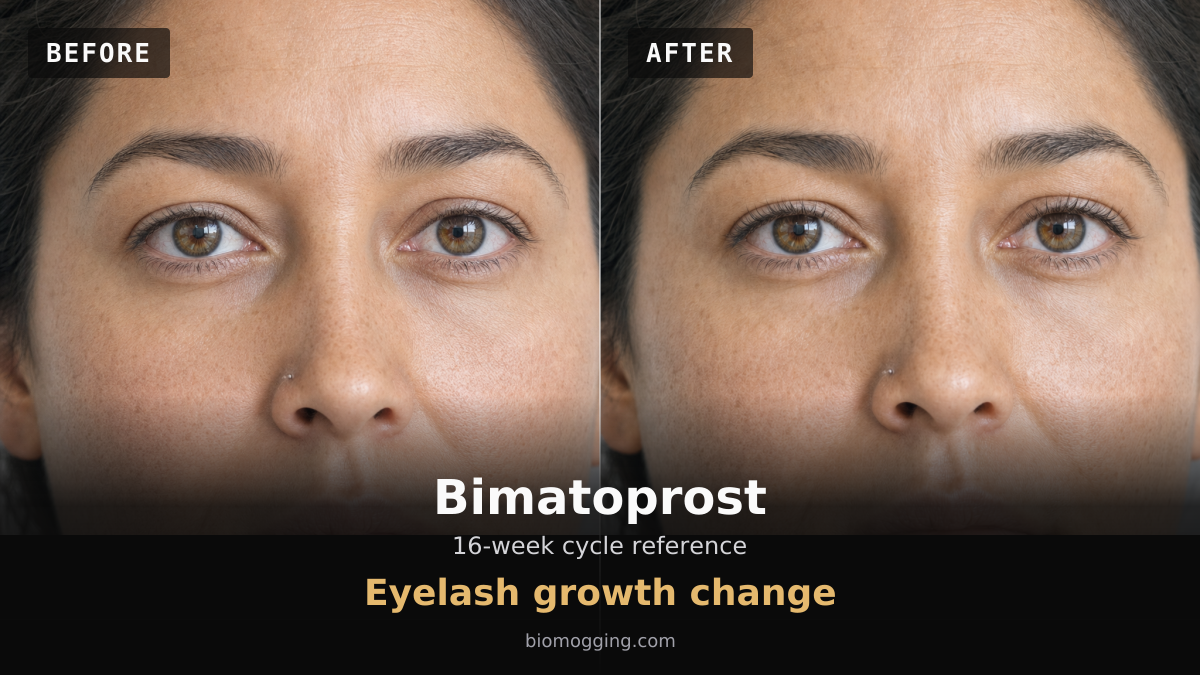
The mechanism is a synthetic prostamide / PGF2α analog that binds FP receptors on dermal papilla cells, prolonging the anagen (growth) phase and increasing hair bulb diameter and melanin deposition. In the pivotal trial, users saw a 25% increase in lash length, 106% increase in fullness, and 18% increase in darkness at 16 weeks — numbers that translate to an obvious, photographable difference, not a subtle one.
"At week 16, bimatoprost-treated patients had a 25% increase in eyelash length, 106% increase in fullness/thickness, and 18% increase in darkness compared with baseline." — Carruthers et al., J Drugs Dermatol 2013
The catch: results regress within 8–12 weeks of stopping, so this is a long-term commitment, and the community has learned the hard way that sloppy application causes two specific regrets — periorbital fat atrophy (PAP / "sunken eyes") and unwanted hair growth wherever the drug migrates. Run precisely and it's one of the highest-ROI additions to a looksmaxxing stack. Run it carelessly and you'll see it on your face.
The rest of this page covers the practical protocol: 0.03% vs 0.01% dosing for lashes and brows, off-label scalp use (and why it underperforms minoxidil there), how bimatoprost compares to minoxidil and finasteride for AGA, the full side-effect profile including PAP mitigation, stacking with tretinoin and hair stacks, and sourcing generic Careprost vs brand Latisse without paying the cosmetics-market markup.
How Bimatoprost works
Bimatoprost is a synthetic prostamide — structurally a prostaglandin F2α ethanolamide analog — originally developed to lower intraocular pressure in glaucoma. The hair-growth effect was a lucky accident: glaucoma patients kept showing up with thicker, darker, longer lashes on the treated eye. What looks like a cosmetic quirk is actually a direct pharmacological push on the hair cycle itself, which is why it works on lashes, brows, and (more modestly) scalp and patchy beard areas.
FP Prostaglandin Receptor Activation at the Follicle#
Bimatoprost binds prostamide-sensitive receptors and, after local hydrolysis to bimatoprost free acid, engages the FP prostaglandin receptor expressed on dermal papilla cells and outer root sheath keratinocytes of the hair follicle. This is the same receptor family that endogenous PGF2α uses to regulate follicular cycling, which is why PGF2α analogs as a class (bimatoprost, latanoprost, travoprost) all produce hypertrichosis as an off-target effect. Binding happens directly under the lash line or brow skin — the drug is acting locally, not systemically, which is the whole point of dosing it topically.
Anagen Prolongation and Telogen-to-Anagen Conversion#
The core mechanism driving visible results is hair-cycle modulation. Bimatoprost extends the duration of the anagen (growth) phase and coaxes resting telogen follicles back into active growth earlier than they otherwise would. Longer anagen means each hair keeps growing for more weeks before it sheds, so lashes reach greater length; more follicles in anagen at any given time means the lash line looks denser.
"PGF2α demonstrated a significant stimulatory effect on the anagen phase and hair follicle diameter in human hair follicle models." — Liang Y, et al. Archives of Dermatological Research, 2025
This is also why results take 12–16 weeks to fully express and regress within 8–12 weeks of stopping — you're not building tissue, you're holding follicles in a phase they'd otherwise exit. Pull the drug, the cycle reverts.
Hair Bulb Hypertrophy and Melanogenesis#
Beyond cycle timing, bimatoprost enlarges the hair bulb diameter and upregulates melanocyte activity within the follicle. Thicker shafts + more melanin transfer = the characteristic "darker, fuller" look documented in the pivotal Latisse trials.
"At week 16, bimatoprost-treated patients had a 25% increase in eyelash length, 106% increase in fullness/thickness, and 18% increase in darkness compared with baseline." — Carruthers J, et al. Journal of Drugs in Dermatology, 2013
The melanogenic effect is the double-edged part of the mechanism: it's what makes lashes darker, but it's also what drives iris pigmentation and periocular skin hyperpigmentation when the drug migrates off the lash line. Application discipline contains the downside.
Why Lashes and Brows Respond Better Than Scalp#
The same FP-receptor mechanism applies to scalp follicles, but two factors blunt the response: (1) scalp skin is dramatically thicker than eyelid skin, so topical penetration to the dermal papilla is poor; and (2) androgenetic alopecia is primarily a DHT-driven miniaturization problem, and bimatoprost does nothing to DHT. It's additive at best on the scalp — useful as a tertiary add-on behind finasteride/dutasteride, minoxidil, and microneedling, not a replacement for any of them. Lashes and brows lack the androgen-sensitivity problem and sit under thin, highly permeable skin, which is why they respond so dramatically to the same compound.
Pharmacokinetics That Make It Safe Topically#
Bimatoprost has a plasma half-life of ~45 minutes and an aqueous-humor Tmax around 1.5 hours, with systemic exposure from a lid-margin drop below quantifiable limits in most PK studies.
"Tmax for bimatoprost in the aqueous humor was 1.5 hours and the elimination half-life ranged from 2.1 to 2.5 hours." — Halder A, et al. Indian Journal of Clinical and Experimental Ophthalmology, 2021
For the physique-focused reader, the practical consequence is that bimatoprost does not interact systemically with AAS, SARMs, a fin/dut + minoxidil hair stack, melanotan, tretinoin, or isotretinoin. It's a local-acting cosmetic you can bolt onto any protocol without worrying about hormonal crosstalk or PCT implications — the only real conflicts are physical (dry eyes from accutane amplifying ocular irritation) rather than pharmacological.
Protocol
| Level | Dose | Frequency | Notes |
|---|---|---|---|
| Low | 15–30 mcg | Once daily | Documented entry-level range |
| Mid | 30–60 mcg | Once daily | Most commonly studied range |
| High | 60–90 mcg | Once daily | One drop (~30 mcg bimatoprost from 0.03% solution) per upper lid margin, nightly. Taper to 2–3×/week maintenance after 12–16 weeks. Eyebrow: one drop split across both brows. Scalp (off-label): 1–2× daily applied to thinning areas. |
Cycle length & outcomes
Documented cycle
12–52 weeks
Plateau after
16 wks
Cycle Structure#
Bimatoprost isn't really a "cycle" in the AAS sense — it's a two-phase topical you commit to long-term. Phase one is a 12–16 week loading run to push follicles into anagen and build visible density. Phase two is indefinite maintenance at reduced frequency. Stop entirely and you lose most of the gains within 8–12 weeks as treated follicles cycle back into telogen.
No systemic suppression, no PCT, no bloodwork cadence required. Absorption from a lid-margin drop is negligible and undetectable in serum in most PK work.
Dose Ladder by Goal#
| Goal | Loading Phase | Maintenance | Nightly Dose |
|---|---|---|---|
| Eyelash density | 12–16 weeks daily | 2–3×/week indefinite | 1 drop (~30 mcg) per upper lid |
| Eyebrow restoration | 16–28 weeks daily | 2–3×/week indefinite | 1 drop split across both brows |
| Alopecia areata patch | 12–24 weeks 1–2× daily | Daily until stable | 1 drop per patch |
| Scalp AGA (adjunct only) | 16+ weeks 1–2× daily | Daily, indefinite | 1–2 drops per thinning zone |
| Beard patches | 16+ weeks 1–2× daily | Daily, indefinite | 1 drop per patch |
The 0.03% strength is the default. A 0.01% formulation exists and has a slightly cleaner side-effect profile for sensitive users, but head-to-head data favors 0.03% for brows.
"Bimatoprost 0.03% showed statistically significant improvement in eyebrow score as compared with 0.01% at 16 weeks." — Ahluwalia et al., J Cosmet Dermatol 2019
Onset Timing#
Don't judge results before week 8. The hair cycle doesn't move faster just because you want it to.
- Weeks 1–4: nothing visible. Some users report lid-margin itching or mild hyperemia as they adapt.
- Weeks 4–8: new lashes begin appearing thicker and darker at the base; brow vellus hairs start terminalizing.
- Weeks 12–16: peak effect. Pivotal trial data at week 16 showed ~25% length increase, ~106% fullness/density increase, and ~18% darkness increase vs. baseline.
- Month 7: brow studies show continued accrual past the 4-month mark — brows are slower than lashes.
"At week 16, bimatoprost-treated patients had a 25% increase in eyelash length, 106% increase in fullness/thickness, and 18% increase in darkness compared with baseline." — Carruthers et al., JDD 2013
"At Month 7, improvement in the primary efficacy endpoint was statistically significantly greater for bimatoprost 0.03% subjects than for vehicle subjects." — Yoelin et al., Dermatologic Surgery 2014
Loading & Tapering#
No loading dose. The drug reaches aqueous-humor Tmax in ~1.5 h and is cleared from the target tissue in a few hours; there's no reservoir to saturate. More drug doesn't mean faster results — it means more skin migration, more pigmentation risk, and more periorbital fat atrophy over time.
Tapering is optional but sensible. Once you've hit peak density around week 16, most users drop to every other night or 2–3×/week without losing ground. This cuts drug exposure roughly in half and meaningfully reduces the long-term prostaglandin-associated periorbitopathy (PAP) risk — the sulcus hollowing that's the biggest long-term regret associated with this compound. If you notice any early sulcus deepening, taper further or pause for 4–8 weeks.
Stopping cold turkey isn't dangerous — it just means losing the cosmetic effect over 2–3 months as treated follicles cycle back toward their genetic baseline.
Monitoring#
- Bloodwork: not required. Topical systemic exposure is negligible.
- Baseline photos: worth taking — frontal and three-quarter shots with neutral lighting. Useful for tracking both gains and slow PAP changes that are hard to notice day-to-day.
- Iris color check: if you have hazel, green-brown, or mixed-color irises, photograph them at baseline. Iris pigmentation from lash-line application is lower-risk than from direct ocular instillation but non-zero, and permanent when it occurs.
- Eye exam: a routine exam every 12–18 months is reasonable if you're running this daily for years, particularly to catch any sulcus deepening or macular changes early.
Stacking Notes#
Bimatoprost is mechanistically inert toward everything in a typical looksmaxxing / bodybuilding stack — no interactions with AAS, SARMs, oral or topical 5-AR inhibitors, minoxidil, RU58841, melanotan-II, tadalafil, isotretinoin, or tretinoin. The one practical conflict is that isotretinoin-induced dry eye amplifies bimatoprost's ocular irritation; space doses, use preservative-free artificial tears, and drop to 0.01% or alternate-night dosing if irritation becomes limiting.
For scalp use specifically, layer it after minoxidil has fully dried and treat it as a tertiary add-on behind fin/dut + minoxidil + microneedling — not a replacement for any of them.
Risks & mistakes
Common (most users)#
- Conjunctival hyperemia (red eyes) — the most common complaint; usually mild and tolerated. Blot excess drug off the lid line after application so it doesn't wick onto the eye. If it persists, drop to 0.01% or every-other-night dosing.
- Itching, burning, stinging at the lash line — transient, usually fades after the first 2–3 weeks as tissue acclimates. Apply to clean, dry skin; remove contacts first and wait 15 minutes before reinserting.
- Eyelid skin hyperpigmentation — darkening of the skin along the lash line where the drug sits. Usually reversible over months after stopping. Mitigation: apply strictly to the lash line, never to the lid skin above it, and blot thoroughly.
- Unwanted hair growth wherever the drug migrates — lower lid, temples, cheeks, upper lip. This is an application-discipline problem, not a pharmacology problem. Use a micro-brush (not a dripping drop), apply only to the upper lid margin, and blot runoff immediately.
- Dry eye sensation — more noticeable if you're also running isotretinoin. Preservative-free artificial tears in the morning handle it.
Uncommon (dose-dependent or individual)#
- Periorbital fat atrophy / prostaglandin-associated periorbitopathy (PAP) — upper-lid sulcus deepening, loss of periorbital fat volume, "sunken eye" look. This is the side effect that matters most in a looksmaxxing context because the goal is aesthetics and PAP undermines the whole point. Risk scales with duration and with how much drug reaches the lid skin vs. the lash line specifically. Mitigation: minimize skin contact (lash line only, blot excess), consider the 0.01% strength, and take before/after photos every 4–8 weeks to catch sulcus changes early. Back off immediately at the first sign of sulcus deepening — caught early it usually reverses; ignored for months it may not.
- Iris pigmentation (permanent brown darkening) — documented with ocular instillation in glaucoma use. Exposure from lash-line application is much lower but non-zero. Highest risk in mixed-color irises (hazel, green-brown); lowest in solid blue or solid brown. Any color change that does occur is permanent. If you notice darkening, stop.
- Eyelash darkening beyond desired — the same melanogenesis that darkens the iris also darkens lashes. Usually welcome; occasionally excessive in blondes who wanted length without the "mascara look." Reduce frequency.
- Lower-lid hair growth from sloppy application — not dangerous, but visible and annoying to remove. Fix the application technique.
Rare but serious#
- Cystoid macular edema — rare, mostly reported in patients with pre-existing risk factors (pseudophakia, torn posterior lens capsule, uveitis history). Warning signs: sudden blurred or distorted central vision. Stop and see an ophthalmologist.
- Reactivation of herpetic keratitis — if you have a history of ocular herpes, bimatoprost can trigger recurrence. Burning, photophobia, dendritic lesions → stop and get evaluated.
- Anterior uveitis flare — iritis/uveitis can be triggered or worsened. Pain, photophobia, decreased vision → stop.
- Severe hypersensitivity reaction — swelling, rash extending beyond the lid. Uncommon but obvious when it happens; discontinue.
Hard contraindications#
- Active uveitis or iritis — prostaglandin analogs worsen intraocular inflammation.
- Macular edema, or history of pseudophakia with torn posterior capsule — elevated CME risk.
- Active herpetic keratitis or history of ocular HSV — risk of reactivation.
- Pregnancy and breastfeeding — Category C. Systemic exposure from topical use is low, but there is zero upside to running a cosmetic drug during pregnancy.
- Known hypersensitivity to prostaglandin analogs (latanoprost, travoprost, tafluprost).
Gender, stacking, and PCT notes#
No gender-specific dosing and no virilization concerns — this is a topical prostamide, not a hormonal compound. Women and men use identical protocols. PCT is not required; bimatoprost has no effect on the HPTA, liver, lipids, or androgen signaling.
It stacks cleanly with everything in the looksmaxxing toolkit: AAS cycles, SARMs, a fin/dut + minoxidil + RU58841 hair stack, melanotan-II, tretinoin, and tadalafil. The only stacking interaction worth flagging is isotretinoin — accutane's dry-eye effect compounds with bimatoprost's ocular irritation, so expect more burning and keep preservative-free artificial tears on hand. Not a contraindication, just a comfort issue.
The single highest-leverage mitigation for the entire side-effect profile is application discipline: a micro-brush, one drop, lash line only, blot the excess. Users who do this run bimatoprost for years without issues. Users who drip it across the whole lid end up with the PAP and hyperpigmentation stories that fill the Reddit threads.
Stack & combine
Multipliers applied when these compounds run together. Values > 1 indicate a bonus on that axis. Tap a partner to expand the mechanism.
| Partner | Type | Lean | Fat loss | Recovery |
|---|---|---|---|---|
| synergistic | ×1.00 | ×1.00 | ×1.20 | |
| synergistic | ×1.00 | ×1.00 | ×1.00 |
FAQ — Bimatoprost
Research & citations
5 studies cited on this page.
Conclusion
Bimatoprost is the gold standard for lash and brow enhancement — nothing else is as consistent or user-friendly for follicle thickening in the cosmetic space.
Key takeaways:
- Typical protocol: 30–60 µg (one drop 0.03% solution) nightly to upper lid margin for lashes, split between brows for density
- Expect visible results by week 8, peak effect at 12–16 weeks, then drop to 2–3×/week for maintenance
- Off-label scalp results are modest for androgenetic alopecia — best treated as an adjunct, not a minoxidil/finasteride replacement
- Biggest risks: periorbital fat atrophy (PAP), skin hyperpigmentation, unwanted facial hair — avoid overapplication or migration to adjacent skin
- Stacks well with minoxidil, topical antiandrogens (RU58841, pyrilutamide), and can be layered with tretinoin or microneedling (apply at different times)
- Sourcing generic Careprost 0.03% is standard; refrigeration extends shelf life after opening
If you want thicker lashes and brows — and are willing to apply with accuracy and consistency — bimatoprost delivers industry-leading results with a strong safety profile when used topically.