Pyrilutamide
KX-826 · KX826
Last updated
At a glance
Overview
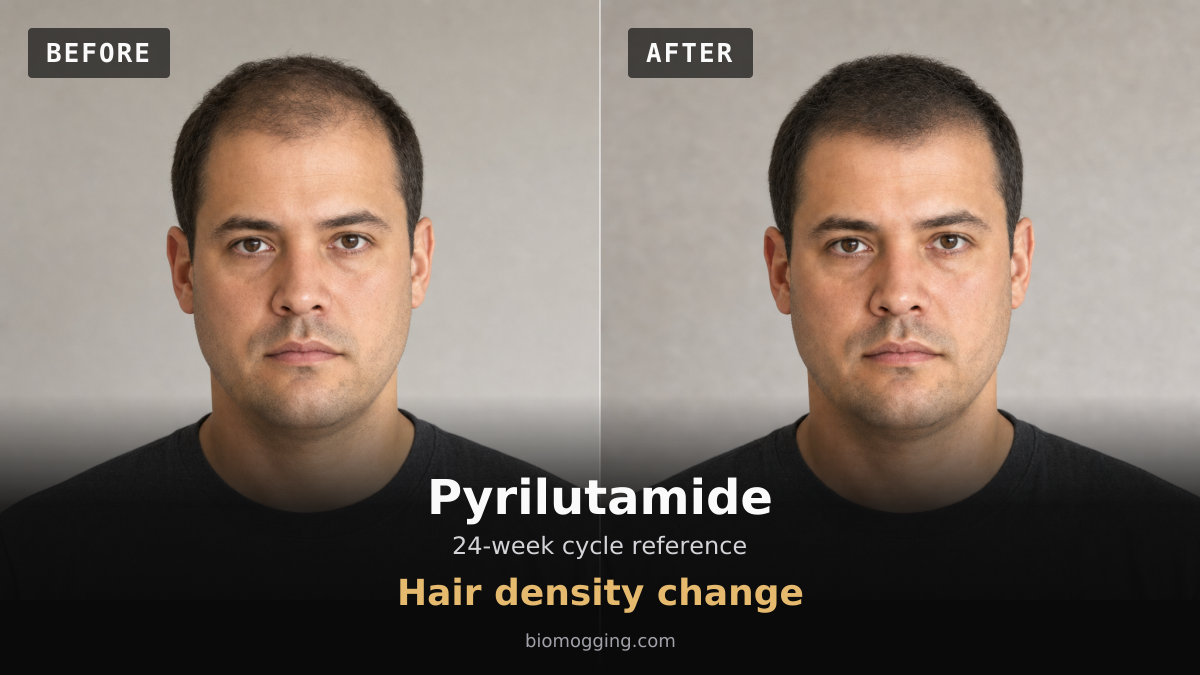
Pyrilutamide (KX-826) is the topical androgen receptor antagonist the hair-loss world has been waiting on for half a decade — and in March 2026 it finally hit its Phase 3 primary endpoint in China. For the looksmaxxing and physique community, the appeal is specific: it blocks the androgen receptor locally at the scalp without touching systemic DHT, which means you get finasteride-style protection of the follicle without finasteride-style libido, mood, or fertility worries. That's exactly the mechanism guys running AAS — especially 19-nors like nandrolone or trenbolone, which oral 5-AR inhibitors can't touch — have been stitching together off-label with RU58841 for years.
On paper, the molecule is genuinely impressive: an AR IC₅₀ of 0.28 nM, roughly 10× tighter than bicalutamide and orders of magnitude tighter than clascoterone. In practice, the clinical file has been messier — a failed US Phase 2, a missed first Chinese Phase 3 in 2023, and a cleaner win on the 2026 adaptive redesign at 0.5% and 1.0% BID. Community use has consolidated around the clinical protocol rather than freelanced doses, which is rare for a research-grade topical and makes dialing in protocol easier than with RU58841.
"KX-826 met the primary endpoint in the phase III study with mean increases in target area non-vellus hair count of 10.65/cm² (1% BID) and 9.78/cm² (0.5% BID) versus placebo." — BioWorld, 2026
Below we cover the pyrilutamide protocol most users actually run (0.5% vs 1% BID, female QD dosing), realistic results timelines at 12 / 24 / 52 weeks, how it stacks against finasteride and minoxidil, why it's become the default hair defense for anyone who refuses oral 5-AR inhibitors, how to slot it into an on-cycle stack alongside RU58841 and dutasteride, and the side effects (mostly scalp irritation) that are actually worth planning around.
How Pyrilutamide works
Silent Androgen Receptor Antagonism#
Pyrilutamide is a nonsteroidal, high-affinity silent antagonist of the androgen receptor (AR). It binds the ligand-binding domain of AR and competes directly with testosterone and dihydrotestosterone (DHT) for occupancy — but unlike an agonist, it does not trigger the conformational change required for coactivator recruitment and downstream transcription. The net effect at the follicle is that the AR is "plugged" but silent: whatever androgen is circulating through the scalp dermal papilla cannot drive the miniaturization cascade that defines androgenetic alopecia.
The binding affinity is the part that makes the molecule interesting on paper:
"The IC50 value of the compound for AR is 0.28 nM, which is significantly lower than that of bicalutamide (3.1 nM) or clascoterone (>50,000 nM), indicating very high binding affinity." — Kintor Pharmaceuticals / Tong Y., Canadian Patent CA2829322 (2017)
For the bodybuilder or looksmaxxer, the practical read is this: pyrilutamide works downstream of 5α-reductase. It does not care whether the offending androgen is testosterone, DHT, DHN (the nandrolone metabolite), or trenbolone's AR-active form — it blocks the receptor itself. This is the same class of mechanism as RU58841, with more published binding data and a real clinical file behind it.
Why This Matters On Cycle — The Mechanistic Case vs Oral 5-AR Inhibitors#
Finasteride and dutasteride work by cutting DHT production: they inhibit the enzyme that converts testosterone into DHT. That is elegant for a natural lifter with a normal endocrine profile, but it has two gaps that matter the moment AAS enter the picture.
First, 19-nor compounds bypass 5α-reductase entirely. Nandrolone is reduced to DHN (dihydronandrolone), which is a weaker AR agonist than nandrolone itself — meaning 5-AR inhibition in a nandrolone user actually increases scalp AR activation, not decreases it. Trenbolone is not a 5-AR substrate at all. Finasteride is mechanistically useless against either.
Second, even on plain testosterone, a gram-per-week cycle floods the system with enough substrate that scalp DHT still climbs despite oral 5-AR inhibition. You are fighting mass action.
A topical AR antagonist sidesteps both problems. It does not care what androgen is arriving at the follicle — it occupies the receptor regardless. This is the core reason physique-focused users running heavy cycles reach for pyrilutamide (and RU58841) rather than leaning solely on finasteride.
"Unlike finasteride, pyrilutamide acts locally on the androgen receptor, so there is little systemic effect and a different side effect profile." — Verbinnen A, Bloxham B (med. rev.), Anagen / HairDAO (2026)
Scalp-Local Action with Minimal Systemic Exposure#
The entire design intent of pyrilutamide is potent local AR blockade with quiet systemic pharmacology. The molecule is formulated as an ethanol/propylene glycol tincture that penetrates the stratum corneum to reach follicular AR, but is designed to be cleared or metabolized before meaningful plasma concentrations accumulate. Phase 1 ascending-dose work up to 9.6% formulations in AGA males found plasma levels low and adverse events limited to mild contact dermatitis.
"Pyrilutamide is a potent nonsteroidal androgen receptor antagonist with an IC50 of 0.28 nM, showing topical efficacy in androgenetic alopecia with minimal systemic absorption." — Saceda-Corralo D, Domínguez-Santas M, Vañó-Galván S, Grimalt R., American Journal of Clinical Dermatology (2023)
The practical payoff: the sexual, mood, and semen-quality concerns that drive a meaningful minority of men off oral finasteride are mechanistically far less likely with pyrilutamide, because the drug is not meaningfully antagonizing AR anywhere below the scalp. "Less likely" is not "impossible" — anecdotes of libido effects exist in the community pool — but the dose-to-receptor math strongly favors local-only action.
Short Topical Residence and the BID Protocol#
Pyrilutamide's plasma half-life has not been formally published, but the clinical dosing schedule is instructive. Kintor's Phase 2 and Phase 3 protocols both converged on twice-daily application for the male arms, with efficacy clearly favoring BID over QD. This implies a relatively short topical residence time at the follicle — receptor occupancy decays over roughly a 12-hour window and needs to be re-established morning and evening to keep AR continuously blocked.
The female arms plateaued at QD, probably reflecting lower baseline scalp androgen pressure rather than different drug kinetics.
For the user, the mechanistic consequence is simple: missed doses directly surrender receptor occupancy. This is not a molecule you can run three days a week and expect results from. Consistency over 24+ weeks is the whole game — the 2026 Phase 3 readout of +9.78 hairs/cm² (0.5% BID) and +10.65 hairs/cm² (1% BID) over placebo was earned on rigid BID compliance, not intermittent use.
Follicle-Cycle Effect and the 24-Week Timeline#
AR blockade does not instantly regrow hair. What it does is release miniaturized follicles from androgenic suppression, allowing them to re-enter and sustain anagen (the growth phase) rather than prematurely converting to telogen (shedding). Because human hair cycles are slow — anagen takes months to express as visible terminal hair — every topical AR antagonist, pyrilutamide included, has a mandatory 12–24 week lag before response is judgeable. A synchronized shed in weeks 4–8 is common and usually signals that dormant follicles are being pushed back into cycle, not a treatment failure.
"KX-826 met the primary endpoint in the phase III study with mean increases in target area non-vellus hair count of 10.65/cm2 (1% BID) and 9.78/cm2 (0.5% BID) versus placebo." — Sami T., BioWorld (2026)
The commitment is lifetime. Stop applying and the AR is no longer blocked; androgenic miniaturization resumes from wherever your genetics set it. This is the same trade-off as finasteride, minoxidil, RU58841, and every other AGA intervention — the mechanism works only for as long as the mechanism is active.
Protocol
| Level | Dose | Frequency | Notes |
|---|---|---|---|
| Low | 1–1 ml | Twice daily | Documented entry-level range |
| Mid | 1–2 ml | Twice daily | Most commonly studied range |
| High | 2–2 ml | Twice daily | Standard clinical protocol is 1 mL of 0.5% tincture BID (AM and PM), matching the Kintor Phase 3 arm. Advanced users run 1.0% BID after the 2026 readout showed a small efficacy edge. Women dose 0.5% QD. |
Cycle length & outcomes
Documented cycle
24–260 weeks
Plateau after
52 wks
Cycle Length & Onset#
Pyrilutamide isn't a "cycle" in the AAS sense — it's a commitment protocol. Like every AR-directed hair compound, it holds follicles against androgenic pressure only while you're applying it. Stop, and the miniaturization clock restarts within 3–6 months. Plan for indefinite use.
Onset timing follows anagen cycling, not pharmacology. Expect:
- Weeks 1–8: initial shed as follicles synchronize. Do not panic, do not quit.
- Weeks 8–16: stabilization. Shedding slows, existing hair holds.
- Weeks 16–24: visible thickening and terminal hair count gains. This is the Kintor Phase 3 readout window.
- Weeks 24–52: peak response. Further gains taper.
"KX-826 met the primary endpoint in the phase III study with mean increases in target area non-vellus hair count of 10.65/cm² (1% BID) and 9.78/cm² (0.5% BID) versus placebo." — BioWorld, 2026
Dose Ladder by Goal#
| Goal | Cycle Length | Concentration | Frequency |
|---|---|---|---|
| Early AGA maintenance (finasteride-intolerant) | Indefinite, reassess at 24 wk | 0.5% | 1 mL BID |
| Aggressive NW3+ retention (non-AAS) | Indefinite | 0.5–1.0% | 1 mL BID |
| On-cycle AAS hair defense | Length of cycle + PCT + 8 wk | 0.5–1.0% | 1 mL BID |
| RU58841 replacement | Indefinite | 1.0% | 1 mL BID |
| Female pattern hair loss | Indefinite | 0.5% | 1 mL QD |
The 1% BID arm edged out 0.5% BID in the 2026 adaptive Phase 3 readout by about 1 hair/cm² — real but small. Most users start at 0.5% BID, escalate to 1% only if the 24-week photo check shows insufficient response and the scalp tolerates it.
Tapering & Loading#
No loading phase is needed and no taper is required. Pyrilutamide acts at the receptor in real time — there's no tissue saturation curve to pre-load and no endogenous axis being suppressed. You're either occupying scalp AR today or you're not.
If discontinuing (switching to RU58841, moving fully onto oral dutasteride, or taking a break):
- Stop cleanly, no wean-down.
- Expect a delayed shed 8–16 weeks post-cessation as the retained hairs lose AR protection and miniaturize back to baseline.
- Any gains captured over the preceding year are on borrowed time without a replacement AR strategy.
Bloodwork Cadence#
Pyrilutamide itself doesn't require monitoring — systemic exposure is low by design and the Phase 3 AE file showed no meaningful separation from placebo.
"Contact dermatitis was the only meaningful side effect in clinical work, with no significant difference in adverse event rates versus placebo and no drug-related serious events." — King & English, Perfect Hair Health, 2026
What you do monitor is the rest of the stack:
- On AAS: full panel (lipids, LFTs, estradiol, PSA, hematocrit, CBC) at pre-cycle, mid-cycle, and end-of-cycle. Pyrilutamide doesn't affect these — your gear does.
- On oral finasteride/dutasteride + pyrilutamide: baseline free/total testosterone and DHT before starting the orals, recheck at 12 weeks. Pyri does not shift these numbers.
- Standardized scalp photography every 12 weeks: front hairline, part, crown, vertex, consistent lighting. This is your actual efficacy readout. Pull counts and "shower drain vibes" are not.
Stacking Windows#
- With minoxidil 5%: apply minoxidil first, let it dry 20–30 minutes, then apply pyrilutamide. Different mechanisms (vasodilation vs AR antagonism), fully complementary.
- With microneedling (1.0–1.5 mm, weekly): needle on a dedicated night, skip the pyri application on that scalp for 12–24 hours. Driving a topical AR antagonist through fresh microchannels is not in any protocol and meaningfully raises systemic exposure.
- With RU58841: stagger — RU in the morning, pyri at night, or alternate days on heavy 19-nor cycles. Running both at full clinical dose simultaneously is redundant at the receptor and just burns more money.
"Unlike finasteride, pyrilutamide acts locally on the androgen receptor, so there is little systemic effect and a different side effect profile." — Verbinnen & Bloxham, Anagen/HairDAO, 2026
Run it clean, run it consistently, judge it at the 24-week photo — not the 6-week one.
Risks & mistakes
Common (most users)#
- Mild scalp irritation / contact dermatitis — the most consistent finding across every Kintor trial and the dominant real-world complaint. Usually the vehicle (ethanol/PG) rather than the molecule itself. Mitigation: apply to fully dry scalp, let it dry completely before hat/pillow contact, drop from BID to QD for 1–2 weeks if it flares, or alternate application days until the skin tolerates it. A vendor with a cleaner vehicle often solves it outright.
- Initial shed (weeks 4–8) — expected with anything that pushes follicles into synchronized anagen. Do not stop. Ride it out and re-evaluate at 24 weeks against standardized photos, not the shower drain.
- Dryness / flaking at application site — PG-heavy vehicles are dehydrating. A non-comedogenic scalp moisturizer on off-hours (not mixed with the tincture) handles it. Avoid layering minoxidil and pyrilutamide at the exact same moment — space them by 30–60 minutes.
- Transient lightheadedness post-application — occasional community report, typically resolves within an hour. Apply before bed rather than pre-workout if it bothers you.
"Contact dermatitis was the only meaningful side effect in clinical work, with no significant difference in adverse event rates versus placebo and no drug-related serious events." — King & English, Perfect Hair Health (2026)
Uncommon (dose-dependent or individual)#
- Persistent irritation at 1.0% BID — the 1% arm edges 0.5% on efficacy but noticeably raises local tolerability issues. If the scalp stays red or itchy past 2 weeks, drop to 0.5% BID — the efficacy gap is small and an inflamed scalp is not a growing scalp.
- Libido or mood blunting — mechanistically implausible at documented systemic exposures, but present in the anecdote pool as with any AR-targeting compound. Far less common than with oral finasteride. If it appears, pause for 2 weeks to confirm attribution before restarting at a lower concentration.
- Contact transfer to partners — pyrilutamide is a potent AR antagonist (IC₅₀ 0.28 nM). Do not let a partner's scalp, face, or chest contact treated skin until fully dry; wash hands thoroughly after application.
- No routine bloodwork required for pyrilutamide itself — systemic exposure is low by design. If you're on AAS, the usual panel (lipids, LFTs, E2, PSA, hematocrit) runs on its normal cycle cadence and is unrelated to the pyri.
"Unlike finasteride, pyrilutamide acts locally on the androgen receptor, so there is little systemic effect and a different side effect profile." — Verbinnen & Bloxham, Anagen / HairDAO (2026)
Rare but serious#
- Severe allergic contact dermatitis — blistering, spreading rash, or scalp weeping. Stop immediately, treat with a short topical corticosteroid course, and do not rechallenge with the same vehicle.
- Systemic hypersensitivity — hives, facial swelling, respiratory symptoms. Stop and seek care. Extremely rare in the Kintor safety file but possible with any topical drug.
- Meaningful systemic antiandrogen symptoms (gynecomastia signal, significant libido collapse, mood disturbance) — not reported in the trials, but warning sign to discontinue and evaluate for another cause, especially if running AAS where E2 mismanagement is the far more likely driver.
Hard contraindications#
- Pregnancy, or women who may become pregnant, handling the product — nonsteroidal AR antagonists are teratogenic in principle to male fetal development. No shared bottles, no shared surfaces, wash hands after every application.
- Concurrent oral antiandrogens (bicalutamide, enzalutamide, flutamide, apalutamide) — redundant mechanism, pointlessly raises systemic AR-blockade burden. Pick one.
- Known pyrilutamide or vehicle hypersensitivity — do not rechallenge.
- Broken or actively inflamed scalp skin — wait until it heals. Applying a potent AR antagonist in ethanol/PG to broken skin increases both absorption and irritation.
Gender-specific and PCT considerations#
Men dose 0.5% or 1.0% BID per the Kintor Phase 3 arms. Women dose 0.5% QD — female efficacy plateaued at once-daily in the Phase 2 data, and BID meaningfully raises irritation risk in a more reactive scalp population. Women of reproductive potential who choose to use it should be on reliable contraception; pregnant women should not use or handle it.
Pyrilutamide does not suppress the HPTA, does not lower systemic DHT, and does not affect semen quality — one of its main selling points over oral finasteride/dutasteride for lifters who want to keep fertility intact while still defending the hairline. No PCT required. You can run it continuously through a cycle, through PCT, and indefinitely after — and you have to, because like every AR-targeted hair treatment, stopping means losing the ground you gained over the following 6–12 months.
Stack & combine
Multipliers applied when these compounds run together. Values > 1 indicate a bonus on that axis. Tap a partner to expand the mechanism.
| Partner | Type | Lean | Fat loss | Recovery |
|---|---|---|---|---|
| synergistic | ×1.00 | ×1.00 | ×1.00 |
FAQ — Pyrilutamide
Research & citations
5 studies cited on this page.
Conclusion
Pyrilutamide is the go-to topical AR antagonist for users who want to fight androgenic hair loss without the systemic baggage of oral 5-AR inhibitors. It's fast to apply, stacks well with established protocols, and finally gives a real clinical-data-backed topical option — especially for anyone running AAS or looking to avoid finasteride sides.
Key takeaways:
- Typical dose: 0.5% or 1% tincture, 1 mL applied to the scalp twice daily (BID)
- Route: Topical only — apply directly to affected scalp zones, let dry before bed or styling
- Stack: Pairs well with minoxidil, oral finasteride/dutasteride (if tolerated), RU58841 (on heavy cycles), and microneedling
- Cycle: Commit to at least 24 weeks for visible results; effects require ongoing use to maintain
- Side effects: Mainly mild scalp irritation — systemic sides are rare and much milder than with oral antiandrogens
- Best suited for: Finasteride-refusers, looksmaxxers/AAS users wanting scalp-only AR blockade, and anyone who prizes a local, non-systemic solution
If you're serious about hair retention and want AR blockade right at the follicle without tanking systemic DHT, pyrilutamide is about as clean and targeted as current science gets for the hair stack.