GHK-Cu
Copper Tripeptide-1 · Glycyl-L-histidyl-L-lysine:copper(II) · Prezatide copper acetate · Cu-GHK · Lamin
Last updated
Buying options
Available at Real Peptides (US) — 20% off auto-applied
At a glance
- Recovery
- 8/10
- Muscle Growth
- 0/10
- Fat Loss
- 0/10
- Strength
- 0/10
- Endurance
- 0/10
- Cognition
- 0/10
Overview
Why GHK-Cu Earned Its Reputation#
GHK-Cu is the rare peptide that actually delivers on the anti-aging marketing copy — because it's not really a drug, it's an endogenous copper-carrying tripeptide that your body already makes and progressively loses with age. Plasma GHK drops from ~200 ng/mL in your twenties to ~80 ng/mL by sixty, and restoring it — topically or subcutaneously — signals fibroblasts to rebuild collagen, elastin, and glycosaminoglycans, enlarges hair follicles, drives angiogenesis, and shifts gene expression toward a younger profile.
"GHK influenced the expression of about 4,000 human genes, shifting their expression from a diseased or aged state toward a healthier profile." — Pickart et al., BioMed Research International (2014)
That's why GHK-Cu shows up in three very different corners of the community: looksmaxxers running a 1–2% topical serum for skin quality and fine lines, hair-stack users layering it with minoxidil and finasteride (or RU58841 on an AAS cycle) for follicle support, and injury-rehab protocols pairing it with BPC-157 and TB-500 as the "healing trio" for tendons, ligaments, and post-surgical recovery. It's non-hormonal, requires no PCT, stacks cleanly with anything, and — uniquely among peptides — actually works topically because the molecule is small enough to penetrate the stratum corneum.
In this guide we'll cover the topical vs. injectable decision, exact dose ladders for each route, DIY 1–2% serum formulation, the healing-trio stack, half-life and cycling logic, what to avoid layering it with (hint: straight ascorbic acid and benzoyl peroxide), and the handful of real side effects and contraindications — Wilson's disease being the one hard stop.
How GHK-Cu works
GHK-Cu is a naturally occurring copper-binding tripeptide (glycyl-L-histidyl-L-lysine) first isolated from human plasma. Serum levels drop roughly 60% between age 20 and age 60, which is the core rationale for exogenous replacement. Its activity is inseparable from its copper cargo — GHK is the delivery vehicle, Cu²⁺ is much of the payload — and together they act as a matrix-signaling molecule that rewires fibroblast behavior, angiogenesis, and gene expression toward a more youthful tissue profile.
Copper Delivery and Fibroblast Activation#
The defining mechanism is selective copper transfer into cells. GHK has a higher affinity for Cu²⁺ than serum albumin does, so it effectively pulls copper off albumin and hands it to cellular copper chaperones and cuproenzymes — lysyl oxidase, superoxide dismutase, cytochrome c oxidase — that run ECM crosslinking, redox defense, and mitochondrial respiration.
"The growth-modulating tripeptide GHK appears to function by increasing the uptake of copper into cells." — Pickart L., Freedman J.H., et al. Nature, 1980
Practically, this is why GHK-Cu outperforms free GHK or plain copper salts: it's the chaperoned delivery that drives the downstream signaling.
ECM Remodeling: Collagen, Elastin, GAGs#
In dermal fibroblasts, GHK-Cu upregulates type I and III collagen, elastin, decorin, and glycosaminoglycan synthesis while simultaneously activating matrix metalloproteinases (MMP-1, MMP-2) and their tissue inhibitors (TIMPs). The net effect is not "more collagen piled on top" — it's coordinated remodeling: degrading disorganized, glycated, photo-damaged matrix and replacing it with new, properly crosslinked fibers. This is the mechanism behind the skin-quality, post-laser recovery, and tendon/ligament rehab use cases.
"GHK-Cu improved skin quality, stimulated hair growth, accelerated wound healing, and had antioxidant and anti-inflammatory effects." — Pickart L., Margolina A. International Journal of Molecular Sciences, 2018
Angiogenesis and Nerve Outgrowth#
GHK-Cu stimulates VEGF expression and capillary formation at application sites, improving perfusion into remodeling tissue. It also supports nerve outgrowth in cutaneous and peripheral tissue. For lifters running it alongside BPC-157 and TB-500 in an injury block, this angiogenic signal layers cleanly with BPC-157's vascular effects and TB-500's cell-migration mechanics — the reason the "healing trio" has stuck around.
Gene Expression Reprogramming#
The most striking mechanism is transcriptional. Analysis in the Broad Institute's Connectivity Map showed GHK modulates expression of ~4,000 human genes — roughly 31% upregulated, 63% downregulated — with consistent shifts in DNA-repair, antioxidant defense, inflammatory signaling, and fibrotic pathways.
"GHK influenced the expression of about 4,000 human genes, shifting their expression from a diseased or aged state toward a healthier profile." — Pickart L., Vasquez-Soltero J.M., Margolina A. BioMed Research International, 2014
This is why the effects look broader than a simple "collagen peptide" story: DNA-repair genes go up, TGF-β–driven fibrosis pathways come down, antioxidant enzymes are induced. It explains the longevity-adjacent framing the compound has picked up in the looksmaxxing and peptide communities.
Antioxidant and Anti-Inflammatory Signaling#
GHK-Cu quenches hydroxyl radicals, chelates reactive iron (blocking Fenton-reaction damage), suppresses NF-κB signaling, and downregulates pro-inflammatory cytokines like IL-6 and TNF-α. In aged or UV-damaged skin this translates to less chronic low-grade inflammation — the substrate on which photoaging, post-inflammatory hyperpigmentation, and androgenetic follicle miniaturization all compound.
"GHK-Cu suppresses the expression of pro-inflammatory cytokines, scavenges free radicals, and promotes DNA repair." — Pickart L., Vasquez-Soltero J.M., Margolina A. Oxidative Medicine and Cellular Longevity, 2012
Hair Follicle Enlargement#
On the scalp, GHK-Cu drives dermal papilla cell proliferation, VEGF-mediated perifollicular angiogenesis, and prolongation of anagen. In the classic fuzzy-rat model, copper-peptide analogs produced follicle enlargement on par with minoxidil.
"Copper-peptide treatment resulted in follicle enlargement comparable to the effect of minoxidil in fuzzy rats." — Uno H., Kurata S. Journal of Investigative Dermatology, 1993
Important framing: this is a follicle-quality and matrix-support mechanism, not an anti-androgen one. GHK-Cu does nothing to 5α-reductase or the androgen receptor. It's a legitimate adjunct in a hair stack alongside finasteride/dutasteride, topical AR antagonists (RU58841, pyrilutamide), and minoxidil — not a replacement for any of them.
Why Topical Usually Wins for Skin and Hair#
At 340 Da for free GHK (402.9 for the copper complex), the molecule is small enough to cross the stratum corneum when properly formulated in a hydrophilic vehicle — a rare property among peptides. Combined with the short plasma half-life of injected GHK (minutes to ~2 hours before peptidase cleavage and copper redistribution to albumin/ceruloplasmin), this is why topical 1–2% serum beats subcutaneous injection for localized skin and scalp endpoints. Systemic SC dosing is reserved for recovery blocks and whole-body anti-inflammatory use, where the tissue-signaling effects outlast the peptide's time in plasma.
Protocol
| Level | Dose | Frequency | Notes |
|---|---|---|---|
| Low | 1–1 mg | Once daily | Documented entry-level range |
| Mid | 1–2 mg | Once daily | Most commonly studied range |
| High | 2–3 mg | Once daily | Injectable: 1–3 mg SC once daily, typically pre-bed into abdominal fat. Topical: 1–2% serum, 1 pump nightly on clean skin/scalp. Separate topical application from vitamin C, AHAs, retinoids, or benzoyl peroxide by ≥30 min or alternate nights. |
Available at Real Peptides (US) — 20% off auto-applied
Cycle length & outcomes
Documented cycle
4–12 weeks
Plateau after
12 wks
Cycle Structure#
GHK-Cu is a non-hormonal, non-suppressive signaling peptide — no HPTA impact, no PCT, no liver or lipid cost. That simplifies cycling enormously: the "cycle" is really just a decision about route (topical vs. injectable), duration, and what you're stacking it with. No loading phase is needed, and there's no evidence that tapering on or off changes outcomes.
"GHK-Cu improved skin quality, stimulated hair growth, accelerated wound healing, and had antioxidant and anti-inflammatory effects." — Pickart & Margolina, Int J Mol Sci (2018)
Dose & Duration by Goal#
| Goal | Route | Cycle Length | Dose |
|---|---|---|---|
| Facial skin rejuvenation | Topical 1–2% serum | 12+ weeks continuous | 1 pump nightly |
| Hair stack adjunct (scalp) | Topical 1–2% serum | 12+ weeks continuous | 1 pump nightly |
| Post-procedure recovery (microneedling, laser, transplant) | Topical 1–2% serum | 2–4 weeks | 1–2× daily, start 48–72h post |
| Tendon / soft-tissue rehab | SC injection | 4–6 weeks | 1–2 mg/day |
| Post-surgical recovery | SC injection | 4–6 weeks | 2 mg/day |
| Systemic anti-aging / longevity | SC injection | 30 on / 30 off, 2–4×/yr | 1–2 mg/day |
| Advanced healing stack (w/ BPC-157 + TB-500) | SC injection | 4–6 weeks | 2–3 mg/day |
Onset Timing#
- Injectable, soft-tissue rehab: subjective improvements in joint/tendon pain often show up in the first 10–14 days, with meaningful structural progress over 4–6 weeks. Stack-dependent — running it solo is slower than the BPC-157/TB-500/GHK-Cu trio.
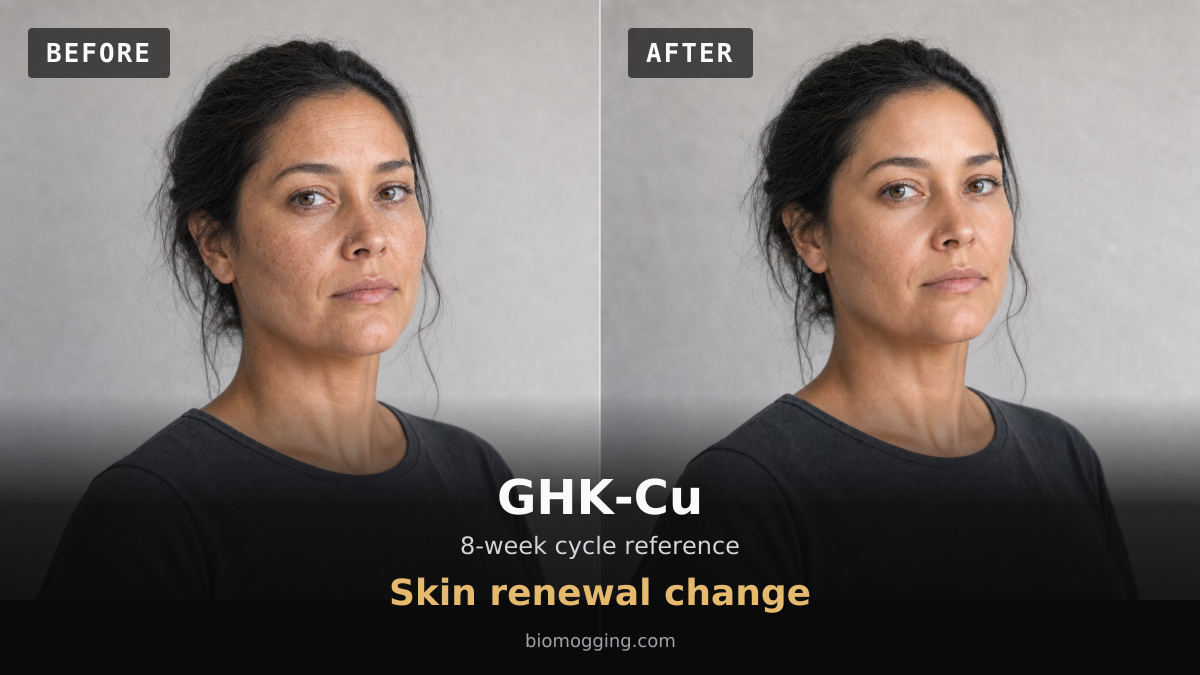
- Topical, skin: dermal remodeling is genuinely slow. Expect 4–6 weeks for texture and radiance changes, 8–12 weeks for firmness and fine-line improvement, 12+ weeks for photoaging metrics. Do not judge results at week 2.
- Topical, scalp: 3–4 months minimum before judging density changes, and GHK-Cu is an adjunct — the anti-androgen leg of the stack does the heavy lifting against AGA.
"GHK influenced the expression of about 4,000 human genes, shifting their expression from a diseased or aged state toward a healthier profile." — Pickart et al., BioMed Res Int (2014)
Loading, Tapering, and Continuous Use#
There is no loading phase. Because GHK-Cu acts as a gene-expression and ECM-signaling modulator rather than a receptor agonist building saturation, a "front-load" doesn't shorten the remodeling timeline — collagen and follicular biology run on their own clock.
There is no taper required. Unlike AAS, GH, or even some of the GH-secretagogues, stopping GHK-Cu produces no rebound, no withdrawal, no suppression recovery period.
Topical can be run continuously. The strongest clinical evidence base is 12-week continuous-use cosmetic trials, and most looksmaxxers simply keep a 1–2% serum in their nightly routine indefinitely. There is no mechanistic reason to cycle off.
Injectable is typically pulsed — 30 on / 30 off is the dominant community template — mostly out of conservatism and cost, not because a safety signal demands it. If you're mid-rehab on a torn tendon, running 6–8 weeks straight is fine.
Bloodwork Cadence#
GHK-Cu requires essentially no monitoring at standard doses and cycle lengths. It's non-hormonal, non-hepatotoxic, and doesn't move lipids, glucose, or inflammatory markers in a concerning direction.
The only meaningful lab consideration is copper status, and only for users running continuous high-dose (2–3 mg/day SC) systemic GHK-Cu beyond ~6 months:
- Serum copper and ceruloplasmin — once at baseline before a long systemic run, once at the 6-month mark. Cheap, gives you a ceiling.
- Anyone with Wilson's disease or any known copper-metabolism disorder should not use GHK-Cu at all — this is the one hard contraindication, topical or injectable.
For topical-only users, no bloodwork is required regardless of duration.
Route Selection#
Pick the route by endpoint, not by preference:
- Skin and hair goals → topical wins. Local 1–2% serum delivery puts the peptide exactly where you need it, at tissue concentrations that systemic 1–3 mg SC simply doesn't replicate in the dermis or scalp.
- Tendon, ligament, post-surgical, systemic inflammation → SC injection. Topical doesn't reach deep tissue.
- Both goals at once → run both. There is no interaction, no additive toxicity, and no reason not to stack topical facial/scalp use with an injectable rehab block.
"Copper-peptide treatment resulted in follicle enlargement comparable to the effect of minoxidil in fuzzy rats." — Uno & Kurata, J Invest Dermatol (1993)
GHK-Cu is one of the most forgiving compounds in the peptide toolkit: no PCT, no HPTA interaction, no cycle-length ceiling for topical use, and no meaningful bloodwork burden. The main way to screw it up is impatience — judging it at week 2, or expecting injectable to do what a direct 1–2% serum does for skin.
Risks & mistakes
Common (most users)#
- Mild stinging or transient erythema (topical) — usually on first week of use or when the serum concentration is >1.5%. Apply to damp (not wet) skin, start at 1%, and buffer with a ceramide moisturizer 30 seconds after. Resolves on its own.
- Blue-green tint on skin or pillowcase — purely cosmetic, from the copper chromophore. Use less product (one pump is enough for the whole face), let it absorb for 2–3 minutes before moisturizer, and apply at night.
- Injection-site redness, mild welt, or itching (SC) — rotate between left and right abdominal fat, inject at room temperature, and pinch the site rather than flat-stab. Ice the spot for 30 seconds if prone to welts.
- Transient fatigue or mild headache on first few injections — reported anecdotally, typically resolves within the first week as tissue-level signaling settles. Dose pre-bed to sleep through it.
Uncommon (dose-dependent or individual)#
- Contact dermatitis from topical — genuine allergic reaction is rare but real. If you get persistent itching, papules, or worsening redness after >72 h, stop and patch-test on the inner forearm before resuming. Often it's the preservative or base, not the GHK-Cu itself.
- Irritation when stacked with actives on the same night — ascorbic acid (vitamin C), glycolic/lactic acid, benzoyl peroxide, and high-strength retinoids will oxidize the copper complex and amplify irritation. Alternate nights or separate application by ≥30 min.
- Serum copper creep on continuous high-dose systemic use — plausible only with daily mg-level SC dosing run continuously for many months. If you're running that kind of protocol >6 months, pull serum copper and ceruloplasmin. In healthy adults eating a normal diet, it's a non-issue at standard 30-on / 30-off cycling.
- DIY serum going off — not a side effect of the peptide, but a frequent cause of "I reacted to GHK-Cu." Unpreserved or room-temp batches grow bacteria fast. Use Germall Plus (or equivalent), refrigerate, and make small batches.
Rare but serious#
- Systemic copper overload — essentially only seen in people with undiagnosed Wilson's disease or other copper-handling disorders. Warning signs: new tremor, personality changes, jaundice, Kayser-Fleischer rings, unexplained LFT elevations. Stop immediately and get ceruloplasmin + 24 h urinary copper.
- Severe hypersensitivity reaction — theoretical with any peptide. Swelling beyond the injection site, widespread hives, or breathing changes → stop, antihistamine, ER if needed.
No hepatotoxicity, nephrotoxicity, endocrine suppression, or cardiovascular adverse signals have been documented in the human or animal literature at the doses in this protocol.
"GHK-Cu improved skin quality, stimulated hair growth, accelerated wound healing, and had antioxidant and anti-inflammatory effects." — Pickart & Margolina, Int J Mol Sci 2018
Hard contraindications#
- Wilson's disease or any diagnosed copper-metabolism disorder — do not use, topical or injectable. GHK-Cu's entire mechanism is copper delivery into cells.
- Pregnancy and lactation — no safety data. Stop before conception attempts and do not use while nursing.
- Known peptide or copper hypersensitivity — obvious but worth stating.
- Do not co-apply topically with benzoyl peroxide, strong ascorbic acid, or high-strength AHAs in the same application — destroys the complex and produces the irritation most people blame on the peptide.
Gender considerations and PCT#
GHK-Cu is non-hormonal. It does not bind androgen, estrogen, progesterone, or glucocorticoid receptors, does not aromatize, and has no effect on the HPG or HPT axes. Women run the same dose as men (topical 1–2% nightly; injectable 1–2 mg/day SC) with no virilization risk. There is no PCT requirement and no impact on fertility or semen parameters — it pairs cleanly with AAS cycles, SARMs, GH, TRT cruise, or 5-AR inhibitor hair stacks without interfering with any of them. The only women's-health line is pregnancy and lactation, where the rule is simply: no data, don't use.
Stack & combine
Multipliers applied when these compounds run together. Values > 1 indicate a bonus on that axis. Tap a partner to expand the mechanism.
| Partner | Type | Lean | Fat loss | Recovery |
|---|---|---|---|---|
| synergistic | ×1.00 | ×1.00 | ×1.22 | |
| synergistic | ×1.12 | ×1.00 | ×1.22 | |
| synergistic | ×1.05 | ×1.00 | ×1.20 | |
| synergistic | ×1.08 | ×1.20 | ×1.15 | |
| synergistic | ×1.05 | ×1.00 | ×1.18 | |
| synergistic | ×1.05 | ×1.00 | ×1.18 | |
| synergistic | ×1.00 | ×1.00 | ×1.18 | |
| synergistic | ×1.00 | ×1.00 | ×1.18 | |
| synergistic | ×1.00 | ×1.00 | ×1.18 | |
| synergistic | ×1.08 | ×1.15 | ×1.13 | |
| synergistic | ×1.00 | ×1.00 | ×1.15 | |
| synergistic | ×1.00 | ×1.00 | ×1.12 |
Featured in stacks1 curated protocol include GHK-Cu
Featured in blends2 blends include GHK-Cu
KLOW Blend
KLOW Blend: Four Regenerative Peptides, One Shot KLOW is a research-peptide blend that packs four of the most well-characterized regenerative compounds — GHK-
GLOW
What GLOW Actually Is GLOW is a pre-mixed peptide blend — BPC-157 + TB-500 + GHK-Cu — sold almost exclusively in a 70 mg vial (50 mg GHK-Cu / 10 mg BPC-157 /
FAQ — GHK-Cu
Where to buy GHK-Cu

Real Peptides
Our pick20% off — auto-applied at checkout
- Buy GHK-Cu · 20% offGHK-Cu Copper Peptide
- Buy GHK-Cu · 20% offGHK-Cu Cosmetic
- Buy GHK-Cu · 20% offGHK-Cu Copper Peptide Serum

Swiss Chems
10% off — auto-applied at checkout
- Buy GHK-Cu · 10% offGHK-Cu Copper Peptide - SwissChems-Buy Best Quality Peptides, SARMS Online

NextGenPeps
10% off — use code at checkout
- Buy GHK-Cu · 10% offGHK-Cu
You'll also need
- Bacteriostatic waterReal PeptidesBuy · 20% off
- Bacteriostatic waterNextGenPepsBuy · 10% offUse code at checkout
- Bacteriostatic waterSwiss ChemsBuy · 10% off
- Sterile waterSwiss ChemsBuy · 10% off
- Spray bottle 10 mlSwiss ChemsBuy · 10% off
- Acetic acid 0.6% solution 10 mlSwiss ChemsBuy · 10% off
Research & citations
5 studies cited on this page.
Conclusion
GHK-Cu stands at the top tier for skin repair, hair support, and tissue recovery — especially when delivered as a 1–2% topical serum or stacked with other healing peptides.
Key takeaways:
- Standard dose: 1–2% topical serum nightly for skin/hair, 1–3 mg SC once daily for systemic/tendon recovery
- Best-in-class for collagen synthesis, ECM remodeling, and anti-inflammatory gene modulation
- Topical route dominates for aesthetics (skin/hair); SC injection pairs best with BPC-157 and TB-500 for injury or post-surgical healing
- Cycle: 4–12 weeks typical for injectables, continuous or 12+ weeks for topical use before judging results
- Stacks cleanly with minoxidil, finasteride/dutasteride, and microneedling in hair protocols
- Side effects are minor — irritation and rare injection-site reaction; avoid if you have Wilson's or copper-metabolism disorders
If you want maximal ECM repair, healthier skin, stronger hair, or a regenerative boost during rehab, GHK-Cu is one of the safest, most proven choices you can reach for in the peptide world.
Similar compounds
Comparisons
Rankings
Disclosures
Affiliate links — we may earn a commission at no cost to you.