Finasteride
Propecia · Proscar · MK-906 · Finpecia · Fincar
Last updated
At a glance
Overview
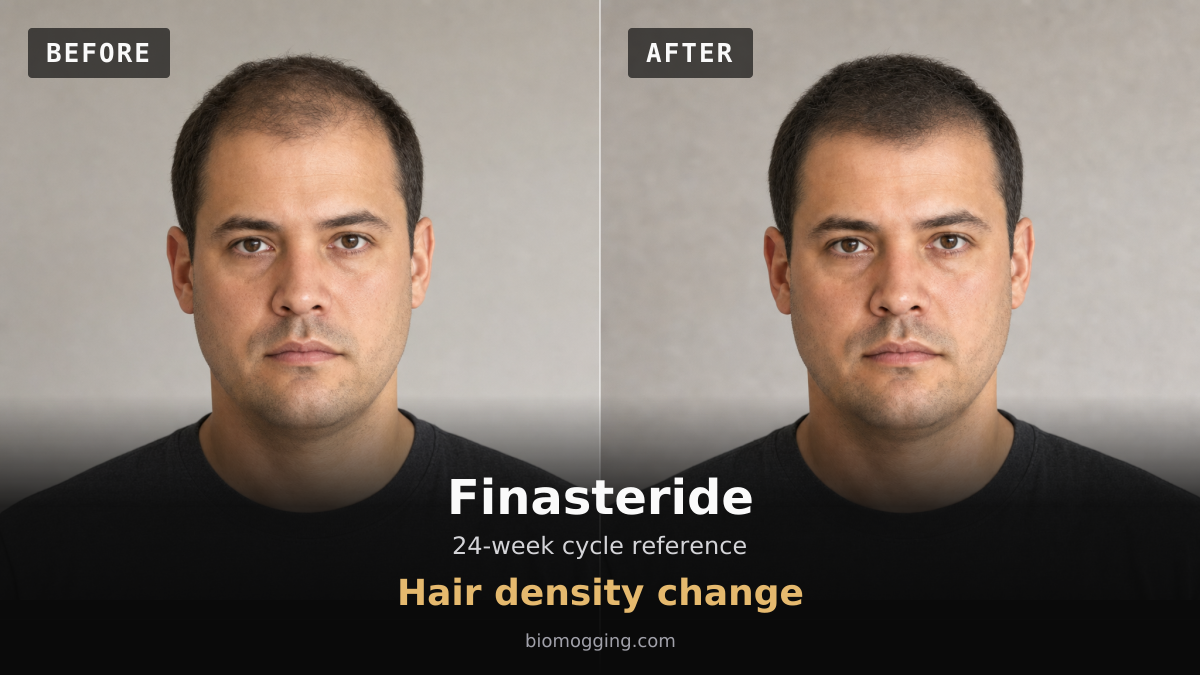
Finasteride is the most battle-tested hair-retention tool in the looksmaxxing and bodybuilding world — and for good reason. A single 1 mg tablet knocks scalp DHT down by roughly 65%, which is the single biggest lever you can pull on androgenetic alopecia short of a transplant. Two decades of clinical data and forum experience say the same thing: guys who start early and stay on it keep their hair.
"The therapeutic effect on hair loss was sustained over 5 years, with continued hair preservation and a favorable safety profile." — Kaufman & Dawber, European Journal of Dermatology (2002)
The catch is that finasteride is a long game with real trade-offs. You won't see meaningful results before month 6, visible regrowth peaks around 12–18 months, and gains reverse within a year of stopping — so this is a lifetime commitment, not a cycle. The oral-vs-topical decision matters: oral 1 mg is cheapest and best-studied, but systemic DHT suppression drives the sexual, mood, and PFS risk that scares people off. Topical 0.25% gets you comparable scalp DHT reduction with meaningfully less systemic exposure, and is the right call for anyone sides-sensitive or planning near-term conception. And if you're on AAS, finasteride only covers testosterone-based cycles — it does nothing against masteron, tren, primo, or winstrol, and actively makes nandrolone worse.
The rest of this page covers the practical protocol: dosing ladders for oral and topical, how finasteride fits into an on-cycle hair stack alongside RU58841, pyrilutamide, and minoxidil, the PFS and semen-quality conversation in honest terms, and the specific compounds where finasteride helps, does nothing, or backfires. If you're building a hair strategy around current or future AAS use, this is the foundation — but it's not the whole stack.
How Finasteride works
Type II 5α-Reductase Inhibition#
Finasteride is a competitive, mechanism-based ("suicide") inhibitor of 5α-reductase type II, the isoenzyme concentrated in scalp dermal papilla, prostate, epididymis, and genital skin. It binds the enzyme's active site and forms a stable NADP-dihydrofinasteride adduct — functionally irreversible for the lifetime of that enzyme molecule. This is why tissue DHT suppression outlasts plasma finasteride by 24–48 hours despite a 5–6 hour plasma half-life, and why once-daily (or even EOD) dosing holds serum DHT down at steady state.
At 1 mg/day, you get roughly a 70% drop in serum DHT and a compensatory ~10–15% rise in serum testosterone. Crucially, type I 5αR (dominant in sebaceous glands and non-genital skin) is largely spared, which is why finasteride is milder on sebum and skin oil than dutasteride — and why it also doesn't hit scalp DHT quite as completely.
"Finasteride decreased scalp DHT by 65% and serum DHT by 71% after 42 days compared with baseline." — Drake L, Hordinsky M, Fiedler V, et al., Journal of the American Academy of Dermatology (1999)
Reversal of Follicular Miniaturization#
DHT is the androgen that drives progressive miniaturization of genetically susceptible follicles on the vertex, mid-scalp, and hairline. At the follicle level, DHT binds androgen receptors in the dermal papilla, shortens the anagen (growth) phase, and over successive cycles converts terminal hairs into shorter, finer, depigmented vellus hairs. Occipital (donor) follicles are androgen-insensitive — which is why hair transplants take — and finasteride does nothing for them or against them.
By dropping scalp DHT by ~55–65%, finasteride removes the primary driver of that miniaturization cascade. Susceptible follicles that are still cycling can revert toward terminal morphology; follicles that have fully involuted will not come back. Retention is the real endpoint, regrowth is the bonus — and this is why starting earlier beats starting later.
"Finasteride 1 mg/day slowed the progression of hair loss and increased hair growth in men with androgenetic alopecia." — Kaufman KD, Olsen EA, Whiting D, et al., Journal of the American Academy of Dermatology (1998)
Long-term data confirms the effect holds as long as the drug is on board:
"The therapeutic effect on hair loss was sustained over 5 years, with continued hair preservation and a favorable safety profile." — Kaufman KD, Dawber RP., European Journal of Dermatology (2002)
Stop the drug, and scalp DHT normalizes within weeks — visible loss of gains follows over ~12 months. Treat it like TRT: indefinite commitment or don't start.
The Topical vs Oral Trade-Off#
Topical finasteride (typically a 0.25% solution, ~1 mL/day) exploits the fact that 5αR inhibition is a local-tissue phenomenon. Applied to scalp, it delivers enough drug into dermal papilla to inhibit follicular 5αR while reducing systemic exposure — producing comparable scalp DHT suppression with roughly 20% less serum DHT drop. For sides-sensitive users, this is the rational alternative.
"Topical finasteride demonstrated comparable scalp efficacy to oral finasteride, with lower incidence of adverse effects related to systemic exposure." — Piraccini BM, Blume-Peytavi U, Scarci F, et al., Journal of the European Academy of Dermatology and Venereology (2022)
Important caveat: topical is not zero-systemic. Some drug gets absorbed, some serum DHT suppression occurs, and pregnant partners still can't handle the solution. If you're actively trying to conceive, pause entirely for 3 months — topical or oral, the semen-parameter signal applies to both.
Neurosteroid Suppression (The PFS Pathway)#
5α-reductase doesn't only reduce testosterone to DHT. It also converts progesterone to allopregnanolone and deoxycorticosterone to THDOC — neurosteroids that act as potent positive allosteric modulators of GABA-A receptors. Inhibiting 5αR therefore blunts central GABAergic tone, and this is the current best mechanistic hypothesis for the mood, anxiety, and sexual components of post-finasteride syndrome (PFS) that persist in a minority of users after discontinuation.
"Post-finasteride syndrome describes persistent sexual, neurological, and physical adverse effects that continue after medication discontinuation." — Diviccaro S, Melcangi RC, Giatti S., Neurobiology of Stress (2020)
True PFS incidence is almost certainly well under 1%, but it's real enough that multiple regulatory agencies required label updates. Risk doesn't scale cleanly with dose or duration — which is why going above 1 mg/day buys you no extra scalp protection but does stack extra CNS exposure. If sexual or cognitive sides develop and don't resolve within a few weeks of dose reduction, stop. Don't push through.
Why Finasteride Fails Against Certain AAS#
The mechanism also tells you exactly where finasteride is useless on cycle — and this matters for anyone planning to run gear.
DHT-derived AAS (trenbolone, masteron, proviron, primo, winstrol, anavar, DHB) do not require 5α-reduction to act at the scalp. They bind AR directly. Blocking 5αR does nothing to them. This is the hard mechanistic reason topical AR antagonists — RU58841, pyrilutamide, clascoterone — exist and matter: they compete at the receptor itself, downstream of whatever androgen is driving the follicle.
19-nor compounds (nandrolone/deca, trestolone) are worse. Nandrolone is converted by 5αR into dihydronandrolone (DHN), which is less androgenic at scalp than parent nandrolone. Inhibiting 5αR with finasteride therefore increases scalp androgen exposure on deca and accelerates loss. Finasteride + nandrolone is mechanistically backwards — drop the fin or drop the deca, but don't stack them thinking you're protected.
For a test-only or test + aromatizable cycle, 1 mg/day oral fin is solid. For anything DHT-derived or 19-nor, the scalp protection has to come from topical AR antagonists and oral minoxidil — not from more finasteride.
Protocol
| Level | Dose | Frequency | Notes |
|---|---|---|---|
| Low | 0.25–1 mg | Once daily | Documented entry-level range |
| Mid | 1–1.25 mg | Once daily | Most commonly studied range |
| High | 1–1.25 mg | Once daily | Standard is 1 mg/day oral, or 1.25 mg every other day (quartered 5 mg Proscar/Fincar). Dose-response plateaus at 1 mg — going higher buys almost no extra scalp DHT suppression. Topical 0.25% solution ~1 mL/day is the sides-sensitive alternative. |
Cycle length & outcomes
Documented cycle
52–520 weeks
Plateau after
78 wks
Cycle Notes#
Finasteride is not a "cycle" compound in the AAS sense — it's a maintenance drug. You start it, you stay on it indefinitely, and gains reverse within ~12 months of stopping. There is no taper, no loading phase, no PCT, and no on/off rhythm. The only relevant scheduling decisions are when to start relative to AAS, which route to run, and how long before judging results.
Onset and Timeline#
Steady-state DHT suppression (~65% serum, ~55–65% scalp) is reached within ~14 days. What takes longer is the follicle-cycle response — miniaturized follicles need multiple hair cycles to re-enter anagen and thicken.
| Milestone | Timing |
|---|---|
| Full DHT suppression | 2 weeks |
| Initial shed (if it happens) | Weeks 2–12 |
| Shedding stabilizes | Month 4–6 |
| Visible density change | Month 6–9 |
| Peak regrowth | Month 12–18 |
| Sustained response | 5+ years continuous use |
"The therapeutic effect on hair loss was sustained over 5 years, with continued hair preservation and a favorable safety profile." — Kaufman & Dawber, Eur J Dermatol (2002)
Do not judge results before month 9. The single biggest reason people "fail" finasteride is quitting at month 3–4 during the shed, right before the regrowth phase kicks in.
Dosing by Goal#
| Goal | Protocol | Daily Dose |
|---|---|---|
| Standard hair retention | Oral, indefinite | 1 mg/day (or 1.25 mg EOD) |
| Minimal effective dose | Oral, indefinite | 0.25–0.5 mg/day |
| Sides-sensitive / fertility-conscious | Topical 0.25% solution | ~1 mL/day to scalp |
| On-cycle (test / aromatizable AAS) | Oral + topical minox | 1 mg/day |
| On-cycle (DHT-derivatives: tren, mast, primo) | Finasteride contributes nothing — use topical AR antagonists | N/A |
| On-cycle (19-nors: deca, trest) | Do not run finasteride — worsens scalp androgen exposure | N/A |
"Finasteride decreased scalp DHT by 65% and serum DHT by 71% after 42 days compared with baseline." — Drake et al., J Am Acad Dermatol (1999)
The dose-response plateaus hard at 1 mg. 0.2 mg gives ~55% scalp suppression, 1 mg gives ~65%, 5 mg gives ~70%. Running 2.5 or 5 mg/day "for extra protection on cycle" buys no additional scalp benefit and proportionally more sexual/mood side effect risk.
Oral vs Topical#
The trade-off is systemic exposure vs. diligence.
| Oral 1 mg | Topical 0.25% | |
|---|---|---|
| Scalp DHT reduction | ~65% | ~55–65% |
| Serum DHT reduction | ~70% | ~35–50% |
| Sides risk (libido, mood, PFS signal) | Baseline | Meaningfully lower |
| Daily diligence | Swallow pill | Apply to dry scalp, wait 4h before washing |
| Cost | Negligible (Fincar quartered) | Higher (compounded) |
| Fertility impact | Pause 3 months pre-conception | Still pause, but cleaner |
"Topical finasteride demonstrated comparable scalp efficacy to oral finasteride, with lower incidence of adverse effects related to systemic exposure." — Piraccini et al., JEADV (2022)
Default to oral for cost and convenience. Switch to topical if you develop libido/mood sides, if you're trying to conceive within 6–12 months, or if you want belt-and-suspenders coverage alongside oral at low dose.
On-Cycle Scheduling#
Start finasteride at least 6–8 weeks before your first AAS cycle. You want steady-state scalp DHT suppression established before exogenous androgens hit, not scrambling to catch up.
For a standard test / aromatizable stack: run 1 mg/day from baseline through cycle, through PCT, and indefinitely after. Add topical minoxidil 5% BID. If you're an aggressive NW2+ or have family history, layer topical RU58841 50 mg/day on cycle.
For DHT-derivative cycles (tren, masteron, primo, winstrol, anavar, DHB): finasteride is pharmacologically irrelevant — these compounds aren't 5α-reduced at the scalp, they act directly on the AR. Keep fin running for your test base, but the actual hair protection on cycle comes from topical AR antagonists (RU58841, pyrilutamide, clascoterone) and oral minoxidil 2.5–5 mg/day.
For 19-nor cycles (deca, NPP, trestolone): drop finasteride during the cycle, or at minimum understand that it's working against you. Nandrolone's 5α-reduced metabolite (DHN) is less androgenic at the scalp than the parent — blocking 5αR raises scalp androgen load. Lean on topical AR antagonists instead.
Bloodwork Cadence#
No fin-specific bloodwork is required for a natty user on 1 mg/day. For on-cycle users, your normal panel covers it:
- Baseline (pre-start): serum DHT, free/total T, E2, SHBG — useful for quantifying the effect later
- Week 6–8 of first cycle on fin: confirm DHT is suppressed as expected (~70% drop from baseline)
- On-cycle standard: lipids, LFTs, E2, hematocrit, PSA — run per cycle protocol
- PSA caveat: finasteride halves PSA values. If you're over 40 and getting screened, double the number or tell the reader you're on fin
Tapering and Discontinuation#
No taper required, pharmacologically. You can stop cold. Serum DHT recovers within ~2 weeks, scalp DHT within ~4–6 weeks.
The catch: hair gains reverse on the same timeline they were built. Stopping after 2 years typically returns you to your projected no-treatment baseline within 12 months. Treat finasteride like TRT — you commit, or you don't start.
If you develop sexual, cognitive, or mood symptoms that don't resolve within a few weeks of dose reduction, stop. Don't push through.
"Post-finasteride syndrome describes persistent sexual, neurological, and physical adverse effects that continue after medication discontinuation." — Diviccaro et al., Neurobiology of Stress (2020)
True PFS incidence appears well under 1%, but it's real enough to take seriously. Topical is the lower-risk re-entry if you want to try again after a washout.
Risks & mistakes
Common (most users)#
- Initial shed (weeks 2–12) — DHT withdrawal synchronizes follicles into telogen before the anagen rebound. This is a sign the drug is working, not failing. Do not judge results before month 9, and don't bail at month 3 like most quitters do.
- Mild libido dip — reported in ~1.8% of users vs 1.3% on placebo in the Kaufman trials. Usually resolves within 4–8 weeks as the HPG axis recalibrates. If it doesn't settle, drop to 1.25 mg EOD or switch to topical 0.25%.
- Reduced ejaculate volume — ~1.2% incidence, largely cosmetic. No fertility implication on its own. Bumping zinc (25–50 mg/day) and hydration helps some users; otherwise ignore it.
- Softer morning erections / slower refractory — subtle and dose-dependent. Low-dose tadalafil (2.5–5 mg daily) handles this cleanly and stacks well with hair-focused protocols anyway for scalp microcirculation.
- PSA suppression (~50%) — not a side effect so much as a lab artifact. If you're over 40 and getting screened, tell whoever reads the number to double it.
Uncommon (dose-dependent or individual)#
- Persistent erectile dysfunction — ~1.3% vs 0.7% placebo. If still present at week 8, drop to EOD or pivot to topical 0.25%. Check bloodwork: total T, free T, E2, prolactin, SHBG. On cycle, ED is more often an E2 problem than a fin problem — rule that out first.
- Low mood, flat affect, anhedonia — plausibly tied to reduced 5α-reduced neurosteroids (allopregnanolone, THDOC) on GABA-A receptors (Diviccaro 2020). If mood changes within the first few months, don't power through — drop the dose or switch to topical. Prior depression history is a genuine risk flag.
- Gynecomastia — rare at 1 mg, more common at 5 mg BPH dosing. The ~10–15% rise in serum testosterone can push E2 up in aromatase-prone users. If nipple tenderness develops off-cycle, check E2 and consider a low-dose AI or drop to topical.
- Reduced sperm count / motility — modest but real, reversible within ~3 months of cessation. Check a semen analysis if you're planning conception in the next 6–12 months.
- Testicular ache / mild volume change — uncommon, usually self-resolves. Persistent discomfort warrants bloodwork and a dose reduction.
Rare but serious#
- Post-finasteride syndrome (PFS) — persistent sexual, neurological, and physical symptoms continuing after discontinuation. True incidence is unknown but almost certainly well under 1%; the mechanism involves neurosteroid disruption, possible AR hypersensitivity, and epigenetic changes at the androgen receptor.
"Post-finasteride syndrome describes persistent sexual, neurological, and physical adverse effects that continue after medication discontinuation." — Diviccaro et al., Neurobiology of Stress (2020)
Warning signs: sexual or cognitive side effects that fail to resolve within 4–8 weeks of dose reduction, worsening anhedonia, genital numbness. Stop immediately and don't restart. Risk does not scale cleanly with dose or duration, which is why low-dose and topical protocols are the sensible hedge for anyone concerned.
- Severe depression / suicidal ideation — flagged on MHRA and Swedish MPA labels. Rare but the signal is strong enough to take seriously. Prior depressive episodes are a hard entry flag — use topical or skip.
- High-grade prostate cancer signal — the PCPT trial showed a small increase in high-grade tumor detection on finasteride, though total prostate cancer incidence dropped. Most oncologists now attribute this to detection bias. Relevant only if you have a significant family history.
- Male breast cancer — isolated case reports. Discontinue if persistent gynecomastia, nipple discharge, or a unilateral lump develops.
Hard contraindications#
- Pregnancy / women of childbearing potential handling crushed or broken tablets. Finasteride is Category X — teratogenic, disrupts external genital development in male fetuses. Pregnant partners do not handle broken tablets, period.
- Planned near-term conception. Pause oral finasteride a minimum of 3 months before actively trying. Semen parameters recover in that window.
- History of breast cancer or unexplained breast changes — do not initiate.
- Active depression or prior suicidal ideation — pick a topical entry or skip entirely. This is where the PFS risk concentrates.
- Nandrolone / deca / trestolone cycles. Finasteride blocks conversion of nandrolone to the less androgenic dihydronandrolone at the scalp, which means it raises scalp androgen exposure and accelerates hair loss. This is the opposite of what you want. Drop fin on 19-nor cycles and lean on topical AR antagonists (RU58841, pyrilutamide, clascoterone) plus oral minoxidil.
- DHT-derived AAS (tren, masteron, primo, winstrol, anavar, proviron, DHB). Not a safety contraindication — a utility one. Finasteride does nothing useful against these, because they act directly on AR without needing 5α-reduction. Running fin here gives you sides with zero scalp benefit.
Gender and fertility considerations#
Women: contraindicated in women of childbearing potential. Some post-menopausal women use it off-label for female pattern hair loss, but this is outside standard protocol and not what this page is for. Women on AAS who need hair protection should look to spironolactone and topical AR antagonists instead.
Fertility: finasteride modestly reduces sperm count and motility in a subset of men, reversible within ~3 months of cessation. If conception is anywhere on your 6–12 month horizon, pause oral finasteride and bridge with topical 0.25% or drop the drug entirely. Semen analysis at baseline and pre-conception is cheap insurance.
PCT: none required. Finasteride does not suppress the HPTA — if anything, serum testosterone rises slightly ~10–15% on therapy. You can stop cold at any point; hair gains reverse within ~12 months of discontinuation, so treat it like TRT — you're on it indefinitely or you aren't.
Stack & combine
Multipliers applied when these compounds run together. Values > 1 indicate a bonus on that axis. Tap a partner to expand the mechanism.
| Partner | Type | Lean | Fat loss | Recovery |
|---|---|---|---|---|
| synergistic | ×1.00 | ×1.00 | ×1.18 | |
| synergistic | ×1.00 | ×1.00 | ×1.15 | |
| synergistic | ×1.00 | ×1.00 | ×1.12 | |
| synergistic | ×1.07 | ×1.00 | ×1.08 | |
| synergistic | ×1.00 | ×1.00 | ×1.00 | |
| synergistic | ×1.00 | ×1.00 | ×1.00 | |
| synergistic | ×1.00 | ×1.00 | ×1.00 | |
| synergistic | ×1.00 | ×1.00 | ×1.00 | |
| synergistic | ×1.00 | ×1.00 | ×1.00 |
Pharmacokinetic conflicts, competing pathways, or compounded toxicity. Multipliers below 1 indicate the affected axis.
| Partner | Type | Lean | Fat loss | Recovery |
|---|---|---|---|---|
| antagonistic | ×1.00 | ×1.00 | ×1.00 |
FAQ — Finasteride
Research & citations
5 studies cited on this page.
Conclusion
Finasteride is the backbone of modern hair retention for anyone serious about fighting androgenetic alopecia, especially on-cycle — but optimal results come from a clear-eyed protocol and realistic expectations.
Key takeaways:
- Standard dosing is 1 mg oral daily (or 1.25 mg every other day with quartered 5 mg tabs); higher doses do not yield more scalp DHT reduction
- Topical finasteride (0.25% solution, ~1 mL/day) matches scalp efficacy with lower systemic side effect risk — the move for sides-prone or conception-focused users (Piraccini 2022)
- Expect visible results in 6–12 months; treat it as a lifetime commitment if you want to keep your gains (Kaufman 2002)
- Stack with topical minoxidil and ketoconazole shampoo for maximal effect; add topical AR antagonists (RU58841, pyrilutamide) when running DHT-derivative or 19-nor AAS, as finasteride offers no protection there
- Systemic side effects — libido drop, ED, and rarely, post-finasteride syndrome — are real but manageable for most; if sexual or mood sides persist, stop and consider topicals (Diviccaro 2020)
- Pause at least 3 months before planned conception due to reversible impact on semen parameters
Stay disciplined through the initial shed and trust the timeline — finasteride is the community's most reliable insurance policy against male pattern hair loss.