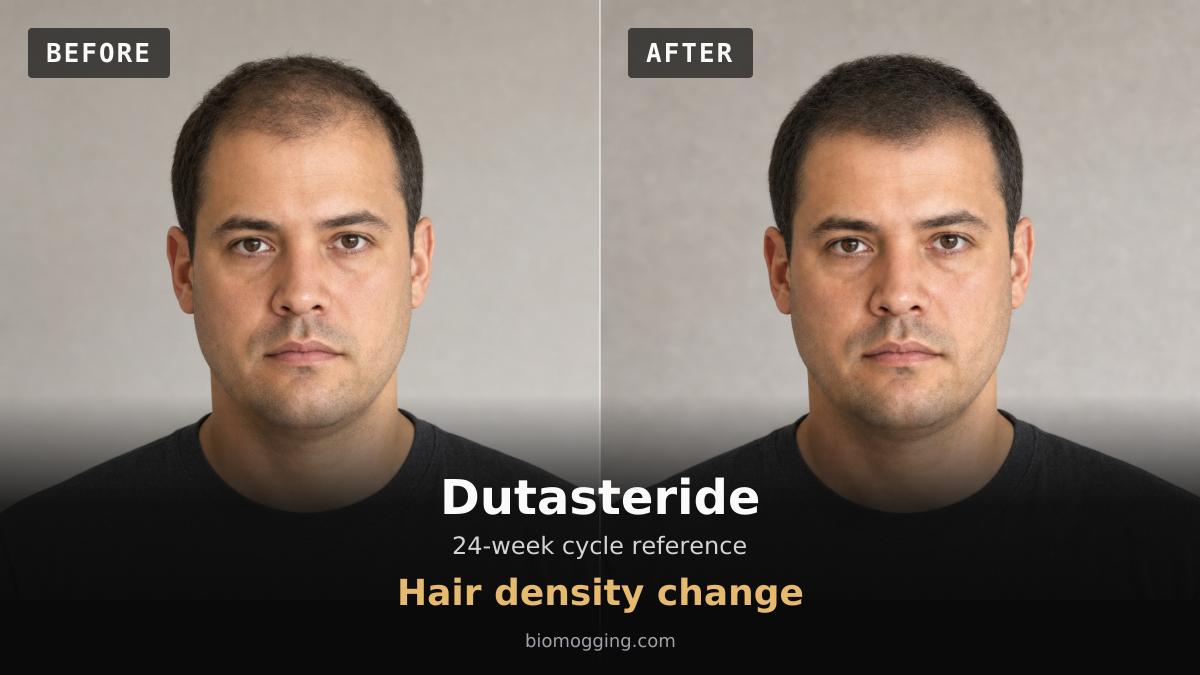
Dutasteride

Avodart · Duagen · GI198745 · GG-745

Last updated

HairDual 5α-Reductase InhibitorRx-Onlyapproved
Best forRecovery 1/10
Cycle24–260wk
RiskModerate
45 min read
Half-Life~5 weeks
Bioavailability60%
RouteOral
Dose Unitmg
Cycle24–260 weeks
Peak2.5h
Active Duration840h
MW528.53 g/mol
StorageRoom temperature, 15–30°C; protect from heat and direct light

At a glance

Effectiveness Profile

Overview

Dutasteride earned its reputation in the hair-retention community as the heavier-hitting cousin of finasteride — a dual 5α-reductase inhibitor that crushes serum DHT by roughly 90%+ versus finasteride's ~70%, and does it with a half-life measured in weeks rather than hours. For looksmaxxers watching their hairline thin, guys running AAS who need systemic DHT kept on the floor, and anyone who plateaued or flat-out failed to respond to finasteride, dutasteride is the obvious next move.

The appeal is simple: deeper suppression, more forgiving dosing, and better head-to-head hair count outcomes in the trials that actually compared the two. Because it inhibits both the type I and type II isoforms (finasteride only hits type II meaningfully), it shuts down DHT generation pathways finasteride leaves open.

"Dutasteride 0.5 mg/day was associated with a significantly higher change in target area hair count at 24 weeks compared with finasteride 1 mg/day and placebo." — Harcha et al., JAAD (2014)

The trade-off is real and worth being honest about — stronger systemic DHT suppression means a meaningfully higher sexual side-effect ceiling, a longer tail if you decide to stop (detectable serum levels persist 4–6 months post-discontinuation), and a hard contraindication for anyone planning near-term conception. The rest of this page covers dosing strategy (including the twice-weekly protocol the community leans on to exploit the 5-week half-life), on-cycle stacking with topical AR antagonists like RU58841, side-effect management, bloodwork cadence, and the specific pitfalls — the dread shed, the "dutasteride won't rescue you from tren" problem, the pointless dose-chasing above 0.5 mg — that cost people their response.

How Dutasteride works

Dual 5α-Reductase Inhibition (Types I, II, and III)#

Dutasteride is a 4-azasteroid that binds irreversibly to all three isoforms of 5α-reductase — the enzyme family that converts testosterone into dihydrotestosterone (DHT). Finasteride only meaningfully blocks type II. Dutasteride hits type I (dominant in sebaceous glands and scalp skin), type II (dominant in the hair follicle dermal papilla and prostate), and type III (expressed in various tissues including scalp). This is the entire basis for why dutasteride suppresses DHT harder, deeper, and more completely than finasteride — and why it tends to rescue responders who plateaued on fin.

"Dutasteride administration (0.5 mg daily) produced mean reductions of serum DHT of 91% after 2 weeks and 94% after 24 weeks, effectively lowering DHT to near-castrate levels." — Clark RV et al., Journal of Clinical Endocrinology & Metabolism, 2004

For the practical outcome: lower scalp DHT means less androgen receptor activation in genetically susceptible follicles, which is the upstream trigger for the miniaturization cascade in androgenetic alopecia.

Reversal of Follicular Miniaturization#

In AGA-prone follicles, DHT binding to the androgen receptor in the dermal papilla shortens the anagen (growth) phase, prolongs the telogen (resting) phase, and progressively shrinks the follicle with each cycle — terminal hairs become vellus, vellus hairs fall out, the scalp goes visibly thin. Knock DHT down to near-castrate levels and you stop feeding that loop. Surviving miniaturized follicles can re-enter anagen, thicken back up, and in many users produce visible regrowth rather than just hold.

"Dutasteride at all doses produced greater increases in target area hair count than finasteride or placebo, and the magnitude of effect was dose dependent up to 2.5 mg daily." — Olsen EA et al., Journal of the American Academy of Dermatology, 2006

The dose-response plateaus around 0.5 mg daily for most users in terms of the efficacy-to-sides trade-off, which is why the labeled AGA dose (South Korea, Japan) and the community standard have converged there.

The 5-Week Half-Life and What It Means Mechanistically#

Dutasteride's terminal half-life of ~5 weeks is not a footnote — it is a central feature of how the drug works in practice. Steady-state serum levels are not reached for 3–6 months of daily dosing, which is a big part of why visible response takes 6–12 months and why the dread shed shows up around weeks 4–12.

The flip side: because elimination is so slow, twice-weekly (0.5 mg Mon/Thu) or even weekly dosing maintains ~80–90% of daily-dose DHT suppression at steady state. This is the mechanistic rationale for the intermittent protocols the community uses to manage sexual side effects without giving up most of the response.

ProtocolWeekly doseApprox. steady-state DHT suppression
Daily 0.5 mg3.5 mg~94%
Twice weekly (Mon/Thu)1.0 mg~85–90%
Every 5–7 days0.5 mg~70–80%

The same PK that makes this elegant also makes troubleshooting slow — upon discontinuation, detectable drug remains on board for 4–6 months.

Why Dutasteride Does Not Protect Against Every AAS#

This is the piece most on-cycle users get wrong. Dutasteride blocks the conversion of testosterone to DHT. It does nothing to block androgen receptor activation by AAS that are already receptor-active without needing 5α-reduction — trenbolone, masteron, primobolan, DHT itself, and most DHT-derivatives. Those compounds walk past 5-AR entirely and bind scalp AR directly.

This is the mechanistic reason topical AR antagonists (RU58841, pyrilutamide, clascoterone) are stacked alongside dutasteride during cycles involving non-5α-reducible androgens. Dutasteride handles the testosterone→DHT axis systemically; topical AR blockade handles the scalp receptor layer for everything else. They work on different parts of the pathway, which is why they stack cleanly rather than redundantly.

Downstream Endocrine Shifts#

Because dutasteride shunts testosterone away from the DHT pathway, serum total testosterone typically rises 10–20% and estradiol may rise modestly (more substrate available for aromatization). It is not HPTA-suppressive — LH, FSH, and endogenous production are preserved, which is why no PCT is required. The practical consequences for a physique-focused user:

  • Slightly higher free T on bloodwork is expected and not a problem
  • Mild E2 creep on cycle can contribute to gyno risk if estrogen is already mismanaged
  • Reduced sebum (lower type I 5-AR activity in sebaceous glands) — usually a cosmetic win, but dry skin and dry eyes are real
  • Near-castrate scalp and systemic DHT is the mechanism behind both the hair response and the sexual side-effect profile; they are the same coin

"Dutasteride users showed a numerically higher improvement rate and satisfaction compared to finasteride for long-term management of androgenetic alopecia." — Choi GS et al., Annals of Dermatology, 2022

The long-term data is the reassuring part: sustained suppression over years continues to produce density gains or hold in most users, with the adverse-event profile staying mild and largely reversible on discontinuation.

Protocol

LevelDoseFrequencyNotes
Low0.5–1 mgOnce dailyDocumented entry-level range
Mid1.5–3.5 mgOnce dailyMost commonly studied range
High3.5–3.5 mgOnce dailyDaily 0.5 mg is the labeled, most-studied protocol. Because of the ~5-week half-life, twice-weekly (0.5 mg Mon/Thu ≈ 1 mg/week) maintains ~80–90% of steady-state DHT suppression and is the most popular sides-management protocol in the community. Some users run every 5–7 days for minimum-sides maintenance.

Cycle length & outcomes

Documented cycle

24–260 weeks

Cycle Notes#

Dutasteride isn't a "cycle" in the AAS sense — it's a commitment. Visible response takes 6 months, peak gains land at 12–18 months, and stopping means losing everything you gained over the following year. The only real cycling decision is daily vs intermittent dosing, which the 5-week half-life makes surprisingly flexible.

"Dutasteride administration (0.5 mg daily) produced mean reductions of serum DHT of 91% after 2 weeks and 94% after 24 weeks, effectively lowering DHT to near-castrate levels." — Clark et al., 2004

That ~94% suppression at steady state is the ceiling. Dosing harder than 0.5 mg/day doesn't meaningfully push it further — in the Olsen Phase II, 2.5 mg beat 0.5 mg on hair count, but the added benefit was modest and side effects scale linearly. For hair retention, 0.5 mg/day is the efficacy plateau that matters.

Dose Ladder by Goal#

GoalProtocolWeekly DoseExpected DHT Suppression
Minimum-sides maintenance0.5 mg every 5–7 days0.5–0.7 mg~70–80%
Sides-managed standard0.5 mg Mon/Thu1.0 mg~80–90%
Full-labeled dose0.5 mg daily3.5 mg~90–94%
Aggressive / on heavy AAS0.5 mg daily + topical AR antagonist3.5 mg~90–94% systemic + scalp AR blockade

The twice-weekly protocol is the sweet spot for most users — it captures the vast majority of the hair benefit at roughly a third the weekly exposure. Daily dosing is what the trials ran, so that's the safest bet if you want results that mirror the published literature.

Onset Timing — What To Expect Month By Month#

  • Weeks 1–4: Serum DHT crashes fast (~90% by week 2). No visible hair change yet. Some users notice libido/sebum shifts in this window.
  • Weeks 4–12: Dread shed. Miniaturized follicles cycle out to make way for terminal regrowth. This is a response signal, not a failure — do not quit here.
  • Months 3–6: Shedding slows, density stabilizes, early thickening visible at the hairline and crown.
  • Months 6–12: Visible regrowth and terminal hair recovery. This is where the mirror starts rewarding the protocol.
  • Months 12–18: Peak response.
  • Beyond 18 months: Maintenance phase — you're holding gains, not making new ones.

"Dutasteride 0.5 mg/day was associated with a significantly higher change in target area hair count at 24 weeks compared with finasteride 1 mg/day and placebo." — Harcha et al., 2014

"Most patients maintained or improved hair density during the long-term follow-up, and adverse events were generally mild and reversible." — Jung et al., 2024

No Loading, No Tapering — But Mind the Tail#

There's no loading phase. Daily 0.5 mg reaches steady state in 3–6 months on its own; taking more early doesn't speed up follicular response, which is gated by the hair cycle itself, not by serum kinetics.

Tapering is where the 5-week half-life becomes the whole story. If you stop today:

  • Week 3–4 off: still at ~50% of steady-state serum levels
  • Month 2–3 off: residual suppression is clinically meaningful
  • Month 4–6 off: back to baseline DHT

This means two things. First, if you get side effects, stopping doesn't flip them off — they'll persist weeks to months. Second, if you're switching from daily to twice-weekly, you don't need a bridge; just change the schedule and let steady-state resettle over a month.

On-Cycle Bloodwork Cadence#

For users running dutasteride alone or with TRT/AAS:

TimingPanel
BaselineTotal T, free T, E2 (sensitive), SHBG, LH, FSH, PSA, full lipids, CMP
3 monthsRepeat — expect total T +10–20%, DHT floor, E2 slight uptick
6 monthsRepeat if dialing dose; otherwise annual
Annual (or 6-monthly on AAS)Full panel + PSA

PSA interpretation note: 5-ARIs halve serum PSA. Multiply your reading by ~2 when comparing against reference ranges or when a urologist is evaluating prostate cancer risk. Tell any clinician running PSA that you're on dutasteride — missing this is the single most common source of false-negative prostate screening.

Long-Term Commitment Framing#

"Dutasteride users showed a numerically higher improvement rate and satisfaction compared to finasteride for long-term management of androgenetic alopecia." — Choi et al., 2022

The users who win with dutasteride are the ones who treat it like brushing their teeth — a background protocol that runs for decades, not a 12-week cycle. Gains are held only while DHT stays suppressed. Stopping at year 3 because "my hair looks great" means watching it unravel over the following 12–18 months. If you start, plan to stay on indefinitely, and build your stack (minoxidil, microneedling, ketoconazole, topical AR antagonists when on cycle) around that assumption.

Risks & mistakes

Common (most users)#

Most users tolerate dutasteride well at 0.5 mg daily or twice-weekly. The common sides track DHT suppression — they're mechanistic, dose-responsive, and usually manageable.

  • Decreased libido (~3–5% in controlled trials, higher in community reports) — if it shows up, drop to twice-weekly (0.5 mg Mon/Thu) before considering discontinuation. Adding tadalafil 2.5–5 mg daily preserves erectile quality and often blunts the libido drop indirectly.
  • Erectile dysfunction / weaker erections — tadalafil 5 mg daily is the standard co-add. On AAS, verify E2 isn't mismanaged (high or crashed estrogen is a more common ED culprit than dut itself).
  • Reduced ejaculate volume — expected, not dangerous. Lecithin 1200 mg 2×/day and adequate hydration help modestly. Zinc and pygeum are common community additions with weak evidence.
  • Reduced sebum / dry skin / dry eyes — a direct consequence of lower systemic DHT. Moisturizer, omega-3s, and preservative-free eye drops handle it. Note: lifters who ran accutane concurrently will feel this more.
  • Dread shed (weeks 4–12) — not a side effect, a response marker. Miniaturized follicles cycling out to be replaced by terminal hairs. Hold the course to month 6 before judging anything. Quitting here is the single most common reason people fail on dut.

Uncommon (dose-dependent or individual)#

  • Gynecomastia (~1–2%) — lower than finasteride in head-to-head data but real. Check E2 sensitive and prolactin if nipple sensitivity develops. An AI is rarely needed off-cycle; on-cycle, your normal AI protocol covers it.
  • Depressed mood / anhedonia / brain fog — drop to twice-weekly or weekly, or switch back to finasteride. If it doesn't resolve within 4–8 weeks of discontinuation, treat it seriously (see PFS below).
  • Testicular discomfort / breast tenderness — usually transient. Check E2 sensitive and SHBG. Tends to resolve on twice-weekly dosing.
  • Elevated total T (10–20%) — expected, not pathological. Testosterone is shunted away from the DHT pathway. Adjust TRT dosing if you're stacking with exogenous test and your trough runs high.
  • Semen quality reduction — sperm count, motility, and morphology can decline in a subset of users. Relevant if conception is on the 6–12 month horizon (see contraindications).
  • PSA suppression — dutasteride roughly halves serum PSA. Document your baseline; any future PSA result should be doubled for age-matched interpretation. Tell any urologist you work with that you're on a 5-ARI.

"Most patients maintained or improved hair density during the long-term follow-up, and adverse events were generally mild and reversible." — Jung et al., J Dermatol Treat (2024)

Rare but serious#

  • Post-5-ARI syndrome (PFS analog) — persistent sexual, cognitive, or mood side effects after discontinuation. True incidence is debated and appears low, but it's not zero. Warning signs: sides that worsen after stopping, or fail to resolve within 3–6 months of wash-out. Given the ~5-week half-life, assume any symptoms can persist 4–6 months regardless. If you notice meaningful cognitive or mood changes at 6–8 weeks in, stop and reassess — don't tough it out.
  • Severe depression / suicidal ideation — rare but documented with 5-ARIs. Stop immediately and seek care.
  • High-grade prostate cancer signal — the REDUCE trial showed a small increase in high-grade tumors in dutasteride users, though interpretation is confounded by PSA suppression making low-grade tumors harder to detect. Relevant mainly for men with prostate cancer family history or existing prostate concerns.
  • Hepatotoxicity — rare; dutasteride is hepatically metabolized (CYP3A4). Baseline LFTs and annual rechecks are reasonable, especially if you're stacking orals.

Hard contraindications#

These are non-negotiable. Do not cross.

  • Pregnancy or partner planning pregnancy in the near term. 5-ARIs are teratogenic — they feminize male fetuses. Dutasteride is secreted in semen in small amounts; condoms are standard if your partner is pregnant or TTC. Pregnant women must not handle leaking capsules.
  • Planning conception within 6 months. Dutasteride's 5-week half-life means a long wash-out, and semen parameters can take months to normalize. If fatherhood is imminent, come off now or use finasteride instead (shorter half-life, smaller semen-quality footprint).
  • Women of childbearing potential. Not appropriate for pre-menopausal women, full stop — both for the teratogenic risk and because systemic anti-androgen therapy is the wrong tool.
  • History of high-grade prostate cancer. Discuss with a urologist; this is not a DIY call.
  • Severe hepatic impairment. Metabolism is hepatic; clearance will be unpredictable.
  • Known 5-ARI hypersensitivity. Rare but reported.

Gender considerations and PCT#

Men running AAS: Dutasteride is not HPTA-suppressive and does not require PCT on its own — it doesn't affect LH/FSH and doesn't shut you down. It will, however, eliminate the 5α-reduction pathway almost entirely, which has two on-cycle implications: (1) DHT-derivatives like masteron, proviron, and primobolan lose some of their androgenic "feel" since downstream metabolism shifts, and (2) dut offers zero protection against non-5α-reducible androgens at the scalp — trenbolone, masteron, primo, oxandrolone, and any pure AR agonist still bind scalp receptors directly. Topical RU58841 or pyrilutamide is the only mechanistic counter for those compounds.

Semen quality: This is the one consideration that separates dut from the rest of a hair stack. If you're on a 2–5 year horizon to try for kids, run finasteride instead, or plan to come off dut 6+ months before TTC. Bank sperm cheaply if you're uncertain — it's a low-effort hedge.

Women: Contraindicated in women of childbearing potential. Post-menopausal women have used dutasteride off-label for female pattern hair loss, but that's outside the scope of the looksmaxxing audience this page is written for.

Stack & combine

Pairwise synergies

Multipliers applied when these compounds run together. Values > 1 indicate a bonus on that axis. Tap a partner to expand the mechanism.

PartnerTypeLeanFat lossRecovery
synergistic×1.00×1.00×1.00
Avoid combining with

Pharmacokinetic conflicts, competing pathways, or compounded toxicity. Multipliers below 1 indicate the affected axis.

PartnerTypeLeanFat lossRecovery
antagonistic×1.00×1.00×1.00

FAQ — Dutasteride

Research & citations

5 studies cited on this page.

Conclusion

Dutasteride is the go-to oral 5-AR inhibitor for hardcore hair retention — deeper DHT suppression than finasteride, especially for guys running AAS or who've already lost ground on fin. Its long half-life means you have real flexibility in dosing; you can tailor the protocol for max effectiveness or minimum sides.

Key takeaways:

  • Standard dose: 0.5 mg daily — solid evidence for hair count increases and maintenance (Olsen 2006, Harcha 2014)
  • Minimum-sides protocol: 0.5 mg twice weekly (or every 5–7 days) leverages the 5-week half-life for ~80–90% DHT suppression with reduced side effect risk
  • On-cycle with AAS: stack with topical RU58841 or pyrilutamide for true scalp protection — dutasteride won't block non-5α-reducible androgens
  • Results require patience: visible thickening at 6 months, full gains by 12–18 months; expect an initial shed
  • Side effects (libido, ED, mood) are manageable for most, but plan a long washout if you stop due to the extended half-life; semen quality and conception are hard limits for some users
  • Lifetime commitment: stop dutasteride, lose the progress — weekly or daily, it's a maintenance play

If you're after maximum systemic DHT blockade for real-world hair preservation, especially in the context of cycling, dutasteride is your high-leverage move. Stack it smart, dose with intent, and don't judge results before month six.

Similar compounds

Comparisons