Tirzepatide
LY3298176 · Mounjaro · Zepbound
Last updated
Buying options
Available at Real Peptides (US) — 20% off auto-applied
At a glance
- Fat Loss
- 10/10
- Recovery
- 2/10
- Endurance
- 1/10
- Cognition
- 1/10
- Muscle Growth
- 0/10
- Strength
- 0/10
Overview
Tirzepatide is the most effective fat-loss pharmaceutical ever brought to market, and the physique community figured that out roughly ten minutes after the SURMOUNT-1 data dropped. Dual agonism at GIP and GLP-1 receptors produces mean weight reductions of ~15% at 5 mg/wk and ~20.9% at 15 mg/wk over 72 weeks — numbers no stimulant, thyroid protocol, or "fat burner" stack has ever credibly touched. For cutting phases, contest prep, blast-adjunct glucose control, or simply keeping appetite governed during a lean bulk, it's the single most useful non-hormonal tool available right now.
"At 72 weeks, participants in the 15-mg group had a mean percentage change in weight of −20.9%, as compared with −3.1% for placebo." — Jastreboff et al., NEJM 2022 (SURMOUNT-1)
The catch — and it is a real one — is that tirzepatide is an appetite and glycemic tool, not a body-recomposition tool. Run it carelessly and 25–40% of the weight you lose will be lean mass. Run it correctly, alongside a testosterone base, aggressive protein intake, and heavy resistance training, and you get the kind of clean, controlled cut that used to require either genetic gifts or a clenbuterol habit. The community has converged on markedly lower doses than the obesity labels (often 1–5 mg/wk, sometimes split twice weekly) precisely because the goal is appetite governance without flattening training output.
This guide covers the practical side of running tirzepatide as a physique-focused user: dose ladders and titration schedules, split-dosing vs. weekly protocols, cutting and microdose-recomp stacks, muscle-preservation strategy (protein, creatine, lifting, test base), GI side-effect mitigation, reconstitution math for lyophilized research vials, and the monitoring cadence that keeps bloodwork and lean mass where you want them.
How Tirzepatide works
Tirzepatide is a 39-amino-acid synthetic peptide engineered on the GIP backbone, with a C20 fatty-diacid side chain that binds albumin and stretches the half-life out to roughly five days. Unlike the pure GLP-1 agonists that came before it (semaglutide, liraglutide), tirzepatide hits two incretin receptors at once — GIP and GLP-1 — and the resulting signalling profile is what makes it the most effective fat-loss pharmacotherapy currently available.
Dual GIP / GLP-1 Receptor Agonism#
Tirzepatide activates both the glucose-dependent insulinotropic polypeptide (GIP) receptor and the glucagon-like peptide-1 (GLP-1) receptor, but with an intentional imbalance — full-potency GIP agonism paired with slightly attenuated GLP-1 activity relative to native GLP-1. This "biased" profile appears to be the secret sauce: it captures the metabolic upside of GIP (adipose handling, insulin sensitivity) while pulling back enough GLP-1 signalling to reduce the nausea ceiling that caps pure GLP-1 agonists.
In a head-to-head against semaglutide, this translated to cleaner results across the board:
"Tirzepatide resulted in significantly greater reductions in HbA1c and body weight than semaglutide at all three doses, with low rates of hypoglycemia." — Frías JP et al., New England Journal of Medicine, 2021
Appetite Suppression via Central Incretin Signalling#
The weight loss is not "metabolic boost" — it is caloric intake reduction, mediated centrally. GLP-1 receptors in the hypothalamus (arcuate nucleus) and brainstem (area postrema, NTS) drive satiety and reduce food reward. GIP receptors in overlapping CNS regions appear to potentiate this effect while dampening the nausea signal. The lived experience: food noise goes quiet, portion sizes shrink by themselves, and the hedonic pull of hyperpalatable food collapses.
This is the primary driver of the ~20.9% mean body-weight reduction seen at 15 mg/week over 72 weeks:
"At 72 weeks, participants in the 15-mg group had a mean percentage change in weight of −20.9%, as compared with −3.1% for placebo." — Jastreboff AM et al., New England Journal of Medicine, 2022 (SURMOUNT-1)
Delayed Gastric Emptying#
Tirzepatide slows gastric transit, which extends postprandial fullness and blunts post-meal glucose excursions. This is the mechanism behind early satiety on small meals — and also behind the GI side effects (nausea, sulfur burps, constipation) during titration. The effect partially tachyphylaxes over 4–6 weeks at a stable dose, which is why slow titration works: you let the gut adapt before pushing the next step up.
Practical implication for lifters: pre-workout carbs sit heavier, and peri-workout nutrition timing needs to shift earlier. For contest prep, stop the compound 2–3 weeks before peak week so carb-ups and water manipulation work normally.
Glucose-Dependent Insulin Secretion and Glucagon Suppression#
Both receptors drive glucose-dependent insulin secretion from pancreatic β-cells — insulin is released only when blood glucose is elevated, which is why monotherapy hypoglycemia rates are near placebo. Simultaneously, glucagon output drops in hyperglycemia, reducing hepatic glucose production and de novo lipogenesis. For a bodybuilder running orals or a high-calorie blast, this means fasting glucose and HbA1c typically improve even under androgen load — a real metabolic-health win alongside the fat loss.
The caveat: stack tirz with exogenous insulin or a sulfonylurea without cutting those doses, and the hypoglycemia risk is no longer theoretical.
GIP-Mediated Adipose Tissue Effects#
This is where tirzepatide pulls ahead of pure GLP-1 agonists. GIP receptors are densely expressed in white adipose tissue, where GIP agonism improves postprandial lipid buffering, enhances insulin sensitivity in fat cells, and promotes efficient partitioning of fatty acids into subcutaneous depots rather than ectopic sites (liver, muscle, visceral). The net effect is better fat-mass-specific loss and improved metabolic flexibility — and likely part of why community users report slightly better lean-mass retention on tirzepatide vs. semaglutide at equivalent weight-loss endpoints.
"Tirzepatide's dual agonism at GIP and GLP-1 receptors offers a novel approach that resulted in superior weight loss compared with existing pharmacotherapy." — le Roux CW et al., Obesity (Silver Spring), 2023
Pharmacokinetic Profile Supporting Weekly Dosing#
The C20 diacid linker drives >99% albumin binding, which protects the peptide from renal filtration and proteolysis. Clearance happens via proteolytic cleavage of the backbone and β-oxidation of the fatty-acid chain — no CYP450 involvement, meaning essentially no drug-drug interactions with the usual lifter pharmacopeia (AAS, AIs, SSRIs, PDE5s, statins).
"Tirzepatide displays a long half-life of approximately 5 days in humans, supporting once-weekly subcutaneous administration." — Martin JA et al., European Journal of Pharmaceutical Sciences, 2024
The ~5-day half-life is also why split dosing works: steady-state plasma levels are barely affected whether you inject 5 mg once weekly or 2.5 mg twice weekly. The community-favored split protocol flattens the appetite and nausea peaks without changing the underlying exposure — a genuine protocol upgrade over the label.
Protocol
| Level | Dose | Frequency | Notes |
|---|---|---|---|
| Low | 1–2.5 mg | Weekly | Documented entry-level range |
| Mid | 2.5–5 mg | Weekly | Most commonly studied range |
| High | 7.5–15 mg | Weekly | Once weekly is standard. Many physique-focused users split the weekly dose into two smaller SubQ shots to flatten nausea and appetite swings — steady state is unchanged given the ~5-day half-life. Titrate up in 2.5 mg increments every 4 weeks. |
Available at Real Peptides (US) — 20% off auto-applied
Cycle length & outcomes
Documented cycle
8–24 weeks
Plateau after
72 wks
Cycle Structure#
Tirzepatide isn't cycled the way AAS or peptides like GH are — there's no suppression to recover from and no receptor desensitization that forces a break. The "cycle" is really a titration up, a run at an effective dose, and a taper down. Stopping cold brings rebound hunger within 2–3 weeks, and without behavior change, most users regain a meaningful fraction of the weight within a year.
The dose you hold at is goal-dependent, and for lean, trained users it's almost always lower than the clinical obesity doses. Above ~5 mg/wk, most physique-focused users start losing training output and lean mass faster than they want.
Dose Ladder by Goal#
| Goal | Cycle Length | Weekly Dose | Notes |
|---|---|---|---|
| Microdose recomp / appetite governor | 12–24 weeks | 1.0–2.0 mg | Often split into 2× weekly shots; minimal GI, training preserved |
| Standard cut (lean user) | 8–16 weeks | 2.5 → 5 mg | Titrate 2.5 mg × 4 wks → hold at 5 mg; reverse-taper at end |
| Aggressive cut (higher body fat) | 12–24 weeks | 5 → 10 mg | Escalate 2.5 mg every 4 wks as tolerated |
| Clinical obesity protocol | 16–72 weeks | 5 → 15 mg | Full titration; max efficacy at 72 wks in SURMOUNT-1 |
| On-cycle metabolic adjunct (orals, high-cal blast) | Duration of blast | 2.5–5 mg | Blunts glucose intolerance from orals/tren; pair with telmisartan |
| Contest prep appetite control | 8–12 wks, stop 2–3 wks out | 2.5–5 mg | Delayed gastric emptying will wreck a carb-up if not cleared |
| Post-blast / PCT fat hold | 8–12 weeks | 2.5 mg | Non-suppressive; doesn't interfere with HPTA recovery |
Titration Schedule#
The FDA-labelled titration is the starting point, and it exists for a reason — GI tolerability is the rate-limiter, not efficacy. Jumping the schedule to chase faster weight loss is the #1 reason community users quit the compound entirely.
| Weeks | Dose | Purpose |
|---|---|---|
| 1–4 | 2.5 mg/wk | Tolerability dose — not therapeutic |
| 5–8 | 5 mg/wk | First therapeutic dose; most aesthetics users hold here |
| 9–12 | 7.5 mg/wk | Escalate only if 5 mg plateaus and GI is manageable |
| 13–16 | 10 mg/wk | Rarely needed for lean users |
| 17+ | 12.5–15 mg/wk | Clinical obesity territory |
"Tirzepatide displays a long half-life of approximately 5 days in humans, supporting once-weekly subcutaneous administration." — Martin et al., Eur J Pharm Sci (2024)
That 5-day half-life is why splitting the weekly dose into two smaller SubQ shots is mechanically sound — steady state is unchanged, but peak-to-trough appetite and nausea swings flatten out. Most users who split report smoother training energy and less Day 1–2 nausea after injection.
Onset Timing#
- Appetite suppression: within 24–72 hours of the first shot, even at 2.5 mg.
- Measurable fat loss on the scale: 1–2 weeks (after initial water shifts settle).
- Steady state: ~4 weeks at any given dose.
- Peak efficacy: compounds over the first 36–72 weeks in trial data.
"At 72 weeks, participants in the 15-mg group had a mean percentage change in weight of −20.9%, as compared with −3.1% for placebo." — Jastreboff et al., NEJM (2022) — SURMOUNT-1
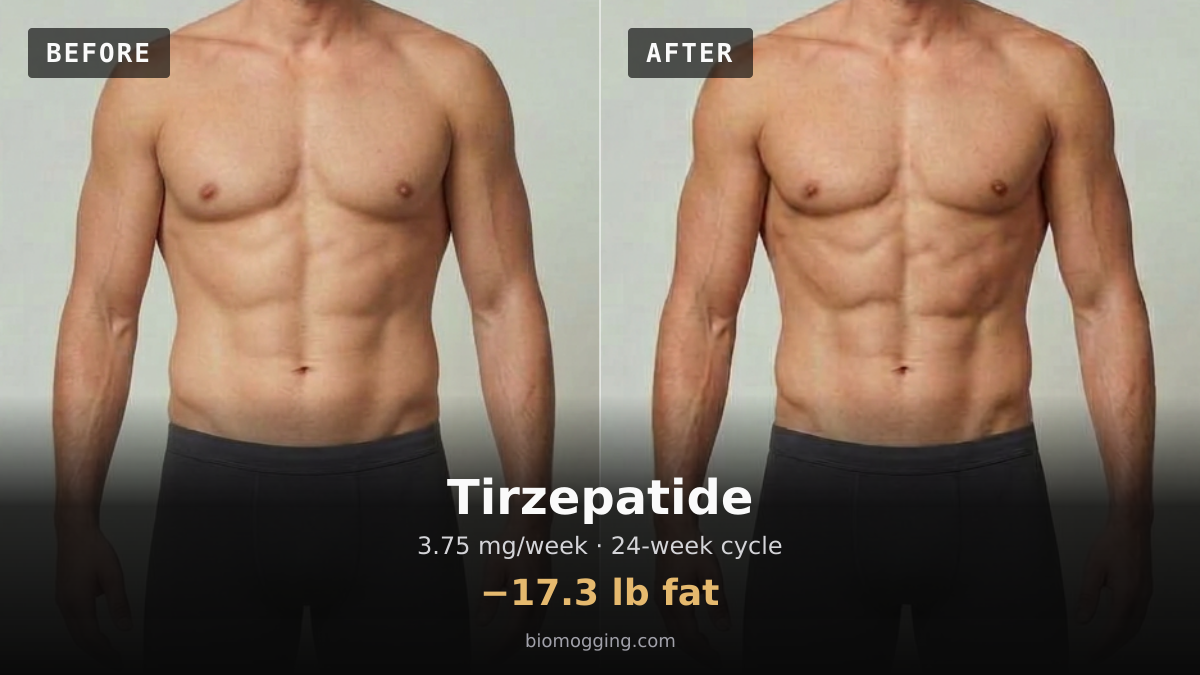
Realistic expectation for a trained, lean user running 2.5–5 mg/wk with a moderate deficit: 0.7–1.2 lb/wk fat loss sustained over 12–16 weeks, with the rate tapering as body fat drops.
Exit Strategy#
Do not stop cold. Standard exit:
| Weeks After Goal Hit | Dose |
|---|---|
| 1–2 | Drop to previous dose step (e.g. 5 → 2.5 mg) |
| 3–4 | 2.5 mg or 1.25 mg |
| 5+ | Discontinue or hold 1 mg/wk as a maintenance governor |
The 5-day half-life means plasma levels are still non-trivial at 2 weeks post-last-dose — plan contest timing, conception timing, and any surgical procedures accordingly. Discontinue at least 2 months before attempting conception.
Bloodwork Cadence#
- Baseline: fasting glucose, HbA1c, lipid panel, LFTs, lipase (pancreatitis marker), CBC.
- Week 12: repeat the above. Lipase is the one that matters most — acute pancreatitis is rare but labelled, and catching a rising lipase early means you stop before it becomes a hospital visit.
- Every 12–16 weeks thereafter if running long.
- DEXA every 12–16 weeks if you're serious about tracking lean-mass preservation. Scale weight alone will lie to you — the question is never "how much did I lose" but "what percentage was fat."
- Home BP cuff and resting HR weekly. Expect mild BP drop and a 2–4 bpm HR increase.
"Tirzepatide resulted in significantly greater reductions in HbA1c and body weight than semaglutide at all three doses, with low rates of hypoglycemia." — Frías et al., NEJM (2021) — SURPASS-2
Hypoglycemia as monotherapy is rare, but if you're stacking insulin or sulfonylureas, reduce the companion dose before starting tirz — this is the one scenario where hypo risk is real and fast.
The Non-Negotiables#
No cycle length or dose strategy saves you if these aren't in place:
- Protein ≥1.0–1.2 g/lb LBM, force-fed through the appetite suppression. Liquid protein solves most of this.
- Heavy compound lifting 3–5×/wk. Drop volume if energy is low during titration, but keep the weights heavy.
- Creatine 5 g/d.
- Structured deficit — tirz is an appetite and glycemic tool, not a fat-burner. The deficit does the work.
"I was shocked at how quickly my strength dropped and lean mass went down on DEXA after starting tirzepatide without maintaining high protein and resistance training." — r/Tirzeglutide (2024)
Users who run tirz with these locked in report recomp-grade results — fat down, lean mass held, lifts maintained. Users who treat the appetite suppression as license to coast lose 25–40% of their total weight as lean mass. The difference is entirely in how you run the supporting protocol, not in the peptide itself.
Risks & mistakes
Common (most users)#
Most of what you'll feel on tirzepatide is GI, and almost all of it is dose-dependent and titration-driven. It fades as your gut adapts — rush the ramp and you'll pay for it.
- Nausea — 17–22% at therapeutic doses, worst in the 48–72 h after injection. Mitigate by injecting after your largest meal of the day, splitting the weekly dose into two smaller SubQ shots, and keeping meals smaller and lower-fat during titration weeks. Ondansetron 4–8 mg PRN handles breakthrough nausea.
- Diarrhea or constipation — 13–16% and ~7% respectively. Hydrate aggressively (3–4 L/day), add soluble fiber (psyllium 5–10 g), and do not let sodium crash — GLP-1/GIP agonists plus a cutting diet plus low sodium is how people end up lightheaded in the gym.
- Sulfur burps, early satiety, reflux — delayed gastric emptying is the mechanism. Eat slower, stop at 80% full, cut carbonation, and don't lie down within 2 h of eating.
- Fatigue / low training energy during the first 2 weeks at a new dose — usually a caloric-intake problem disguised as a drug side effect. Force-feed protein (liquid whey/casein works when solid food is unappealing) and keep carbs around training.
- Injection-site reactions — mild redness or itch. Rotate between abdomen, thigh, and upper arm; let the vial warm to room temp before injecting.
- Transient heart-rate bump (~2–4 bpm) — rarely symptomatic; check resting HR at baseline so you know what "normal" looks like for you.
"Tirzepatide resulted in significantly greater reductions in HbA1c and body weight than semaglutide at all three doses, with low rates of hypoglycemia." — Frías et al., NEJM 2021 (SURPASS-2)
Uncommon (dose-dependent or individual)#
These show up mostly above 5 mg/wk, or in users who escalate too fast, eat too little, or stack carelessly.
- Meaningful lean-mass loss — this is the side effect physique-focused users need to respect. DEXA data and community reports consistently show 25–40% of total weight lost can be lean mass without aggressive protein intake and heavy lifting. Back off the dose, raise protein to 1.0–1.2 g/lb LBM, and keep compound lifts heavy if lean mass starts dropping faster than body fat.
"I was shocked at how quickly my strength dropped and lean mass went down on DEXA after starting tirzepatide without maintaining high protein and resistance training." — r/Tirzeglutide, 2024
- Hair shedding — telogen effluvium secondary to rapid weight loss, not a direct drug effect. Slow the rate of loss (smaller deficit), keep protein and iron/ferritin in range, and it self-resolves in 3–6 months. Check ferritin, vitamin D, and TSH if it persists.
- Gallbladder issues (cholelithiasis, biliary colic) — risk rises with the pace of weight loss. RUQ pain after fatty meals, fever, or jaundice = get imaging. Slowing the weight-loss rate to <1% body weight per week helps.
- Lipase / amylase elevation — usually asymptomatic and clinically irrelevant, but worth checking at 12 weeks. Persistently elevated lipase with epigastric pain is the pancreatitis workup trigger.
- Resting HR >10 bpm above baseline, or BP dysregulation — back off the dose and check thyroid if you're also running T3.
- Hypoglycemia when stacked with insulin or sulfonylureas — monotherapy hypo rates are 0.2–1.7%, but add slin and the picture changes. Drop insulin doses 20–30% when starting tirz and glucometer-check for the first two weeks.
Rare but serious#
Low incidence, high severity. Know the warning signs and stop the compound if they appear.
- Acute pancreatitis — severe persistent epigastric pain radiating to the back, nausea/vomiting that doesn't fit the usual GI pattern. Stop immediately and get lipase drawn. Alcohol-heavy users should be particularly cautious.
- Severe dehydration / AKI — from prolonged vomiting or diarrhea during titration. If you can't keep fluids down for 24 h, skip the next dose and rehydrate with electrolytes before restarting at a lower dose.
- Gallbladder disease requiring surgery — uncommon but documented in rapid-weight-loss populations.
- Severe hypoglycemia — essentially only seen with insulin or sulfonylurea co-administration. Don't stack slin with tirz without cutting slin doses first.
- Hypersensitivity / anaphylaxis — rare; discontinue for any systemic allergic reaction.
Hard contraindications#
These are non-negotiable. Do not run tirzepatide if any of these apply:
- Personal or family history of medullary thyroid carcinoma (MTC) — boxed warning based on rodent C-cell tumor data. Human relevance is debated, but this is a bright line.
- Multiple endocrine neoplasia syndrome type 2 (MEN-2) — same reason.
- Pregnancy, or trying to conceive within ~2 months — discontinue at least 2 months before attempting conception given the 5-day half-life. This applies to the female partner, not the male.
- History of pancreatitis — too much downside, not enough upside.
- Severe gastroparesis — tirzepatide makes it dramatically worse.
- Concurrent insulin at unchanged doses — reduce insulin 20–30% before the first tirz injection. Running full slin doses alongside tirz is how users end up hypoglycemic mid-workout.
Gender & protocol considerations#
Tirzepatide is non-hormonal — same dosing for men and women, no virilization risk, no HPTA suppression, no PCT required. Women on oral contraceptives should note that delayed gastric emptying can transiently reduce oral absorption during titration weeks; a barrier method as backup for the first 4 weeks after any dose increase is reasonable. For users planning pregnancy, stop ≥2 months before conception attempts.
No PCT is needed coming off tirz, but taper rather than stop cold — drop 2.5 mg/wk every 2–4 weeks until off. Rebound hunger is significant, and most of the weight-regain literature shows ~2/3 of lost weight returns within a year without behavior change. The compound is a tool; the diet and training habits built while on it are what hold the physique afterwards.
Stack & combine
Multipliers applied when these compounds run together. Values > 1 indicate a bonus on that axis. Tap a partner to expand the mechanism.
| Partner | Type | Lean | Fat loss | Recovery |
|---|---|---|---|---|
| synergistic | ×1.22 | ×1.12 | ×1.05 | |
| synergistic | ×1.12 | ×1.22 | ×1.00 | |
| synergistic | ×1.08 | ×1.22 | ×1.12 | |
| synergistic | ×1.05 | ×1.08 | ×1.22 | |
| synergistic | ×1.18 | ×1.22 | ×1.15 | |
| synergistic | ×1.15 | ×1.22 | ×1.07 | |
| synergistic | ×1.18 | ×1.08 | ×1.05 | |
| synergistic | ×1.18 | ×1.12 | ×1.14 | |
| synergistic | ×1.03 | ×1.18 | ×1.00 | |
| synergistic | ×1.18 | ×1.08 | ×1.06 | |
| synergistic | ×1.10 | ×1.15 | ×1.05 | |
| synergistic | ×1.08 | ×1.15 | ×1.13 | |
| synergistic | ×1.08 | ×1.15 | ×1.08 | |
| additive | ×1.00 | ×1.05 | ×1.00 |
FAQ — Tirzepatide
Where to buy Tirzepatide

Real Peptides
Our pick20% off — auto-applied at checkout
- Buy Tirzepatide · 20% offGLYCON-X™

NextGenPeps
10% off — use code at checkout
You'll also need
- Bacteriostatic waterReal PeptidesBuy · 20% off
- Bacteriostatic waterNextGenPepsBuy · 10% offUse code at checkout
- Bacteriostatic waterSwiss ChemsBuy · 10% off
- Sterile waterSwiss ChemsBuy · 10% off
- Spray bottle 10 mlSwiss ChemsBuy · 10% off
- Acetic acid 0.6% solution 10 mlSwiss ChemsBuy · 10% off
Research & citations
5 studies cited on this page.
Conclusion
Tirzepatide is hands-down the most potent fat-loss peptide currently in the real-world arsenal — and it rewards careful titration, a disciplined training stack, and a high-protein backbone.
Key takeaways:
- Run 2.5–5 mg SubQ weekly (split dosing optional) for 8–24 weeks for aggressive fat loss; microdose 1–2 mg/wk if you want appetite control with minimal side effects
- Titrate up by 2.5 mg every 4 weeks; escalate past 5 mg only if you can handle the GI sides and don't care about maximizing lean mass retention
- Non-negotiable: Force protein at ≥1.0 g/lb LBM and keep resistance training heavy — otherwise, you will lose muscle right along with the fat
- Stack with creatine (5 g/d), test cruise (100–150 mg/wk if using AAS), and T3 (25–50 µg for contest-prep scenarios) for best muscle preservation
- Most GI issues fade after week 4–6 at any given dose; use ondansetron PRN during titration
- Lean-mass loss is worst in users who under-eat or skip training — prioritize DEXA and track protein intake if you're serious about physique
If you want maximal, sustainable fat loss with real appetite control and are willing to respect the protocol, tirzepatide is as good as it gets right now for physique and aesthetics-driven users.
"Tirzepatide resulted in significantly greater reductions in HbA1c and body weight than semaglutide at all three doses..." (Frías et al., NEJM 2021)
Similar compounds
Comparisons
Rankings
Disclosures
Affiliate links — we may earn a commission at no cost to you.