Tretinoin
all-trans retinoic acid · ATRA · retinoic acid · vitamin A acid · Retin-A · Renova · Avita · Altreno · Atralin
Last updated
At a glance
Overview
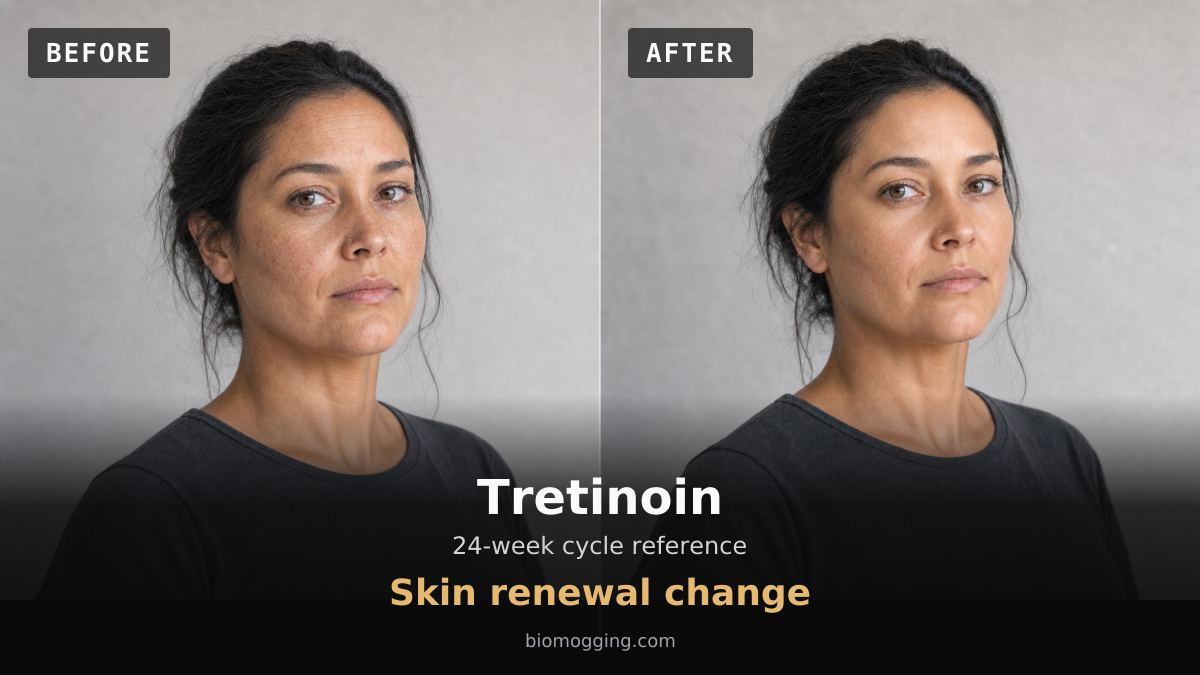
Tretinoin is the gold standard of topical skin work and the single highest-ROI aesthetic intervention in the looksmaxxing toolkit. It's the active carboxylic-acid form of vitamin A — the molecule every other retinoid (retinol, retinaldehyde, adapalene) is trying to imitate or convert into — and it's the only topical with decades of double-blind data showing it actually reverses photoaging, not just prevents it. Clearer skin, refined pores, smoother texture, faded hyperpigmentation, fewer fine lines, and visibly better light reflection off the face at 6–12 months: that's the payoff, and it's reproducible.
The community reaches for tretinoin for three overlapping use cases: acne control (including the androgenic, jawline-and-shoulder breakouts that come with AAS and SARM cycles), photoaging reversal from the early 30s onward, and baseline skin-quality looksmaxxing — the "glow" people can't quite place when they look at you. Unlike almost every compound on this site, tretinoin has zero endocrine footprint, no PCT burden, no bloodwork, and stacks cleanly with anything you're running. You monitor it with a mirror, not a lab panel.
"Topical tretinoin produced striking improvement in mottled hyperpigmentation, surface roughness, fine wrinkling, and lentigines on facial skin after daily use for 3 to 12 months." — Kligman et al., JAAD (1986)
The catch is patience. Tretinoin rewards a slow ramp and a long runway — visible acne response at 6–12 weeks, real anti-aging endpoints at 3–6 months, continued gains through a year and beyond. Rush the ramp and you'll quit mid-purge in week 4 like most beginners do. Below we break down the three strengths (0.025 / 0.05 / 0.1%), the sandwich-method ramp protocol, dedicated playbooks for acne, photoaging, PIH, and on-cycle breakouts, how to manage the retinization window, where experienced users source generic tret for $5–15 a tube, and the hard contraindications — pregnancy and pregnancy potential chief among them — that are non-negotiable.
How Tretinoin works
Tretinoin is all-trans retinoic acid — the active carboxylic-acid form of vitamin A and the endogenous ligand your skin's nuclear receptors are actually built for. Every other topical retinoid on the market (retinol, retinaldehyde, adapalene, tazarotene) is either a pro-drug that must be enzymatically converted to tretinoin in the skin, or a synthetic analog designed to mimic it at the receptor. Tretinoin is the reference compound, and it works through four interlocking mechanisms that each map onto a specific aesthetic outcome.
RAR Activation and Gene Transcription#
Tretinoin binds the nuclear retinoic acid receptors RARα, RARβ, and RARγ — with RARγ dominant in epidermis. The ligand-bound RAR heterodimerizes with RXR and binds retinoic-acid response elements (RAREs) in DNA, switching on transcription of keratinocyte differentiation genes and switching off the AP-1 transcription factor, which otherwise drives matrix metalloproteinase (MMP) expression and collagen breakdown. This is the master switch; everything else downstream flows from it.
"RAR-mediated signaling is the predominant molecular mechanism by which retinoic acid counteracts the pathophysiology of photoaged skin." — Shao Y, He T, Fisher GJ, Voorhees JJ, Quan T. Molecular Medicine Reports, 2017
Practical outcome: this is why tretinoin actually reverses photoaging instead of just exfoliating the surface like an AHA. You're rewiring transcription, not sanding the stratum corneum.
Epidermal Remodeling and Follicular Normalization#
RAR activation accelerates keratinocyte turnover, thickens the viable epidermis, compacts the stratum corneum, and — critically for acne-prone and on-cycle users — normalizes follicular keratinization. In acne, dead keratinocytes glue together inside the follicle and form the microcomedone that becomes a whitehead or cyst. Tretinoin prevents that cohesion.
Practical outcome: unclogged pores, smaller visible pore size, smoother tactile texture, and — for anyone running AAS or breaking out on cycle — resolution of the androgenic comedonal acne that BPO and antibiotics alone won't touch. This is also the mechanism behind the infamous "purge" in weeks 2–6: existing microcomedones are being accelerated to the surface all at once.
Dermal Collagen Induction#
In photoaged skin, chronic UV exposure upregulates AP-1, which drives MMP-1, MMP-3, and MMP-9 to degrade type I and III collagen faster than fibroblasts can replace it. Tretinoin suppresses AP-1 and MMP expression while simultaneously upregulating procollagen I and III synthesis. The net result over 3–12 months is measurable dermal thickening and reversal of fine lines, sallowness, and surface roughness.
"Topical tretinoin produced striking improvement in mottled hyperpigmentation, surface roughness, fine wrinkling, and lentigines on facial skin after daily use for 3 to 12 months." — Kligman AM, Grove GL, Hirose R, Leyden JJ. Journal of the American Academy of Dermatology, 1986
"Fine wrinkling, mottled hyperpigmentation, and roughness were significantly improved in the tretinoin-treated skin compared with vehicle-treated skin at the end of the 16-week period." — Weiss JS, Ellis CN, Headington JT, Tincoff T, Hamilton TA, Voorhees JJ. JAMA, 1988
Practical outcome: this is the anti-aging mechanism. Expect visible texture and fine-line improvement at 3–6 months with continued gains through month 12. This is also why tretinoin is meant to be run indefinitely — stop the compound, AP-1 climbs back, collagen degradation resumes.
Pigment Dispersion and Vascularization#
Accelerated epidermal turnover physically disperses melanin-laden keratinocytes faster than they would otherwise shed, and tretinoin additionally interferes with melanosome transfer from melanocytes to keratinocytes. Combined with upregulation of dermal microvasculature in chronically photodamaged skin, this is the mechanism behind the "glow" users describe at 4–6 months and the gradual fading of post-inflammatory hyperpigmentation (PIH) and solar lentigines.
Practical outcome: PIH from old acne scars lightens, sunspots fade, skin tone becomes more uniform, and perfusion visibly improves. For darker skin types, this mechanism is also why irritation control matters — any inflammation during the retinization window can deposit new PIH, so the sandwich method isn't optional, it's part of the protocol.
Why Tretinoin ≫ Retinol#
Retinol must be enzymatically oxidized twice inside the keratinocyte (retinol → retinaldehyde → retinoic acid) before it can bind RAR. Each conversion step is rate-limited and lossy. Tretinoin skips the queue — it is the active ligand — which is why it is roughly 20× more potent in vitro than retinol and why clinical endpoints (wrinkle reduction, pigment evening, collagen induction) show up months faster. Systemic absorption stays negligible despite that potency:
"The mean percutaneous absorption of tretinoin was 1.6% following single topical doses and remained low after 28 days of repeated application." — Latriano L, Tzimas G, Wong F, Wills RJ. Journal of the American Academy of Dermatology, 1997
That ~2% systemic absorption is the reason topical tretinoin has effectively zero endocrine footprint, zero HPTA impact, and stacks cleanly with every AAS, SARM, and peptide protocol on this site. The mechanism is overwhelmingly local — potent at the receptor in the skin, invisible systemically. Pregnancy remains a hard contraindication anyway, because the oral form is a proven teratogen and the risk:reward calculus on an unborn child does not justify the small residual systemic exposure. Everyone else: run it, ramp it properly, and run it for life.
Protocol
| Level | Dose | Frequency | Notes |
|---|---|---|---|
| Low | 0.025–0.025 mg | Once daily | Documented entry-level range |
| Mid | 0.05–0.05 mg | Once daily | Most commonly studied range |
| High | 0.1–0.1 mg | Once daily | Pea-sized amount (~0.25g) to entire face nightly, applied to fully dry skin 20–30 min after cleansing. Beginners ramp from 2–3x/week to nightly over 6–8 weeks. Values in dose fields are % strength of the formulation, not mg applied. |
Cycle length & outcomes
Documented cycle
12–520 weeks
Plateau after
52 wks
Cycle Length & Protocol#
Tretinoin isn't a cycle — it's a commitment. Unlike anabolic compounds or peptides with defined on/off windows, tretinoin works on the timescale of skin biology: the stratum corneum turns over in ~4 weeks, collagen remodeling takes months, and photoaging reversal continues accruing through at least a year of daily use. Stop, and the gains quietly regress. The "protocol" is really a ramp strategy followed by indefinite maintenance.
Tretinoin Protocol by Goal#
| Goal | Strength | Ramp | Steady-State Frequency | Time to Visible Change |
|---|---|---|---|---|
| Acne / oily skin | 0.05% gel | 2–3×/wk for 2–4 wks → EOD → nightly | Nightly, indefinite | 6–12 weeks (post-purge) |
| Skin-quality looksmaxxing (baseline) | 0.025% cream | 2–3×/wk for 4 wks → EOD for 4 wks → nightly | Nightly, indefinite | 8–16 weeks |
| Photoaging / anti-aging | 0.05% → 0.1% cream | Start 0.05% nightly once adapted; step to 0.1% at month 6+ | Nightly, indefinite | 3–6 months; continues through 12 months |
| PIH / melasma (Kligman trio) | 0.05% cream + HQ 4% + hydrocortisone 1% | No ramp — run the trio 8–12 wks | Tret-only maintenance after | 8–12 weeks |
| On-cycle AAS acne | 0.05% gel + BPO 2.5% wash | EOD for 2 wks → nightly | Nightly for cycle duration + 4 wks | 4–8 weeks |
| Minoxidil adjunct (sub-responders) | 0.025% in minox vehicle | 2–3×/wk from the start | 2–3×/wk ongoing | Follows minoxidil timeline (4–6 months) |
The Retinization Window#
Weeks 1–8 are non-negotiable suffering. Expect peeling, erythema, tight dry patches, and — for acne users — a purge around weeks 2–6 as subclinical microcomedones get accelerated to the surface. This is the single biggest reason people quit; the drug is working, not failing.
"Fine wrinkling, mottled hyperpigmentation, and roughness were significantly improved in the tretinoin-treated skin compared with vehicle-treated skin at the end of the 16-week period." — Weiss et al., JAMA 1988
Push through to week 12 before judging results. The Kligman dataset out to 12 months is where the full photoaging benefit lives:
"Topical tretinoin produced striking improvement in mottled hyperpigmentation, surface roughness, fine wrinkling, and lentigines on facial skin after daily use for 3 to 12 months." — Kligman et al., JAAD 1986
Ramp, Don't Load#
There is no "loading dose" with retinoids — the opposite. CYP26A1 (the enzyme that degrades retinoic acid in the skin) is itself induced by tretinoin, which is why tolerance builds over 6–8 weeks. Going straight to nightly 0.1% on day one doesn't accelerate results; it just blows out your barrier and forces a 2-week reset.
The community ramp that actually works:
- Weeks 1–2: 0.025%, 2 nights per week, sandwich method (moisturizer → wait 15 min → pea-sized tret → moisturizer)
- Weeks 3–4: 3 nights per week
- Weeks 5–6: every other night
- Week 7+: nightly
- Month 6+: consider stepping to 0.05%; another 3–6 months before considering 0.1%
Apply to completely dry skin 20–30 min after cleansing. Wet-skin application 2–3×'s the irritation without adding benefit.
Dose Strength vs. Benefit#
Past 0.05%, the curve flattens hard. 0.1% buys marginal additional collagen induction in photoaging users and significantly more irritation. Most long-term users settle at 0.05% indefinitely; 0.1% is for advanced users with thick, adapted skin chasing maximum anti-aging effect.
Tapering & Discontinuation#
No taper needed — topical tretinoin doesn't suppress anything systemic. You can stop whenever you want. You just shouldn't, because the photoaging, pigment, and texture gains regress over 6–12 months off. Treat it like SPF: a permanent fixture.
The exceptions where you do pause:
- 5–7 days before and after chemical peels, microneedling, or ablative laser
- During active eczema or rosacea flares
- If running concurrent oral isotretinoin (redundant + irritation stacking)
- Pregnancy or active conception attempts — discontinue entirely; topical absorption is low (~2%) but the compound is FDA Category C and the oral form is a known teratogen, so the community default is to stop, not to gamble
"The mean percutaneous absorption of tretinoin was 1.6% following single topical doses and remained low after 28 days of repeated application." — Latriano et al., JAAD 1997
Monitoring#
No bloodwork. No hormonal panels. No liver enzymes. Topical tretinoin doesn't move systemic markers (Latriano et al., 1997), and it has zero interaction with AAS, SARMs, peptides, or ancillaries on cycle. You monitor tretinoin the way you monitor training: standardized front/side photos under the same lighting every 4 weeks. Progress is slow enough that the mirror lies to you; the photos don't.
Onset Timing — What to Expect When#
| Timepoint | What's happening |
|---|---|
| Week 1–2 | Peeling, tightness, mild erythema begin |
| Week 2–6 | Acne purge (if acne-prone); skin feels worse before better |
| Week 6–8 | Retinization complete; skin stabilizes, tolerance established |
| Week 8–12 | Pore refinement, texture smoothing, early post-inflammatory pigment fading |
| Month 3–6 | Visible tone evening, reduced fine lines, "glow" from dermal vascularization |
| Month 6–12 | Measurable collagen induction, lentigo fading, sustained photoaging reversal |
| Year 2+ | Cumulative prophylaxis against new photodamage; the gap between tret users and non-users widens every year |
Tretinoin is the highest-ROI aesthetic compound with the longest runway. Ramp it properly, run it forever, and it quietly does more for how your skin looks at 45 than anything else in the looksmaxxing toolkit.
Risks & mistakes
Common (most users)#
The first 6–8 weeks on tretinoin are called retinization for a reason — the skin is remodeling, and almost everyone gets some version of the following. None of these are signs the drug isn't working; they're the drug working.
- Erythema, peeling, flaking — start at 0.025% 2–3×/week and ramp over 6–8 weeks rather than jumping in nightly. Use the sandwich method: ceramide moisturizer → wait 10–20 min → pea-sized tret → moisturizer on top. Apply to fully dry skin (wet skin amplifies irritation 2–3×).
- Stinging on application — normal for the first 2–4 weeks. Back off to every third night if it's intolerable, then rebuild. Never apply within 20 minutes of cleansing.
- Dryness, tightness, lip cheilitis — ceramide moisturizer AM and PM; plain petrolatum (Aquaphor, Vaseline) on lips and around the nostrils/mouth corners.
- Purge (weeks 2–6) — transient acne flare as subclinical comedones get accelerated to the surface. This is the #1 reason people quit in month 1. Hold the protocol; it resolves.
- Photosensitivity — daily broad-spectrum SPF 30+ is non-negotiable, not optional. Skipping SPF negates the photoaging benefit and increases irritation.
- Transient PIH in darker skin types (Fitzpatrick IV–VI) — minimize by controlling irritation aggressively: slower ramp, sandwich method, 0.025% for longer before stepping up.
Uncommon (dose-dependent or individual)#
These show up mostly in people who skipped the ramp, jumped straight to 0.1%, or layered aggressive actives on top.
- Persistent erythema past week 12 — you're dosing too high or too frequently. Drop to every other night or step down a strength. Tretinoin is a plateau curve, not a linear one — 0.1% nightly is not meaningfully better than 0.05% nightly for most users (Weiss et al., 1988).
- Periorbital or perioral dermatitis — usually from applying too close to the eye or mouth, or from gel formulations creeping. Switch from gel to cream or microsphere/polymeric emulsion (Retin-A Micro, Altreno), which are noticeably better tolerated (Olsen et al., 1992).
- Contact dermatitis — almost always the vehicle (propylene glycol, fragrances in some formulations), not tretinoin itself. Switch brands/formulations.
- Barrier damage from over-stacking — AHAs, BHAs, vitamin C, benzoyl peroxide, and tretinoin in one routine is a recipe for a compromised barrier. Separate AM/PM, introduce one active at a time, and cycle off the adjuncts for a week if your skin gets shiny-red and stings to water.
- Worsening of rosacea or seborrheic dermatitis — tretinoin isn't gentle on these phenotypes. Consider azelaic acid or adapalene as better-tolerated alternatives.
Rare but serious#
Genuinely rare with topical use. Stop and reassess if any of these appear:
- Severe blistering, crusting, or erosions — this is well past irritation. Discontinue, repair the barrier with petrolatum for 7–10 days, then restart at a lower strength and slower cadence.
- Suspected allergic contact dermatitis (spreading eczematous rash, not just irritation at application sites) — discontinue; tretinoin allergy is rare but possible.
- Paradoxical worsening of pigmentation in darker skin types from uncontrolled irritation — slow the protocol dramatically; consider a modified Kligman trio under dermatology guidance.
Systemic toxicity from topical tretinoin is not a realistic concern. Percutaneous absorption is ~2% and plasma ATRA concentrations remain within the endogenous range even after 28 days of daily 0.1% application (Latriano et al., 1997) — topical dosing does not move systemic vitamin A pools.
Hard contraindications#
- Pregnancy and women actively attempting to conceive. Oral isotretinoin and oral ATRA are known teratogens. Systemic absorption from topical tretinoin is low (~2%, Latriano et al., 1997) and human data are reassuring, but the compound is FDA Category C. Do not run topical tretinoin during pregnancy or while trying to conceive. Discontinue before conception attempts. This line does not get crossed.
- Concurrent oral isotretinoin. Redundant mechanism, stacked irritation, no additive benefit. Run one or the other.
- Active eczema, rosacea flare, or broken/abraded skin. Repair the barrier first.
- Recent ablative laser, deep chemical peel, or fresh microneedling. Pause tretinoin 5–7 days before and after.
- Known retinoid allergy. Rare but real.
Gender and cycle considerations#
- Men: no endocrine effects, no HPTA suppression, no interaction with AAS, SARMs, or PCT ancillaries. Tretinoin pairs cleanly with every compound on this site and is one of the few aesthetics tools with zero cycle-management burden.
- Women: same dosing as men. The pregnancy contraindication above is the only gender-specific line. No effect on menstrual cycle or hormonal contraception.
- On-cycle acne (AAS/SARM users): 0.05% tretinoin gel is the workhorse for androgenic jawline, shoulder, and back acne. Stack with benzoyl peroxide 2.5% wash and, if needed, topical clascoterone (Winlevi) — a topical AR antagonist that doesn't affect systemic androgen levels, so it doesn't blunt the user's cycle.
- PCT: not required. No bloodwork monitoring needed — tretinoin is evaluated with a mirror and progress photos, not a lab panel.
Tretinoin's side-effect profile is almost entirely front-loaded into the first 2–3 months. Ramp properly, sandwich, wear sunscreen, and the compound becomes a background fixture you run indefinitely — which is exactly how it's meant to be used.
Stack & combine
Multipliers applied when these compounds run together. Values > 1 indicate a bonus on that axis. Tap a partner to expand the mechanism.
Featured in stacks2 curated protocols include Tretinoin
Skinmaxx Reset Protocol
Moderate-HighThe dermatology gold-standard skin overhaul — a full isotretinoin course (16 weeks) for permanent sebum gland reduction and severe acne resolution, followed by tretinoin maintenance for ongoing collagen induction and texture refinement. Clinically backed, definitive results.
Topical Skin Renewal Stack
LowThe dermatologist-meets-peptide skin protocol — tretinoin drives epidermal turnover and collagen induction, GHK-Cu activates wound-healing pathways and improves skin elasticity, and topical BPC-157 amplifies barrier repair and angiogenesis. Genuine layered synergy applied morning and night.
FAQ — Tretinoin
Research & citations
5 studies cited on this page.
Conclusion
Tretinoin is the backbone of any serious looksmaxxing skin protocol — slow to show but high-ROI, with the deepest clinical and community backing of any topical.
Key takeaways:
- Standard dose: 0.025–0.05% cream or gel, applied once nightly; ramp up from 2–3×/week over 6–8 weeks to minimize irritation
- Apply to fully dry skin using the sandwich method (moisturizer before and after) for best tolerability
- Indefinite cycle — run year-round for lasting results; clinical improvements in fine lines, texture, and pigment are seen from 12–24 weeks onward
- Stack with daily SPF 30+ (non-negotiable), vitamin C serum in the AM, and optionally azelaic acid or niacinamide for pigment/texture
- Side effects (peeling, redness, purge) are expected early; managed with a slow ramp and barrier-repairing moisturizers
- Hard contraindication: pregnancy and those trying to conceive — do not use
If you want clearer, younger-looking skin with actual long-term evidence, tretinoin is the top-tier move. Ramp it patiently and make it your default for skin quality.
"Fine wrinkling, mottled hyperpigmentation, and roughness were significantly improved in the tretinoin-treated skin compared with vehicle-treated skin at the end of the 16-week period." — Weiss et al., JAMA (1988)