Isotretinoin
13-cis-retinoic acid · Accutane · Roaccutane · Absorica · Claravis · Myorisan · Sotret · Amnesteem
Last updated
At a glance
Overview
Why Isotretinoin Earned Its Reputation#
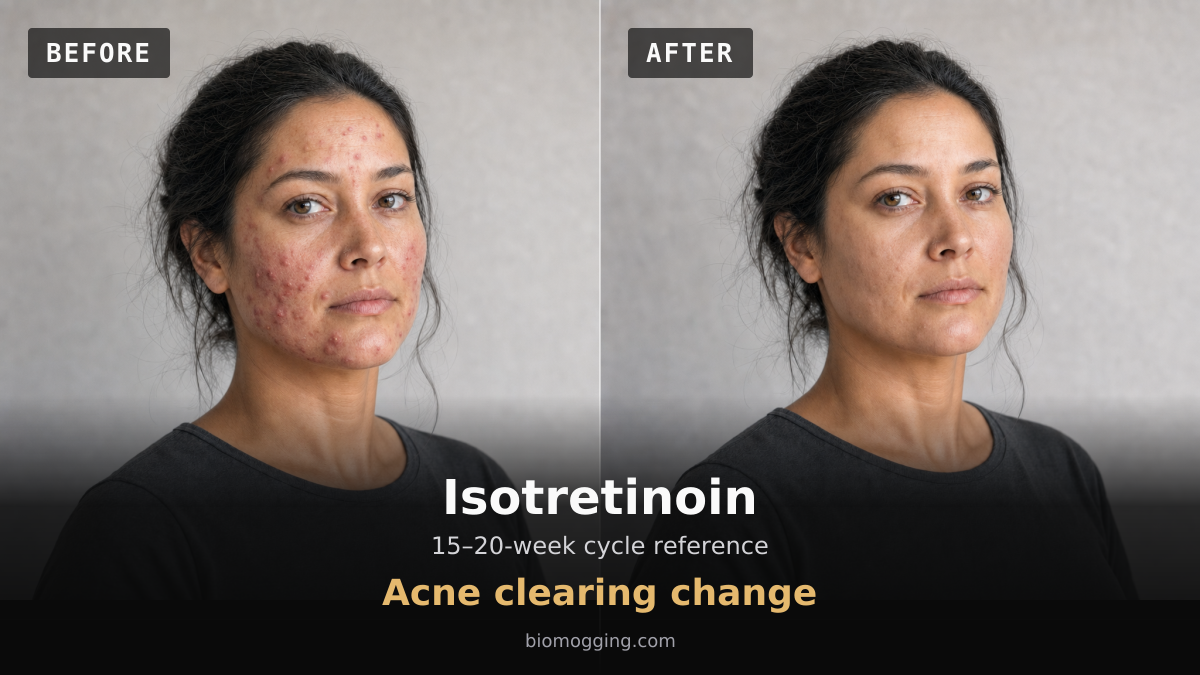
Isotretinoin is the single most effective acne drug ever developed — the only compound that shuts down all four drivers of acne at once (sebum output, follicular keratinization, C. acnes colonization, and inflammation). For the looksmaxxing and bodybuilding community, it's the definitive answer to the back, shoulder, and jawline acne that trenbolone, anadrol, and high-dose test reliably produce. One low-dose run and the oily-skinned, cyst-prone phenotype gets permanently recalibrated.
The mechanism is elegant: 13-cis-retinoic acid triggers apoptosis in sebocytes, shrinking the sebaceous gland itself rather than just managing its output. This is an anatomical reset, not a cosmetic patch.
"13-cis-retinoic acid induced a dose- and time-dependent increase in apoptosis and cell cycle arrest in SEB-1 sebocytes, independent of retinoic acid receptors." — Nelson et al. 2006, J Invest Dermatol
What the Community Actually Uses It For#
Clinical dermatology runs isotretinoin at 0.5–1.0 mg/kg/day to a cumulative 120–150 mg/kg target — the protocol for permanent remission. The physique-focused community mostly doesn't. On-cycle users run 10–20 mg/day or 20 mg EOD indefinitely, treating it as a sebum-control tool that runs in the background of a blast-and-cruise. Looksmaxxers without frank acne run the same low dose for 3–6 months to refine pores, kill T-zone shine, and matte the skin. Both approaches work because sebum suppression saturates well below the dose needed for gland atrophy.
Low-dose protocols hold up in the literature too — comparable clearance with dramatically better tolerability, provided you understand the trade-off on durability.
"Low-dose isotretinoin regimens (20 mg 3 times weekly) were comparable in efficacy to higher doses for mild-to-moderate acne, with markedly improved tolerability." — Rasi et al. 2014, J Dermatolog Treat
What This Page Covers#
The rest of this profile walks through the practical protocol: the cumulative-dose math for a once-and-done clinical run, the low-dose "forever-tane" approach for on-cycle acne, how to dose it with a fatty meal for proper absorption, the bloodwork cadence (lipids, ALT/AST, CK) that keeps you ahead of triglyceride drift, and how to stack it around tren, anadrol, and oral AAS without blowing up your liver panel. We'll also cover the hard contraindications plainly — pregnancy or pregnancy potential is absolute, tetracyclines are off the table, and vitamin A stacking is out — plus the mood question handled honestly, and how to think about waxing, laser, and training volume while you're on it.
How Isotretinoin works
Isotretinoin is the 13-cis stereoisomer of retinoic acid and the single most potent sebosuppressive agent ever identified. It's also the only acne drug that hits all four pillars of acne pathogenesis simultaneously — sebum output, ductal hyperkeratinization, C. acnes colonization, and inflammation — which is why it clears AAS-driven cystic acne that benzoyl peroxide, antibiotics, and topical retinoids can't touch.
Sebocyte Apoptosis — The Primary Event#
The headline mechanism is selective apoptosis of sebaceous gland cells. Unlike tretinoin and adapalene (which work almost entirely through retinoic-acid-receptor transcription), isotretinoin's sebum-killing effect is RAR-independent — it triggers programmed cell death in sebocytes directly, with caspase-3 activation, p21 upregulation, and cyclin D1 suppression.
"13-cis-retinoic acid induced a dose- and time-dependent increase in apoptosis and cell cycle arrest in SEB-1 sebocytes, independent of retinoic acid receptors." — Nelson AM, Gilliland KL, Cong Z, Thiboutot DM, Journal of Investigative Dermatology (2006)
Clinically this translates to ~90% reduction in sebum excretion within 4–8 weeks and durable sebaceous-gland atrophy at cumulative doses ≥120 mg/kg. For on-cycle users, even low-dose protocols (10–20 mg EOD) shrink sebum output enough to stop tren/anadrol acne in its tracks — you're not curing the gland, you're starving it.
FoxO1 / FoxO3 / p53 Axis#
Acne-prone sebaceous glands show nuclear depletion of FoxO1 and FoxO3 — transcription factors that normally restrain lipogenesis and androgen-receptor signalling in the skin. Isotretinoin reverses that depletion and layers p53 activation on top, which is the molecular basis of both its efficacy and its teratogenicity.
"Isotretinoin induces significant nuclear translocation of FoxO1 and FoxO3 proteins in sebaceous gland cells, contributing to its therapeutic efficacy in acne." — Agamia NF et al., Journal of Investigative Dermatology (2018)
Practically, this FoxO-driven reset is what makes a completed clinical course durable — you're not just suppressing sebum, you're rewriting the transcriptional program of the sebaceous unit. It also explains why maximum daily dose matters less than cumulative dose: the transcriptional remodelling needs time and total exposure to stick.
Follicular Keratinization and C. acnes Suppression#
The second arm of acne pathology — comedone formation — comes from hyperproliferative keratinocytes plugging the follicular duct. Intracellular isomerization of 13-cis-RA to all-trans retinoic acid activates RAR/RXR in keratinocytes, normalizing turnover and preventing microcomedone formation.
C. acnes itself is not directly killed, but it's an obligate lipophile — strip the sebum and the colony collapses. This indirect antibacterial effect is why isotretinoin works on deep cystic lesions that oral antibiotics fail against, and why you can run it as monotherapy without the resistance concerns of long-term doxycycline.
Anti-inflammatory Signalling#
Isotretinoin downregulates toll-like receptor 2 (TLR-2) expression on monocytes and suppresses the innate immune cascade that converts a blocked follicle into a painful red cyst. This is the mechanism behind the "post-accutane glow" — the diffuse background erythema, flushing, and reactive sebum oiliness that plague AAS users gradually fade as inflammatory tone drops. Users running trenbolone especially notice it: the compound's characteristic facial flush and reactive oiliness blunt noticeably within a few weeks of starting even a low dose.
The Teratogenicity Problem#
The same apoptotic mechanism that kills sebocytes kills neural crest cells during embryogenesis — producing the severe craniofacial, cardiac, and CNS malformations that make isotretinoin a Category X teratogen. There is no dose threshold for this effect and no workaround. Women of childbearing potential must use two forms of contraception from one month before through one month after the last dose, with monthly pregnancy tests. Do not donate blood during or for one month after treatment. This is not a "talk to your doctor" disclaimer — it's a hard mechanistic limit of the drug and the single non-negotiable rule of running it.
Tying It Back to the Skin#
The mechanism stack — sebocyte apoptosis, FoxO/p53 reprogramming, keratinocyte normalization, TLR-2 suppression — is why isotretinoin delivers outcomes no other acne drug approaches: matte skin, refined pores, a permanent drop in facial oil, and clearance of cystic acne even under heavy androgen load. The trade-off is a long ramp (visible change at 4–8 weeks, full remodelling at 4–6 months) and the dryness profile that comes with shutting down a secretory organ. For the physique-focused user running tren, anadrol, or a high-test blast, it's the only compound that reliably makes AAS acne a non-issue.
Protocol
| Level | Dose | Frequency | Notes |
|---|---|---|---|
| Low | 10–20 mg/kg | Once daily | Documented entry-level range |
| Mid | 20–40 mg/kg | Once daily | Most commonly studied range |
| High | 40–80 mg/kg | Once daily | Community on-cycle protocol: 10–20 mg/day or 20 mg EOD with a fatty meal. Clinical acne protocol: 0.5–1.0 mg/kg/day split BID, targeting cumulative 120–150 mg/kg over 16–24 weeks. Low-dose 'forever-tane' maintenance: 10 mg 2–3×/week indefinitely on blast-and-cruise. |
Cycle length & outcomes
Documented cycle
4–24 weeks
Plateau after
24 wks
Cycle Length & Dosing Strategy#
Isotretinoin doesn't cycle like an AAS or a peptide — there's no taper, no HPTA suppression, no loading phase. What matters is cumulative dose and duration, not peak serum level. Community protocols split into three distinct use cases: short-term on-cycle sebum control, long-term "forever-tane" maintenance, and a one-and-done clinical course aimed at permanent remission.
| Goal | Cycle Length | Daily Dose | Cumulative Target |
|---|---|---|---|
| On-cycle acne rescue (tren, anadrol, high-test) | 8–16 weeks | 20 mg EOD or 10–20 mg/day | Not targeted — sebum control only |
| Pre-cycle skin prep | 6–8 weeks pre-cycle | 10–20 mg/day | Not targeted |
| "Forever-tane" maintenance (blast & cruise) | Indefinite | 10 mg 2–3×/week | Not targeted |
| Looksmaxxing — pore & sebum refinement | 12–24 weeks | 10 mg 3×/week | Not targeted |
| Full clinical remission course | 16–24 weeks | 0.5 mg/kg × 2 wk → 1.0 mg/kg | 120–150 mg/kg |
Onset & Ramp Time#
- Sebum reduction: noticeable within 5–10 days at any dose. Skin gets visibly less oily before acne clears.
- Initial flare: weeks 2–6 at clinical doses. Much milder or absent at 10–20 mg EOD community dosing. Don't panic and don't bail.
- Inflammatory acne clearance: 4–8 weeks.
- Cystic acne clearance: 8–16 weeks.
- Skin texture / pore / redness benefits: continue improving for 3–6 months after discontinuation as the sebaceous glands remain atrophied and inflammation resolves.
Each dose should be administered with the fattiest meal of the day — absorption roughly doubles vs. fasted (Orfanos & Zouboulis 1998). Skipping this effectively halves the delivered dose. Lidose/Absorica formulations eliminate the food effect if you can get them.
Cumulative Dose — When It Matters and When It Doesn't#
The 120–150 mg/kg cumulative-dose target comes from relapse data — recent analysis confirms cumulative dose, not peak daily dose, predicts long-term remission:
"Cumulative dose, rather than maximum daily dose, best predicts probability of relapse following isotretinoin therapy." — Barbieri et al. 2025, JAMA Dermatology
If the goal is permanent remission, hit the target. For an 80 kg user, that's ~9.6–12 g total — roughly 40 mg/day × 5–6 months.
If the goal is on-cycle sebum suppression, cumulative dose is irrelevant. You're not curing anything — you're running a tap that shuts off when the drug does. Low-dose 20 mg 3×/week is comparably effective to higher doses for mild-to-moderate acne with markedly better tolerability:
"Low-dose isotretinoin regimens (20 mg 3 times weekly) were comparable in efficacy to higher doses for mild-to-moderate acne, with markedly improved tolerability." — Rasi et al. 2014, J Dermatol Treat
This is the evidence base behind the community "forever-tane" protocol.
Bloodwork Cadence#
Non-optional, especially stacked on oral AAS:
| Timepoint | Panel |
|---|---|
| Baseline (pre-start) | Lipid panel, CMP (ALT/AST, bilirubin), CK, CBC, hCG if applicable |
| Week 6–8 | Lipid panel, CMP, CK |
| Every 3 months thereafter | Lipid panel, CMP |
Most abnormalities are mild and fully reversible:
"Most laboratory abnormalities, including lipid and hepatic enzyme elevations, were mild and reversible upon discontinuation of isotretinoin." — Zane et al. 2006, Arch Dermatol
Triglycerides >300 mg/dL → add 3–4 g/day EPA+DHA and reduce dose. >500 mg/dL → pause. ALT/AST >3× ULN → pause and reassess — almost always the oral AAS stacked on top, not the isotretinoin.
Tapering#
None required. No rebound, no HPTA recovery, no PCT. Stop when you're done. Plasma clearance is functionally complete within ~4 weeks — unlike acitretin/etretinate, isotretinoin does not accumulate in adipose.
Hard Contraindications — Non-Negotiable#
- Pregnancy or any possibility of pregnancy. Category X teratogen causing severe craniofacial, cardiac, and CNS malformations. Women of childbearing potential must use two forms of contraception starting 1 month before, throughout, and for 1 month after, with monthly pregnancy tests. Do not donate blood during or for 1 month after the last dose.
- Tetracyclines (doxycycline, minocycline). Risk of pseudotumor cerebri. Finish the antibiotic course and wait ≥1 week before starting isotretinoin.
- Vitamin A supplementation. Discontinue — additive hypervitaminosis A.
- Heavy alcohol + oral AAS + isotretinoin. Pick two at most. The liver/lipid triple-stack is where people get themselves into real trouble.
Mood — Honest Framing#
Large cohort data do not show a consistent causal link between isotretinoin and depression, but idiosyncratic mood changes do happen in a minority of users. If mood shifts, libido craters (beyond what the underlying cycle explains), or sleep architecture breaks down, drop the dose or discontinue. It's not heroic to white-knuckle through it — the drug clears fast and you can restart later.
Pitfalls to Avoid#
- Taking it fasted (half the absorption).
- Stacking with doxycycline (pseudotumor cerebri).
- Running it through a Dbol/Anadrol/Superdrol block without lipid and liver monitoring.
- Waxing, ablative laser, or aggressive chemical peels on-cycle or within 6 months of finishing — skin barrier is fragile.
- Assuming the 120–150 mg/kg cumulative target matters when you're running 10 mg EOD for sebum control. It doesn't. You're managing a symptom, and management stops when the drug stops — which is fine if that's the plan.
Run at the lowest dose that controls the problem, take it with fat, stay on top of lipids, and isotretinoin is one of the highest-ROI compounds in the looksmaxxing arsenal — clearer skin, smaller pores, and a permanent reset of the sebaceous profile that outlasts the course itself.
Risks & mistakes
Common (most users)#
- Cheilitis (dry, cracked lips) — universal and the canary for adequate dosing. Aquaphor, Vaseline, or CeraVe Healing Balm applied hourly. If your lips aren't dry, the dose probably isn't doing much.
- Dry skin, dry nasal mucosa, occasional nosebleeds — ceramide-based moisturizer (CeraVe, La Roche-Posay Cicaplast), saline nasal spray, and a bedroom humidifier handle it. Petroleum jelly inside the nostrils at night stops the bleeds.
- Dry eyes — preservative-free artificial tears as needed. Contact lens wearers should keep a pair of glasses in rotation.
- Photosensitivity — daily SPF 50, non-negotiable. Skip the sunbed and skip Melanotan stacking during the course.
- Retinoid purge / initial flare (weeks 2–6) — ride it out. If it's severe, halve the dose for 2 weeks and ramp back up. Do not bail on the protocol over a flare.
- Mild triglyceride and LDL rise — 20–40% bumps are typical and reverse on discontinuation. Run 3–4 g/day EPA+DHA omega-3 from day one.
"Most laboratory abnormalities, including lipid and hepatic enzyme elevations, were mild and reversible upon discontinuation of isotretinoin." — Zane et al., Arch Dermatol (2006)
- Myalgia and elevated CK — especially noticeable if you train heavy. Drop training volume 10–20%, keep intensity. You don't need to stop lifting.
Uncommon (dose-dependent or individual)#
- Triglycerides >300 mg/dL — add or uptitrate omega-3, reduce dose by 25–50%, and retest in 4 weeks. Relevant for anyone also running orals.
- ALT/AST >2× ULN — drop dose, kill alcohol entirely, pause any oral AAS (Anadrol, Dbol, Winstrol, Superdrol) stacked alongside. Recheck at 4 weeks.
- Retinoid dermatitis / eczematous rash — especially on the hands and forearms. Hydrocortisone 1% short-term, heavier emollient, and a dose reduction if it doesn't settle.
- Mood changes / low motivation / flattened affect — inconsistent in the literature but real in a subset of users. If it shows up, drop dose or discontinue. Don't tough it out.
- Reduced night vision — back off night driving. Reverses after discontinuation.
- Hair shedding / telogen effluvium — usually mild, usually temporary. Relevant if you're already on a finasteride/minoxidil hair stack — isotretinoin doesn't wreck the stack, but expect a temporary density dip.
- Scalp dryness / mild seb-derm rebound post-course — ketoconazole shampoo 2×/week handles it.
Bloodwork cadence: lipid panel + CMP (ALT/AST) + CK at baseline, 6–8 weeks, then every 3 months. Low-dose maintenance users can stretch to every 4–6 months once stable.
Rare but serious#
- Pseudotumor cerebri (idiopathic intracranial hypertension) — severe headache, visual disturbance, nausea. Risk jumps dramatically when combined with tetracyclines. Stop immediately and seek care.
- Severe hypertriglyceridemia (>500 mg/dL) — pancreatitis risk. Pause the drug, aggressive omega-3, re-evaluate.
- Hepatitis-grade ALT/AST rise (>3× ULN with symptoms) — stop and investigate. Rare at community doses, more common when stacked on orals.
- Severe depression / suicidal ideation — statistically uncommon and causality is debated, but stop immediately if it appears. Don't rationalize.
- Inflammatory bowel flares — a contested association; if you have a personal or strong family history of IBD, weigh carefully.
- Hyperostosis / DISH-like skeletal changes — only reported with years of high-dose use, not at community maintenance doses. Worth knowing if you plan to run "forever-tane" indefinitely.
Hard contraindications#
- Pregnancy or any possibility of pregnancy. Category X teratogen — severe craniofacial, cardiac, thymic, and CNS malformations. Women of childbearing potential require two forms of contraception starting one month before, throughout treatment, and for one month after, with monthly pregnancy tests. This is not a line that gets crossed.
- Blood donation during treatment or for one month after. Same reason.
- Tetracyclines (doxycycline, minocycline). Pseudotumor cerebri risk. If you were running doxy for acne before starting isotretinoin, stop the doxy first. Do not overlap.
- Vitamin A supplementation. Additive hypervitaminosis A. Drop it from your stack.
- Severe hepatic impairment or untreated hyperlipidemia. Fix first or address in parallel with a statin/fibrate; don't just layer isotretinoin on top.
- Heavy alcohol use. Stacks hepatotoxicity and triglyceride load. If you're going to drink meaningfully, don't run isotretinoin.
- Oral AAS + isotretinoin + alcohol as a triple stack. Pick two at most. Running Anadrol or Superdrol alongside isotretinoin is doable with bloodwork; adding alcohol on top is not.
Gender-specific and PCT considerations#
Women: iPLEDGE or equivalent contraception protocol is mandatory — not optional, not something to negotiate around. Two methods, monthly tests, one-month washout before any attempt at conception. Isotretinoin does not cause virilization and has no androgenic activity, so it's otherwise compatible with a female physique protocol.
Men: no impact on semen quality, no HPTA suppression, no aromatization, no AR binding. Fully compatible with a cycle from an endocrine standpoint — the concern is purely hepatic/lipid load when stacked with orals.
PCT: none required. Isotretinoin does not touch the HPTA and does not need to be factored into SERM timing. Run it straight through cycle, cruise, and PCT without interruption if that's the protocol.
Stack & combine
Multipliers applied when these compounds run together. Values > 1 indicate a bonus on that axis. Tap a partner to expand the mechanism.
| Partner | Type | Lean | Fat loss | Recovery |
|---|---|---|---|---|
| synergistic | ×1.00 | ×1.00 | ×1.18 | |
| synergistic | ×1.00 | ×1.00 | ×1.18 | |
| synergistic | ×1.00 | ×1.00 | ×1.18 | |
| synergistic | ×1.00 | ×1.00 | ×1.18 |
Featured in stacks1 curated protocol include Isotretinoin
FAQ — Isotretinoin
Research & citations
5 studies cited on this page.
Conclusion
Isotretinoin is the definitive fix for persistent and AAS-induced acne, with a side bonus of dramatically improved skin texture and sebum control if run right.
Key takeaways:
- Low-dose protocols (10–20 mg/day or 20 mg EOD) deliver serious sebum suppression for on-cycle and looksmaxxing use, with much lower side effect burden than the classic clinical regimen
- Cumulative dose (120–150 mg/kg) matters only if you want long-term remission; for maintenance or cycles, the daily dose is the lever
- Always take with your fattiest meal of the day for proper absorption (unless using a Lidose/Absorica variant)
- Lipid panel and liver enzymes: baseline, 6–8 weeks in, then every 3 months — side effects are usually mild and reversible (Zane et al. 2006)
- Stack with omega-3s, moisturizers, and SPF 50; expect and manage dry lips and skin
- Absolute hard line: do not use if pregnant or with pregnancy potential — isotretinoin is a Category X teratogen
- Mood effects are rare but watch for them; some get idiosyncratic shifts, most do not
If you want reliably clear, matte skin and are willing to follow the bloodwork and risk protocols, low-dose isotretinoin is as close to a permanent acne solution as the community has found.