Melanotan-1
Afamelanotide · Scenesse · NDP-α-MSH · CUV1647 · EPT-1647 · MT-1
Last updated
Buying options
Available at Real Peptides (US) — 20% off auto-applied
A 7-week protocol at 0.75 mg/day ≈ 4 vials
At a glance
Overview
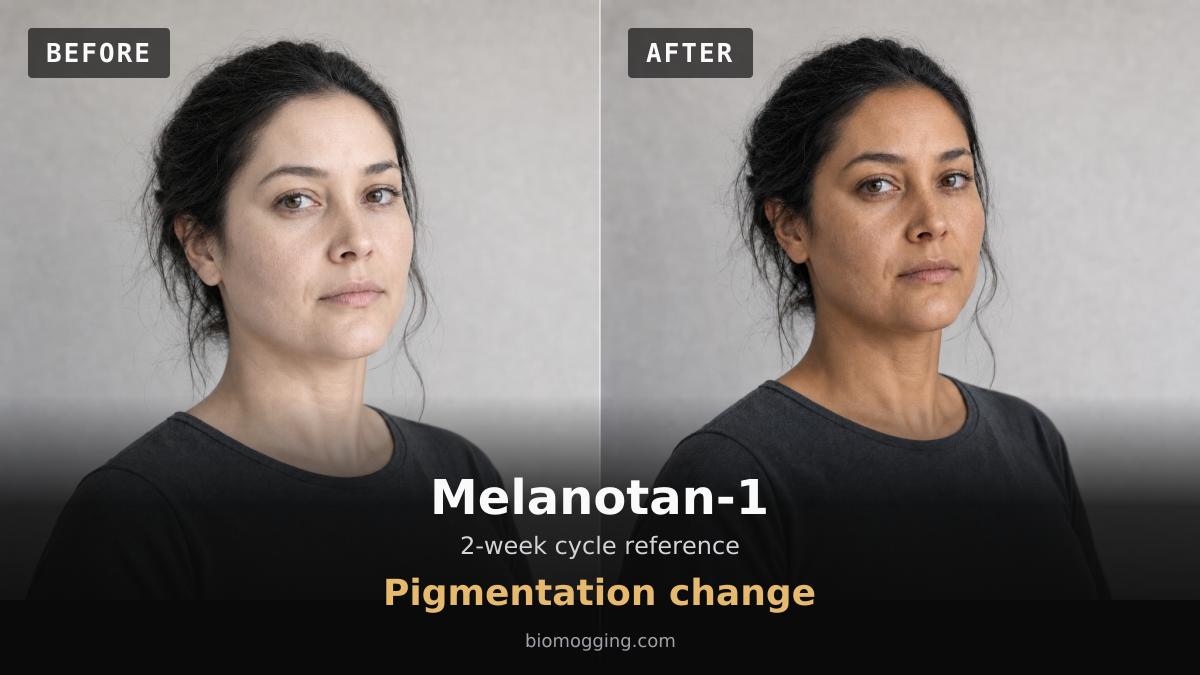
Melanotan-1 is the grown-up version of the tanning peptide category. Unlike its cousin MT-2 — which the community tolerates for its potency but fights against for its nausea, flushing, and unsolicited erections — MT-1 is the same molecule as afamelanotide (Scenesse), an FDA- and EMA-approved drug with real human PK, long-term safety data, and a cleaner side-effect profile thanks to tighter MC1R selectivity. For looksmaxxers and physique-focused users who want a year-round tan without the MT-2 rollercoaster, MT-1 is the upgrade.
The mechanism is simple: MT-1 agonizes MC1R on melanocytes, shifting pigment synthesis toward eumelanin (brown/black) instead of pheomelanin (red/yellow). You load daily during a 2–4 week ramp, pair it with 2–3 short UV sessions per week, then taper to 1–2× weekly maintenance to hold color. Without UV, melanocytes are primed but idle — MT-1 is the signal, sunlight is the trigger. In EPP patients, the clinical data is striking:
"Patients treated with afamelanotide could spend significantly longer periods in direct sunlight without pain and showed increased melanin density in skin samples." — Langendonk et al., NEJM 2015
The trade-offs are real but manageable: it costs more than MT-2, it tans more slowly, and — like any MC1R agonist — it is a hard no for anyone with a history of melanoma, dysplastic nevi, or atypical mole syndrome. A baseline full-body mole check with a dermatologist prior to initiating use, and annually thereafter, is non-negotiable. Below we'll cover the loading protocol and dose ladder, how to pair UV exposure correctly, side-effect mitigation, how MT-1 stacks against MT-2 and alternatives, and sourcing considerations in the unregulated peptide market.
How Melanotan-1 works
MC1R Agonism and the cAMP → MITF → Tyrosinase Cascade#
Melanotan-1 is a linear 13-amino-acid analog of endogenous α-MSH with two substitutions — norleucine at position 4 and D-phenylalanine at position 7 — that make it roughly 1000× more resistant to enzymatic degradation and substantially more potent at the melanocortin-1 receptor (MC1R) than native α-MSH.
When MT-1 binds MC1R on epidermal melanocytes, the Gs-coupled receptor activates adenylate cyclase → ↑cAMP → PKA → phosphorylation of CREB → transcription of MITF (microphthalmia-associated transcription factor), the master regulator of melanogenesis. MITF then drives expression of tyrosinase, TRP-1, and TRP-2, the three enzymes that convert tyrosine into melanin inside melanosomes.
The practical outcome: darker skin that actually protects against UV, rather than just looking tanned.
The Pheomelanin → Eumelanin Shift#
This is the mechanism that matters for looksmaxxers running MT-1 year-round. At baseline, fair-skinned users (Fitzpatrick I–II, especially redheads with MC1R loss-of-function variants) preferentially produce pheomelanin — the reddish-yellow pigment that burns instead of tans and generates free radicals under UV.
MC1R activation flips the melanocyte toward eumelanin, the brown-black pigment that absorbs UV broadly and quenches reactive oxygen species. MT-1 forces this switch pharmacologically, which is why EPP patients on afamelanotide get clinically meaningful photoprotection without needing to get visibly dark first.
"Patients treated with afamelanotide could spend significantly longer periods in direct sunlight without pain and showed increased melanin density in skin samples." — Langendonk JG et al., New England Journal of Medicine, 2015
For the aesthetic user, this is the mechanism behind the "clean tan" MT-1 is known for — it's producing the pigment your skin would produce if you had a higher-functioning MC1R allele, not staining you an artificial orange.
UV as the Rate-Limiting Signal#
This is the mechanism most new users miss and why "users injected for three weeks and got nothing" threads exist. MC1R agonism by MT-1 primes melanocytes — upregulating the machinery — but melanin synthesis itself is still gated by a second signal: UV-induced DNA damage in keratinocytes, which releases α-MSH locally and drives melanosome transfer to surrounding skin cells.
MT-1 saturates the first signal. UV provides the second. Without UV exposure (sun or tanning bed), you get modest baseline darkening at best. With even moderate UV (10–20 min, 2–3×/week), the primed melanocytes respond dramatically faster and darker than they would without the peptide. This is why the protocol is always MT-1 + UV, never MT-1 alone.
Photoprotection Beyond Pigment#
MC1R signaling does more than make pigment. Downstream of cAMP, it also upregulates nucleotide excision repair pathways and endogenous antioxidant defenses in keratinocytes, meaning MT-1-treated skin handles UV-induced DNA damage better even at matched pigment levels. Afamelanotide also appears to produce systemic effects unrelated to skin — in EPP cohorts, erythrocyte protoporphyrin and AST dropped significantly over extended treatment.
"Our data show a sustained, clinically relevant reduction of AST and erythrocyte protoporphyrin, suggesting benefits beyond photoprotection." — Minder AE et al., Therapeutic Advances in Rare Disease, 2022
For aesthetics-focused users this translates into a plausible reduction in cumulative photoaging and actinic damage — a longevity-adjacent bonus on top of the cosmetic tan.
MC1R Selectivity: Why MT-1 Is Cleaner Than MT-2#
MT-1 and MT-2 both agonize the melanocortin family, but MT-2 is a cyclic heptapeptide with significant affinity for MC3R, MC4R, and MC5R in addition to MC1R. That promiscuity is the source of MT-2's signature side effects: MC4R activation in the CNS drives nausea, appetite suppression, and spontaneous erections; MC3R/MC5R hit a range of autonomic effects.
MT-1 is far more MC1R-selective. You still get some flushing and mild nausea in the first week (largely from transient autonomic activation that tachyphylaxes quickly), but the priapism, heavy appetite crash, and intense GI upset that drive users off MT-2 are mostly absent.
"Afamelanotide exhibits a plasma half-life of about 30–50 min following subcutaneous injection, but its pharmacodynamic effects on skin pigmentation persist for weeks." — Minder EI et al., Clinical Pharmacokinetics, 2017
That PK/PD disconnect — short plasma half-life, weeks of pigment response — is the final piece of the mechanism. You're not dosing a drug that lingers. You're pulsing a signal that triggers a biological program (melanogenesis) which then runs on its own timescale. That's why daily microdoses during loading work, why 1–2× weekly maintenance holds color, and why the tan fades over 1.5–3 months after you stop rather than dropping off with the peptide's half-life.
Protocol
| Level | Dose | Frequency | Notes |
|---|---|---|---|
| Low | 0.25–0.5 mg | Once daily | Documented entry-level range |
| Mid | 0.5–1 mg | Once daily | Most commonly studied range |
| High | 1–2 mg | Once daily | Daily during 2–4 week loading phase, then taper to 1–2× weekly maintenance. Inject at night to sleep through any flushing or nausea. UV exposure (sun or tanning bed) 2–3×/week is required for pigment response — MT-1 primes melanocytes, UV drives melanin synthesis. |
Available at Real Peptides (US) — 20% off auto-applied
A 7-week protocol at 0.75 mg/day ≈ 4 vials
Cycle length & outcomes
Documented cycle
2–12 weeks
Plateau after
6 wks
Cycle Structure#
Melanotan-1 isn't a hormone and doesn't suppress anything — cycling is structured around pigment development and seasonal demand, not recovery or PCT. A cycle has two phases: a loading phase where you inject daily to build melanocyte activity, and a maintenance phase where 1–2 weekly injections hold the color. UV exposure is non-negotiable — the peptide primes the melanocytes, but UV is what actually drives melanin synthesis.
"Afamelanotide exhibits a plasma half-life of about 30–50 min following subcutaneous injection, but its pharmacodynamic effects on skin pigmentation persist for weeks." — Minder EI et al., Clin Pharmacokinet (2017)
Cycle Length by Goal#
| Goal | Loading Phase | Maintenance | Loading Dose | Maintenance Dose |
|---|---|---|---|---|
| Aesthetic tan (Fitzpatrick III–IV) | 2–3 weeks | 6–10 weeks | 0.5–1 mg daily | 0.5–1 mg 1–2×/week |
| Aesthetic tan (Fitzpatrick I–II, pale/redhead) | 4–6 weeks | 8–12 weeks | 0.25–0.5 mg daily | 0.5 mg 2×/week |
| Photoprotection (outdoor athletes) | 10–14 days | Full sun season | 0.5 mg daily | 1 mg 1×/week |
| Contest prep / shoot | 4–6 weeks pre-event | Through event | 0.5–1 mg daily | 1 mg 2×/week |
| MT-2 refugee (side-effect intolerant) | 3–4 weeks | 6–10 weeks | 0.5 mg daily | 0.5–1 mg 2×/week |
Loading Protocol#
Load daily, inject at night — nausea and facial flushing hit 20–60 minutes post-injection and fade during sleep. Abdomen SC with a slin pin, rotate sides. Start at the low end of the range for your skin type for the first 3–4 days to gauge tolerance, then escalate.
- Days 1–4: 0.25 mg SC nightly (tolerance check)
- Days 5–14: 0.5 mg SC nightly
- Days 15+: hold at 0.5–1 mg nightly until target color is reached
Pair with 2–3 short UV sessions per week — 5–15 minutes on a tanning bed depending on Fitzpatrick type, or 10–20 minutes of moderate real sun. Skipping UV is the single most common reason "MT-1 didn't work" — the community is full of users who injected for 6 weeks with zero sun and got minimal color.
Onset Timing#
- First darkening: 7–14 days into loading
- Peak pigmentation: ~30 days with consistent UV
- Fade time after stopping: 6–12 weeks depending on UV maintenance
"Patients treated with afamelanotide could spend significantly longer periods in direct sunlight without pain and showed increased melanin density in skin samples." — Langendonk JG et al., NEJM (2015)
This slow ramp is why seasonal users should start loading 3–4 weeks before they actually want the color — running MT-1 from April handles a summer; starting in June means you're still loading when you want to be on the beach.
Maintenance Phase#
Once target color is hit, drop to 0.5–1 mg once or twice weekly plus whatever ambient UV you're getting. Melanocytes remain primed for weeks after the loading phase, so maintenance is mostly about keeping the signal warm, not continuing to build. Users running year-round (rare) typically cycle 8 weeks on / 4 weeks off to give moles a rest and preserve UV-response dynamics.
Monitoring Cadence#
No bloodwork is required — MT-1 doesn't touch lipids, liver enzymes, or the HPTA. The monitoring that actually matters is dermatologic:
- Pre-cycle: full-body mole check with a dermatologist. This is the single most important step. Baseline photos of any notable nevi.
- During cycle: self-check monthly; any new mole, or any existing mole changing in size/color/border, gets evaluated promptly.
- Annually: repeat full-body derm check if you're running MT-1 regularly.
"The most common adverse events were headache and implant-site reaction, with no serious drug-related adverse effects observed across clinical studies." — Barman-Aksözen J, Minder EI et al., Drugs (2016)
Hard Contraindications#
Do not run MT-1 if you have: a personal or strong family history of melanoma, dysplastic nevi / atypical mole syndrome, a high baseline nevus count you haven't had evaluated, active non-melanoma skin cancer, or are pregnant/breastfeeding. MC1R agonism accelerates melanocyte activity — the theoretical risk of promoting existing transformed cells is real enough that this is a line not to cross, regardless of how good the long-term EPP data looks in unaffected populations.
Tapering#
There is no taper. Stop when you're done — pigment fades on its own timeline. No rebound, no withdrawal, no PCT. Most users simply drop back to maintenance through autumn and discontinue through winter, reloading the following spring.
Risks & mistakes
Common (most users)#
- Facial flushing — warm, red-face sensation starting 15–30 minutes post-injection, lasting 30–60 minutes. Tachyphylaxes within the first week. Inject at night so you sleep through it; drop to 0.25 mg if it's intolerable and titrate back up.
- Mild nausea — peaks 30–60 minutes after injection and usually resolves inside the first week of loading. Inject with food in your stomach, at night, and avoid stacking the shot right before cardio or a meal you care about. Drop the dose by half if it persists past week one.
- Injection-site reactions — minor redness, itching, or a small welt. Rotate abdominal sites, use fresh slin pins, and keep reconstituted vials properly refrigerated.
- Headache — the most common AE in the Scenesse trials. Hydrate, dose at night, consider splitting the dose across two smaller injections if it's recurrent.
"The most common adverse events were headache and implant-site reaction, with no serious drug-related adverse effects observed across clinical studies." — Barman-Aksözen & Minder, Drugs (2016)
- Darkening of existing moles, freckles, nipples, lips, and gums — expected, not pathological. Photograph your skin before starting so you have a baseline to compare against.
- Appearance of new lentigines / freckles — common in fair (Fitzpatrick I–II) skin, especially on sun-exposed areas. Track them; anything changing in shape, border, or color goes to a dermatologist.
- Decreased appetite — mild and usually welcome on a cut. Eat on schedule rather than by hunger cue to avoid unintentional undereating.
Uncommon (dose-dependent or individual)#
- Persistent nausea past week two — back off to 0.25 mg daily or every other day. If it doesn't resolve, the product may be underdosed/overdosed relative to label (sourcing issue) or you're in the minority who simply don't tolerate melanocortin agonists well.
- Fatigue / mild malaise on loading days — cut dose frequency to every other day during the load.
- Vivid dreams / disrupted sleep — shift the injection to earlier in the evening rather than right before bed.
- Blood pressure changes — minor swings reported anecdotally. If you're on-cycle with orals or already running hot BP, check cuff readings during the load.
- Spontaneous erections — much rarer than with MT-2 due to MT-1's MC1R selectivity, but possible at higher doses (1.5–2 mg+). Drop the dose; this is a signal you're overshooting what you need for pigment.
- Excessive / uneven pigmentation — patchy darkening on hands, knuckles, or old scars. Reduce frequency; pigment will even out over weeks once melanocyte turnover catches up.
Rare but serious#
- Changing moles — any nevus that changes size, shape, color, or border during a cycle. Stop dosing and see a dermatologist promptly. Don't rationalize it.
- New pigmented lesions with irregular features — same response: stop, get it checked.
- Severe allergic / hypersensitivity reaction to the peptide or vehicle — hives, swelling, breathing difficulty. Stop and seek care. Rare, but reported with any injected peptide.
- Unexplained systemic symptoms — persistent severe headache, vision changes, sustained hypertension. Stop and investigate.
The long-term safety data here is genuinely reassuring for a community peptide:
"Our data show a sustained, clinically relevant reduction of AST and erythrocyte protoporphyrin, suggesting benefits beyond photoprotection." — Minder et al., Ther Adv Rare Dis (2022)
240+ patient-years of afamelanotide exposure in the Swiss EPP cohort produced no serious drug-related AEs and trended favorably on liver enzymes — a profile most recreational compounds can't match.
Hard contraindications#
These are non-negotiable. MT-1 stimulates melanocyte activity; the theoretical risk of promoting existing transformed or dysplastic pigment cells is high enough that every serious source draws the line here.
- Personal history of melanoma — do not use. Ever.
- Dysplastic nevi / atypical mole syndrome — do not use.
- Active non-melanoma skin cancer (basal cell, squamous cell) — do not use until fully treated and cleared, and then only after dermatology review.
- Strong family history of melanoma (first-degree relatives) — do not use.
- High nevus count without a recent full-body dermatology screen — do not start until you've had one. This is the single most important pre-cycle step for MT-1.
- Pregnancy or breastfeeding — no safety data. Do not use.
Gender considerations & PCT#
MT-1 is a pigment-signaling peptide, not a hormone. It does not touch the HPTA, does not aromatize, does not affect lipids, and does not require PCT or ancillaries. Dosing is identical for men and women. Women running MT-1 should still do the same baseline mole check — the skin-cancer contraindications apply equally regardless of sex. The one female-specific note: discontinue before any planned conception, as safety in pregnancy has not been established.
Stack & combine
Featured in stacks1 curated protocol include Melanotan-1
FAQ — Melanotan-1
Where to buy Melanotan-1

Real Peptides
Our pick20% off — auto-applied at checkout
- Buy Melanotan-1 · 20% offMelanotan-1
A 7-week protocol at 0.75 mg/day ≈ 4 vials

NextGenPeps
10% off — use code at checkout
- Buy Melanotan-1 · 10% offMelanotan I (MT1)
You'll also need
- Bacteriostatic waterReal PeptidesBuy · 20% off
- Bacteriostatic waterNextGenPepsBuy · 10% offUse code at checkout
- Bacteriostatic waterSwiss ChemsBuy · 10% off
- Sterile waterSwiss ChemsBuy · 10% off
- Spray bottle 10 mlSwiss ChemsBuy · 10% off
- Acetic acid 0.6% solution 10 mlSwiss ChemsBuy · 10% off
Research & citations
4 studies cited on this page.
Conclusion
Melanotan-1 (afamelanotide) is the go-to choice for a smooth, natural-looking tan with a cleaner side effect profile than MT-2 — ideal for looksmaxxing users prioritizing safety, minimal nausea, and low-risk pigment enhancement.
Key takeaways:
- Standard loading dose: 250–500 µg SC daily for 2–4 weeks, then taper to 0.5–1 mg 1–2× weekly as maintenance
- Always pair with controlled UV exposure (sun or tanning bed 2–3×/week); MT-1 primes pigment, UV drives actual tanning
- Nausea and flushing are common only in the first few days — inject at night to minimize impact
- No sexual, appetite, or strong systemic effects as seen with MT-2 — MT-1 is MC1R-selective
- Absolute contraindication: history of melanoma, dysplastic nevi, or atypical mole syndrome; get a full-body dermatology mole check before starting
- More expensive and slower onset than MT-2, but delivers a subtler, even tan with less freckling or side-effect baggage
When used correctly, MT-1 is one of the safest and most effective routes to year-round color and photoprotection — just respect skin monitoring and sourcing diligence, and you'll be equipped for an elite aesthetic outcome.
Similar compounds
Disclosures
Affiliate links — we may earn a commission at no cost to you.