GT20029
Kintor AR-PROTAC · AR-degrader topical
Last updated
At a glance
Overview
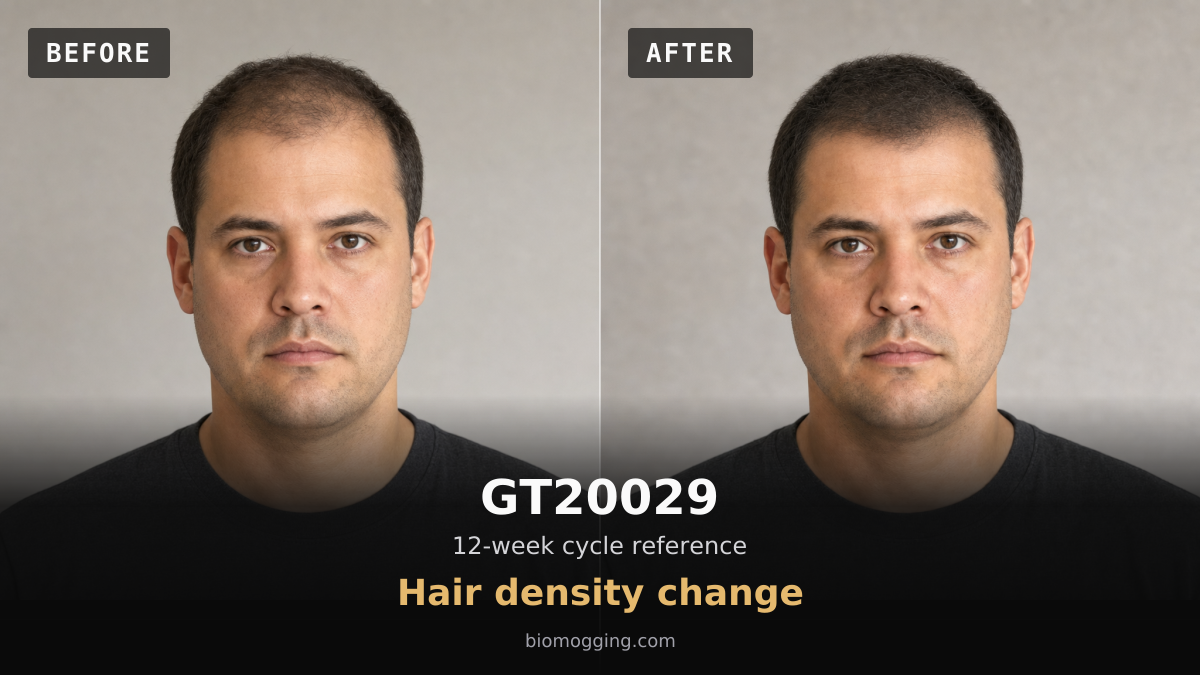
GT20029 is the first topical AR PROTAC to reach late-stage clinical trials for androgenetic alopecia — and the first genuinely novel mechanism in the hair-loss space since finasteride. Instead of blocking the androgen receptor like RU58841 or pyrilutamide, it recruits the cell's own ubiquitin machinery to destroy AR protein outright in scalp tissue, with near-zero systemic exposure at therapeutic topical doses. For physique-focused users, that combination solves a very specific problem: how to protect the hairline on cycle — particularly on 19-nors where finasteride does nothing — without swallowing a systemic AR blocker.
"PROTACs are heterobifunctional molecules that induce the proximity of target proteins to E3 ubiquitin ligases, resulting in polyubiquitination and subsequent degradation of the target proteins." — Békés, Langley & Crews, Nature Reviews Drug Discovery (2022)
The looksmaxxing and AAS communities have been watching Kintor's Phase II readouts closely because GT20029 is the first plausible clean exit from the two dominant compromises in the current hair stack: oral finasteride (effective but systemic, with PFS risk) and RU58841 (effective but gray-market, with real systemic absorption through inflamed scalp). Phase II in Chinese men with AGA showed statistically significant hair-count gains at 2.5% solution — with both once-daily and twice-weekly arms hitting endpoints at 24 weeks, a compliance profile no existing topical can touch.
This page covers how GT20029 actually works, where it fits in an on-cycle hair stack versus finasteride and RU58841, the Phase II dosing evidence and realistic protocols, side-effect profile and contraindications, and the sourcing reality — because as of writing, this is still a watched-list compound, not a vial you should be buying from the usual research-chem vendors.
How GT20029 works
GT20029 is the first topical PROTAC (PROteolysis TArgeting Chimera) to reach late-stage clinical trials in dermatology. Instead of competing with DHT for the androgen receptor's ligand-binding pocket — the job of RU58841, pyrilutamide, clascoterone, bicalutamide — it physically destroys the receptor. The result is the same downstream outcome (AR signaling silenced in the follicle) achieved through a mechanism that is catalytic, long-lasting per dose, and largely confined to the scalp.
Bifunctional Design: AR Warhead + E3 Ligase Recruiter#
A PROTAC is a chimeric small molecule with two heads connected by a linker. One end binds the androgen receptor. The other recruits cereblon — an E3 ubiquitin ligase that normally tags cellular proteins for disposal. When GT20029 bridges the two, it forces the ligase to ubiquitinate the AR, marking it for destruction by the 26S proteasome. Cereblon is the same E3 ligase hijacked by thalidomide and the IMiD drug class, and its structural biology is now well-characterized.
"Our findings identify cereblon as the primary target of thalidomide teratogenicity and provide a molecular basis for considering cereblon as an E3 ubiquitin ligase component in small-molecule targeting strategies." — Ito T, Ando H, Suzuki T, et al., Science (2010)
For the looksmaxxer, the practical translation is simple: the receptor that DHT (or trenbolone, or supraphysiological testosterone) uses to drive follicular miniaturization gets disassembled rather than blocked.
"PROTACs are heterobifunctional molecules that induce the proximity of target proteins to E3 ubiquitin ligases, resulting in polyubiquitination and subsequent degradation of the target proteins." — Békés M, Langley DR, Crews CM., Nature Reviews Drug Discovery (2022)
Catalytic Degradation vs. Stoichiometric Blockade#
This is the mechanistic edge over every competitive AR antagonist currently used for hair. RU58841 and pyrilutamide have to sit on the receptor continuously — one drug molecule per receptor, and the moment it dissociates, DHT can rebind. GT20029 induces degradation and is then released to do it again. One molecule takes down many receptors.
In cellular models of prostate cancer where AR is amplified or mutated past the point where enzalutamide works, AR-directed PROTACs have outperformed competitive antagonists outright:
"PROTAC-induced AR degradation outperforms classical competitive AR antagonists like enzalutamide in suppressing androgen receptor signaling in resistant cancer cell models." — Salami J, Alabi S, Willard RR, et al., Communications Biology (2018)
For a guy running trenbolone or 600 mg/week of test — where scalp AR is saturated with high-affinity ligand — a degrader that removes the receptor entirely is mechanistically a stronger tool than a competitive blocker trying to out-compete that ligand at the pocket. It's also why the Phase II protocol could test twice-weekly dosing successfully; once the receptor pool is drained, it takes time for the follicle to rebuild it.
Scalp-Local Action with Minimal Systemic Exposure#
The second mechanical selling point is pharmacokinetic, not pharmacodynamic. GT20029's molecular weight, lipophilicity, and vehicle were engineered for scalp retention. Phase I data indicated plasma levels essentially absent at therapeutic topical doses:
"Plasma concentrations were near or below the lower limit of quantification at all therapeutic topical doses, indicating minimal systemic exposure during Phase I studies." — ClinicalTrials.gov registry (2023)
This is what separates it from oral finasteride/dutasteride (systemic 5-AR inhibition, with real sexual and cognitive side-effect incidence) and from RU58841 (higher-than-advertised systemic absorption through inflamed or occluded scalp, which drives the tachycardia and malaise reports that show up on forums). For users already managing HPTA suppression, libido, and mood from AAS, a hair tool that doesn't add systemic AR noise is the entire point.
Follicular AR Depletion and Miniaturization Reversal#
Downstream of receptor destruction, the biology is the conventional AGA story played in reverse. DHT-activated AR in dermal papilla cells drives secretion of TGF-β1/2, DKK-1, and IL-6, which shorten anagen, push follicles into premature catagen/telogen, and progressively miniaturize terminal hairs into vellus. Collapse AR protein in the dermal papilla and that signaling cascade goes quiet. Kintor's preclinical work showed dose-dependent AR knockdown in human scalp dermal papilla cells and regrowth in androgenized animal models:
"Topical GT20029 demonstrated dose-dependent reduction of AR protein in human scalp dermal papilla cells with limited systemic exposure, supporting its development for androgenetic alopecia and acne vulgaris." — Kintor Pharmaceutical pipeline disclosure (2023)
The clinical translation in Phase II was a statistically significant target-area hair count improvement at 24 weeks — real but on the same order as minoxidil-class responses, not a miracle. Expect it to behave as an additive pillar in a stack (alongside minoxidil and, for non-19-nor users, oral or topical finasteride), not as a standalone cure.
Why This Matters for AAS Users Specifically#
Two mechanistic facts converge to make GT20029 the most interesting hair tool to hit the pipeline in two decades for bodybuilders:
- It works against non-DHT AR agonists. Finasteride and dutasteride do nothing against trenbolone (not a 5-AR substrate) and only partially tame supraphysiological testosterone. A degrader that takes out the receptor itself is mechanism-agnostic to which agonist is pushing it — it works whether the ligand is DHT, T, tren, or nandrolone.
- It doesn't add systemic AR antagonism on top of an already-suppressed axis. Oral bicalutamide or enzalutamide would absolutely protect hair on cycle, but at the cost of systemic AR blockade — catastrophic for the whole reason you're running AAS in the first place. A scalp-confined degrader threads that needle.
That combination — 19-nor coverage plus negligible systemic footprint — is the specific gap in the current hair arsenal that GT20029 is built to fill.
Protocol
| Level | Dose | Frequency | Notes |
|---|---|---|---|
| Low | 1–1 ml | Once daily | Documented entry-level range |
| Mid | 1–1 ml | Once daily | Most commonly studied range |
| High | 1–1 ml | Once daily | Phase II tested 2.5% solution at 1 mL QD and 1 mL twice-weekly — both arms hit efficacy endpoints at 24 weeks. QD for active recession or on-cycle AR pressure; BIW (Monday/Thursday) is a viable maintenance cadence once hairline is stabilized. |
Cycle length & outcomes
Documented cycle
16–52 weeks
Plateau after
24 wks
Cycle Philosophy#
GT20029 is a hair-retention commitment, not a cycle. Like every effective AGA tool, the minute you stop, the AR pressure on your follicles resumes and the ground you gained miniaturizes back. Budget for it the same way you budget for finasteride or minoxidil: indefinite use, with a realistic 16–24 week window before you see measurable change in photos.
Onset is slow and biology-gated. The follicle cycle is the rate-limiter — AR degradation happens within days in dermal papilla cells, but translating that into terminal hair requires the next anagen re-entry. Expect a possible dread shed between weeks 4–10 (same dynamic as minoxidil/finasteride initiation, driven by synchronized telogen release), visible thickening by week 16, and the real efficacy readout at week 24. Judge it against baseline photos, not against the mirror.
Dose Ladder#
The Phase II program is the only serious dosing evidence that exists. Anchor on it — don't freelance.
| Use Case | Concentration | Volume | Frequency | Cycle Length |
|---|---|---|---|---|
| Active recession, AAS-naive | 2.5% | 1 mL | Once daily | 24 weeks → indefinite |
| On-cycle (test / tren / 19-nors) | 2.5% | 1 mL | Once daily | Full cycle + 6–8 weeks after |
| Finasteride-sides refugee | 2.5% | 1 mL | Once daily | 24 weeks → reassess at BIW |
| Maintenance (hairline stable) | 2.5% | 1 mL | Twice weekly (Mon/Thu) | Indefinite |
| Cautious start / sensitive scalp | 1% | 1 mL | Once daily x 4 wk, then 2.5% | Transition protocol |
Applied at night, to a dry scalp, fingertip-distributed over thinning zones, and left to dry before pillow contact. Do not rinse. Do not stack on top of fresh minoxidil — space them by at least 2 hours to avoid vehicle interaction.
"Phase II tested 2.5% solution at 1 mL QD and 1 mL twice-weekly — both arms hit efficacy endpoints at 24 weeks." — ClinicalTrials.gov registry, 2023
Loading and Tapering#
There is no loading phase. PROTACs are catalytic — one molecule degrades many AR proteins sequentially — so hitting scalp tissue with a double dose on day one buys nothing except faster irritation.
There is also no taper requirement. GT20029 does not suppress the HPTA, does not cross into meaningful plasma levels at clinical topical doses, and does not produce rebound androgenic signaling when discontinued. You stop, scalp AR repopulates over the next few weeks, and DHT signaling resumes its pre-treatment trajectory. That's the honest framing — no withdrawal, but also no permanence.
"Plasma concentrations were near or below the lower limit of quantification at all therapeutic topical doses, indicating minimal systemic exposure during Phase I studies." — ClinicalTrials.gov registry, 2023
The one situation that warrants a "cycle" structure: around a hard AAS blast. Start GT20029 four weeks before pinning trenbolone or a high-dose test cycle to pre-load scalp AR suppression, run QD through the blast, and carry it 6–8 weeks past the last pin to cover the androgenic tail. This is optional structuring, not a requirement — daily indefinite use accomplishes the same thing.
On-Cycle Bloodwork Cadence#
Because systemic exposure is minimal, GT20029 doesn't mandate bloodwork the way an oral 5-ARI or AAS does. That said, if you're already running labs for a cycle (and you should be), the incremental panel is trivial:
- Baseline: total T, free T, LH, FSH, SHBG, PSA, CMP — same panel you'd pull before any hair stack.
- Week 12: repeat hormone panel if you swapped off oral finasteride/dutasteride to GT20029 — this is where PFS-refugee users confirm their LH/T are normalizing.
- Week 24: full re-check alongside target-area photos under consistent lighting.
- Annual thereafter: once stable, yearly is sufficient for the hair-stack panel.
If you're also on oral finasteride, PSA monitoring follows the standard 5-ARI cadence (baseline and annual) — GT20029 itself doesn't alter PSA because it doesn't touch upstream steroidogenesis.
Stacking Structure#
GT20029 occupies the AR-antagonist slot in a conventional three-pillar hair stack. It replaces RU58841 or pyrilutamide; it does not replace finasteride or minoxidil, which work on different mechanisms.
| Slot | Compound | Role |
|---|---|---|
| 5-AR inhibition (upstream) | Finasteride 1 mg PO or topical 0.25% | Drops scalp DHT — skip if running 19-nors |
| AR degradation (downstream) | GT20029 2.5% topical | Destroys the receptor DHT/trenbolone would bind |
| Follicular stimulation | Minoxidil 5% topical BID or oral 2.5–5 mg | Extends anagen, vasodilates |
On trenbolone or other 19-nor AAS, drop the finasteride (it can't touch 19-nor androgens and carries sexual side-effect risk for zero benefit in that context) and lean on GT20029 + minoxidil as the full stack.
Microneedling#
Do not microneedle GT20029 in. The Phase I systemic-exposure data was generated through intact stratum corneum; dermarolling bypasses that barrier and produces plasma levels nobody has characterized. If you microneedle weekly for minoxidil response, do it on a GT20029 rest day, let the skin re-seal for 24 hours, then resume topical application. Microneedling belongs with minoxidil, not with AR-active topicals.
Risks & mistakes
Common (most users)#
- Application-site erythema — mild redness in the first 1–2 weeks is the most frequently reported AE in Phase I/II. Apply at night so flushing settles before morning; if persistent, drop from QD to BIW for a week and re-escalate.
- Pruritus and scalp dryness — the hydroalcoholic vehicle is drying by design (needs to evaporate cleanly and not leave residue). Space application 15+ minutes after showering onto fully dry scalp; if flaky, alternate with a ceramide-based scalp serum on off-hours, not co-applied.
- Transient shedding at weeks 4–8 — expected with any agent that shifts follicles from telogen toward anagen. Do not panic-stop; this phase resolves by week 10–12 and precedes visible regrowth.
- Contact dermatitis in a minority — if it itches and flakes beyond week 3, the culprit is usually the alcohol vehicle, not the active. Consider switching application to damp (not wet) scalp or back off frequency.
"Topical GT20029 demonstrated dose-dependent reduction of AR protein in human scalp dermal papilla cells with limited systemic exposure, supporting its development for androgenetic alopecia and acne vulgaris." — Kintor Pharmaceutical (2023)
Uncommon (dose-dependent or individual)#
- Over-application "dumping" — users who apply >1 mL/day get no additional efficacy (plateau dose-response) and push systemic exposure into uncharacterized territory. Stay at 1 mL. More is not better with a catalytic degrader.
- Scalp sensitization with stacking — layering GT20029 + minoxidil + topical finasteride in the same 30-minute window routinely triggers irritation the individual agents don't. Separate by ≥30 minutes and alternate sides of the scalp if needed.
- Mild local folliculitis — occasional, usually from occluding the scalp (hats, unwashed pillowcases) soon after application. Let the solution dry fully before covering.
- Subclinical hormone shifts — not observed at clinical doses, but anyone stacking with oral 5-ARIs and AAS should pull baseline + 6-month total T, free T, LH, FSH, PSA as general hygiene, not because GT20029 itself demands it.
Rare but serious#
- Severe contact dermatitis / chemical burn — stop immediately if you get weeping, vesicles, or pain rather than simple redness/itch. Rare, but reported in sensitive individuals with any alcohol-vehicle topical.
- Unknown long-term AR-depletion effects in skin — the entire clinical dataset is sub-2-year. PROTACs are new to dermatology; chronically depleting AR in a tissue compartment has no decades-long human record the way finasteride does. Warning signs to take seriously: persistent scalp atrophy, unexplained skin thinning at the application field, or novel pigmentary changes. Stop and reassess.
- Idiosyncratic systemic absorption through broken skin — if you scratch, abrade, microneedle, or sunburn the scalp and then apply GT20029, you bypass the PK assumptions the Phase I was built on. Skip application until the barrier is intact.
"Plasma concentrations were near or below the lower limit of quantification at all therapeutic topical doses, indicating minimal systemic exposure during Phase I studies." — ClinicalTrials.gov (2023)
Hard contraindications#
- Pregnancy, planned pregnancy, or breastfeeding — AR-active agents are presumed teratogenic for male fetuses. Do not use. Do not let a partner who is pregnant or could become pregnant handle the bottle or dosed scalp.
- Women of childbearing potential — not characterized. Post-menopausal AGA is the only female scenario with any rationale, and even that is off-precedent.
- Broken, abraded, sunburned, or infected scalp — vehicle PK was not characterized under compromised barrier; systemic exposure becomes unpredictable.
- Concurrent microneedling session — do not stamp and apply the same day. If you microneedle for hair, do it on a dedicated day and resume GT20029 24–48 hours later once the channels have closed.
- Active scalp infection (fungal, bacterial, seborrheic flare) — treat the infection first. AR degradation does nothing for inflammation and the irritated barrier will misbehave.
Gender and PCT considerations#
GT20029 is not for women of childbearing potential — both on teratogenicity grounds and because efficacy in female AGA has not been characterized. Men do not need PCT; there is no HPTA suppression to recover from. Unlike oral finasteride and dutasteride, GT20029 does not inhibit 5-alpha-reductase and does not affect semen parameters — which makes it the cleaner hair tool for anyone planning conception in the next 6–12 months. For the on-cycle bodybuilder, the point of the molecule is exactly this: scalp-level AR degradation without the systemic sexual-side-effect baggage of oral 5-ARIs and without the tachycardia/malaise some users report on RU58841. Run bloodwork on the same cadence an AAS cycle already requires — GT20029 itself does not add a monitoring obligation.
FAQ — GT20029
Research & citations
5 studies cited on this page.
Conclusion
GT20029 is the first scalp-applied PROTAC AR degrader actually tracked toward clinical use — and it's positioned to make a real difference for anyone looking to keep their hair, especially if you're running androgenic compounds or want out of systemic 5-AR side effects.
Key takeaways:
- Standard dose: 2.5% topical solution, 1 mL to dry scalp once daily; twice-weekly (1 mL) is a valid low-maintenance option after stabilization
- Mechanism: Catalytic androgen receptor degradation — beats classic antagonists (RU58841, pyrilutamide) for both potency and on-cycle applicability
- Minimal systemic exposure at clinical doses — no notable sexual or hormonal side effects seen in trials as of now
- Cycle length: 16–24 weeks minimum for visible regrowth, ongoing/lifetime use to maintain gains
- Stacks well with minoxidil 5% and, if not on 19-nors, oral/topical finasteride; skip microneedling until safety is clarified
- Main side effect: local irritation (dryness, redness) — avoid on broken or microneedled skin
If you're serious about hair retention in an enhanced context, GT20029 is the next-gen topical to watch — just be patient until verified product lands.