Finasteride + Topical Minoxidil
Risk: ModerateHair retention and regrowth in adult men with androgenetic alopecia.
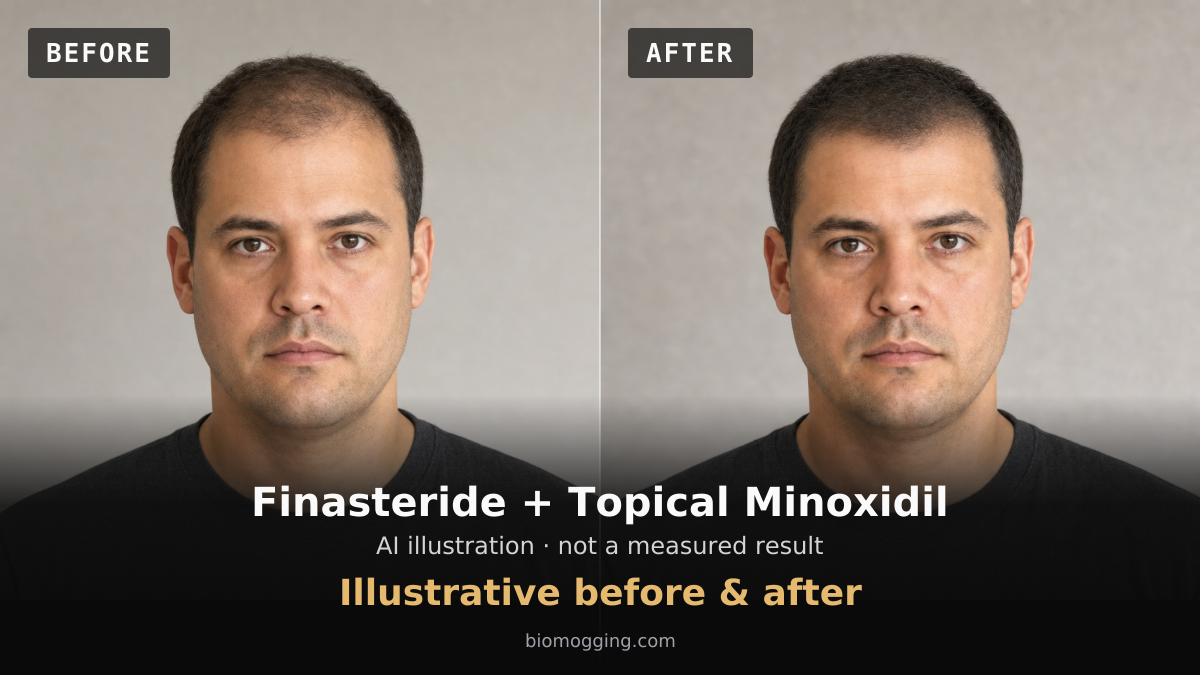
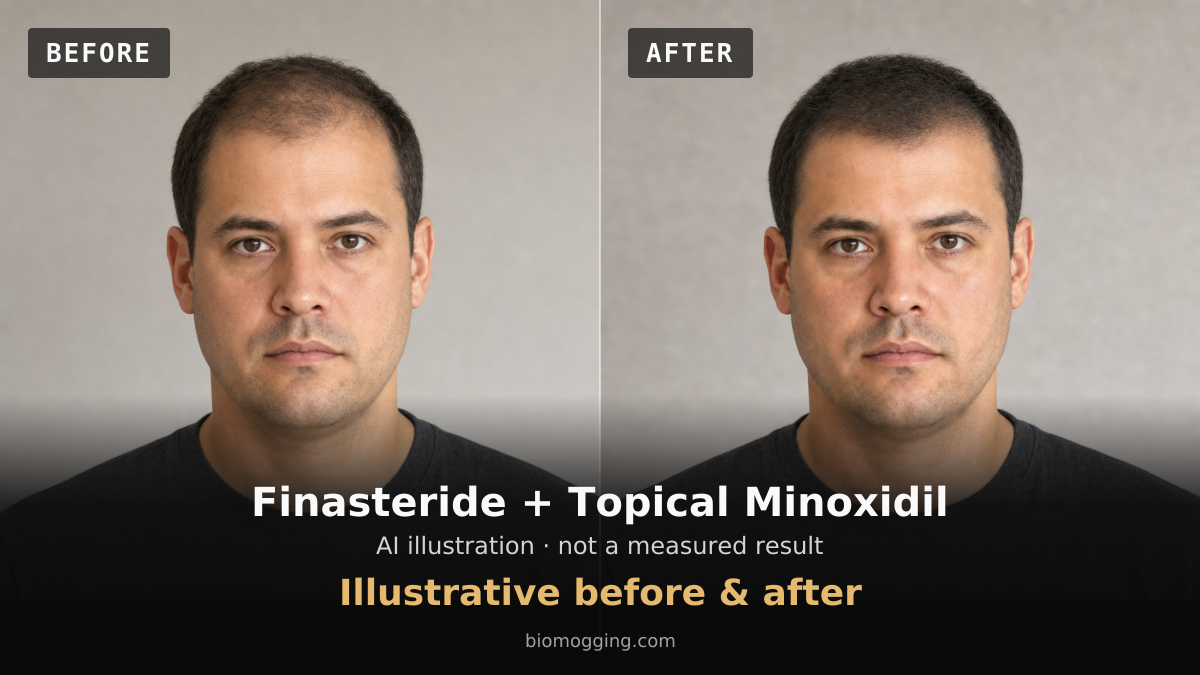
Composition: 2 Hair
Overview
This guide is for intermediate adult male users with prior experience in androgenetic alopecia management who are comparing oral prescription finasteride and men's 5% topical minoxidil solution, or evaluating their concurrent use. Prior experience with hair-loss interventions does not establish individual tolerance, justify exceeding product-specific label directions, or define a minimum effective total dose. Scope and Formulations: This comparison covers exclusively oral prescription finasteride tablets and men's 5% topical minoxidil scalp solution; oral minoxidil and topical finasteride formulations have distinct systemic exposure profiles, regulatory statuses, and risk considerations and are excluded from this protocol. Comparing Mechanisms and Evidence: Oral finasteride targets the androgen pathway by competitively inhibiting type II 5-alpha-reductase, reducing the conversion of testosterone to dihydrotestosterone (DHT). Topical minoxidil acts locally at the hair follicle through androgen-independent pathways involving vasodilation, potassium channel signaling, and modulation of hair cycle phases. While product-specific label directions are established for each single agent in DailyMed product labeling (record 1) and DailyMed product labeling (record 2), and a randomized comparison has evaluated treatment outcomes at a 12-month observation timepoint, none of these sources establishes a specialized combination dose, cross-compound ratio, or finite phase duration for concurrent use. Full numerical administration schedules are detailed in the phase protocols below.
Why this stack works
Pairwise Interactions and Pathway Assessment: Oral finasteride and topical minoxidil operate through distinct, non-overlapping physiological mechanisms—systemic and follicular type II 5-alpha-reductase inhibition versus local follicular cycle and vascular modulation. There is no established pharmacokinetic drug-drug interaction (such as hepatic enzyme inhibition or altered systemic clearance) or opposing receptor-level antagonism between the two compounds. Because their mechanisms address different contributors to follicular miniaturization, concurrent use is common in reported practice. What Can and Cannot Be Inferred from Single-Agent Data: From individual product labeling in DailyMed record 1 and DailyMed record 2, a reader can infer the labeled dosing route, administration frequency, and known adverse-effect profile of each standalone medication. However, single-agent data cannot establish a verified combination dose ratio, prove guaranteed synergy in an individual user, or predict whether concurrent initiation will complicate side-effect attribution. No supplied source establishes an altered dose, ratio, or fixed cycle length for the combination; consequently, the proposed schedule applies each compound's unmodified product-specific label directions rather than manufacturing a novel ratio. Endocrine Balance and Cumulative Risk Profile: Oral finasteride lowers systemic and scalp DHT without suppressing the hypothalamic-pituitary-gonadal (HPG) axis; luteinizing hormone and testosterone are not depleted, so post-cycle therapy (PCT) is not physiologically applicable. However, reduced androgen signaling and a modest shift toward testosterone aromatization into estradiol can contribute to sexual adverse effects (decreased libido, erectile or ejaculatory dysfunction), breast tenderness or gynecomastia, and mood changes. Simultaneously, men's 5% topical minoxidil solution carries local risks of scalp irritation, pruritus, flaking, or contact dermatitis (often linked to vehicle excipients such as propylene glycol and alcohol), as well as transient early hair shedding as telogen follicles synchronize. If topical minoxidil is overapplied or used on compromised scalp skin, increased systemic absorption can cause excessive vasodilatory effects, including dizziness, reflex tachycardia, palpitations, or fluid retention. Starting both compounds together does not create a known chemical interaction, but it can overlap early minoxidil scalp shedding or irritation with systemic finasteride monitoring. Distinguishing Exposure, Observation Checkpoints, and Prognosis: In hair-loss management, daily drug exposure must be distinguished from clinical observation checkpoints. The men's 5% topical minoxidil label specifies an early observation checkpoint at four months, directing men who see no hair regrowth at four months to stop use and ask a doctor (DailyMed record 1, DailyMed record 2). Similarly, a randomized comparison reported a 12-month assessment. That 12-month mark is a study follow-up observation time used to measure group outcomes, not a treatment completion date or a guaranteed individual prognosis. Insufficient duration or premature discontinuation leads to loss of effect, whereas excessive topical dosing increases systemic vasodilatory risk without established benefit. Conditional Support and Monitoring: No routine ancillary drugs are required. Conditional interventions consist of clinician-guided vehicle adjustment or gentle scalp care if topical irritation develops, and prompt medical reassessment or discontinuation if endocrine, sexual, mood, or cardiovascular symptoms arise. Adding extra compounds does not automatically resolve intolerance to either core agent.
Protocol timeline
2 phases · 52 weeks total
Timeline shows the 52-week cycle. Bars overlap when phases run concurrently. Click a bar to jump to its detail card.
The interactive timeline loads here. Phase details are available below.
For adult men with male-pattern hair loss, the prescription finasteride label gives 1 mg by mouth once daily. The men's 5% minoxidil solution label gives 1 mL on the affected scalp twice daily. Apply it to the scalp, wash hands afterward, and follow the product's drying instructions. Finasteride prescribing information · Minoxidil solution label
The calendar approximates four months. If you see no regrowth after four months of using this minoxidil product, its label directs you to stop using it and ask a doctor. The finasteride prescription has its own review plan.
For those continuing treatment with their clinician, the same product-specific directions apply during maintenance. A randomized study of oral finasteride and topical minoxidil assessed men at 12 months. That follow-up visit gives the calendar a useful review point. Maintaining benefit generally requires continued treatment beyond that date. Read the combination study
Compare photographs taken from the same angle and in the same light. Discuss tolerability and whether the treatment still meets your goals with the prescriber.
Compounds in this stack
2 linked · tap for full guide
How they work together
Multipliers applied to the projection above when these compounds run together. Values > 1 indicate a bonus, < 1 a penalty.
| Pair | Type | Lean | Fat loss | Recovery |
|---|---|---|---|---|
| synergistic | ×1.00 | ×1.00 | ×1.00 |
Conclusion
Comparing oral prescription finasteride and men's 5% topical minoxidil solution highlights two complementary, non-overlapping approaches to male androgenetic alopecia: systemic reduction of DHT via 5-alpha-reductase inhibition and local follicular stimulation at the scalp. While single-agent directions are established in DailyMed product labeling (record 1) and DailyMed product labeling (record 2), and clinical research includes a randomized comparison with a 12-month assessment, no supplied source defines a specialized combination ratio or finite treatment cycle. Users and reviewing clinicians should treat four-month and 12-month milestones strictly as observation checkpoints for tolerability and response rather than stop dates, recognizing that continued maintenance exposure is required to sustain any hair retention or regrowth achieved.
Women and Pregnancy: Oral finasteride is contraindicated in women who are or may potentially be pregnant because type II 5-alpha-reductase inhibitors can cause abnormalities of the external genitalia of a male fetus; pregnant women must also avoid handling crushed or broken finasteride tablets (DailyMed record 1, DailyMed record 2). Men's 5% topical minoxidil solution is labeled specifically for adult men and should not be used by women. Pediatric Users: Neither product is indicated for individuals under 18 years of age. Non-Androgenetic or Unexplained Hair Loss: Men with sudden, patchy, or unexplained hair loss, absence of a family history of gradual hair thinning, or hair loss accompanied by scalp redness, inflammation, infection, scaling, soreness, or scarring should avoid self-treatment and seek medical evaluation. Hypersensitivity and Medical Precautions: Individuals with known hypersensitivity to finasteride, minoxidil, or any formulation component (including propylene glycol or alcohol in topical solutions) must avoid the respective product. Men with underlying cardiovascular disease, arrhythmias, or symptomatic hypotension should consult a physician before using topical minoxidil due to potential systemic absorption, and men with hepatic impairment or undergoing prostate-specific antigen (PSA) screening require physician oversight before using oral finasteride, as finasteride lowers serum PSA levels.
Updated 2026-11-18