Semaglutide
Ozempic · Wegovy · Rybelsus · sema
Last updated
Available at NextGenPeps (US) — 10% off with BIOMOGGING
At a glance
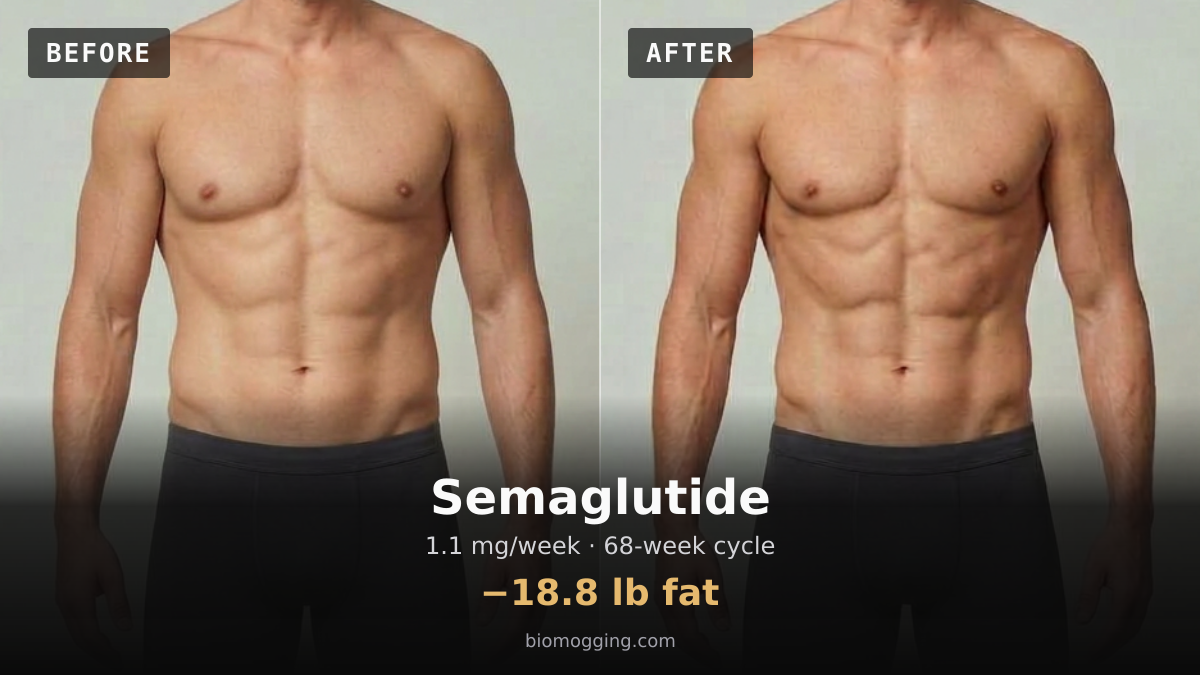
- Fat Loss
- 9/10
- Recovery
- 2/10
- Cognition
- 2/10
- Endurance
- 1/10
- Muscle Growth
- 0/10
- Strength
- 0/10
Overview
Why Semaglutide Became the Cutting Tool#
Semaglutide rewrote what a cut looks like. A once-weekly shot that quiets "food noise," crushes appetite, and produces ~15% body weight loss at 68 weeks in phase III trials (Wilding et al., 2021, NEJM) — with dose-escalated protocols pushing that to −18.7% (STEP UP, Lancet 2025). For physique-focused users, this is the first tool that makes a deep deficit feel manageable rather than miserable.
The community has moved well beyond the label. Bodybuilders run it at microdoses (0.1–0.5 mg weekly) to kill hunger on prep or control appetite during a GH/slin blast. Looksmaxxers use it indefinitely at cruise doses for lean recomp without willpower drain. Post-blast users clean up visceral fat and insulin resistance after heavy offseasons. It's non-hormonal, requires no PCT, works identically in men and women, and stacks cleanly with TRT, AAS, GH, and SARMs.
"Participants who received semaglutide lost a mean of 14.9% of body weight vs. 2.4% with placebo at 68 weeks, and nearly one-third achieved a weight reduction of at least 20%." — Wilding et al., 2021, NEJM
The catch is that semaglutide doesn't care whether the weight you lose is fat or muscle — that's on you. Run without a protein floor and a lifting stimulus and you'll end up lighter, softer, and flatter. Run it correctly and it's the most powerful appetite and metabolic tool available to a physique user.
Below we cover titration and dosing ladders, microdose vs. aggressive-cut protocols, stacking with AAS / GH / insulin, side effect management, muscle-sparing strategy, and the vendor tiers and bloodwork cadence that separate a clean run from a sloppy one.
How Semaglutide works
GLP-1 Receptor Agonism#
Semaglutide is a long-acting agonist at the GLP-1 receptor (GLP-1R), a Gαs-coupled GPCR expressed on pancreatic β-cells, hypothalamic neurons, the area postrema, vagal afferents, and gastric smooth muscle. The molecule is a 31-amino-acid analog of native GLP-1 with three structural modifications — an Aib substitution at position 8 that blocks DPP-4 cleavage, a C18 fatty diacid conjugated at Lys26 that drives reversible albumin binding, and a linker that optimizes receptor affinity. Together these turn a native peptide with a 2-minute half-life into a weekly injectable.
Activation of GLP-1R raises intracellular cAMP, which drives the downstream cascade the user actually cares about: glucose-dependent insulin secretion, glucagon suppression, delayed gastric emptying, and central appetite suppression.
Central Appetite Suppression ("Food Noise")#
The dominant mechanism behind the physique-relevant effects isn't peripheral — it's central. Semaglutide reaches hypothalamic GLP-1R populations (POMC/AgRP neurons) and hindbrain centers (area postrema, NTS), where it drives satiety signaling and blunts reward-based food cue responses. This is the "food noise goes quiet" experience users describe — reduced hedonic drive to eat, not just physical fullness.
"Semaglutide displayed low Kp values (<0.01) in the whole brain, yet hypothalamic concentrations were sufficient to drive central appetite-suppressive effects." — Park EJ, Shin BS, et al., Journal of Chromatography B, 2023
Practical outcome: the deficit enforces itself. A 300–500 kcal cut that required constant willpower suddenly requires none, which is why even microdoses (0.1–0.25 mg weekly) work for lean recomp users who don't need aggressive fat loss.
Delayed Gastric Emptying#
GLP-1R activation on gastric smooth muscle slows the rate at which food leaves the stomach. This produces prolonged mechanical satiety and flattens postprandial glucose excursions — but it's also the source of most early-cycle side effects (nausea, reflux, "sulfur burps," early fullness that makes hitting protein targets harder). The effect partially tachyphylaxes over 4–8 weeks at a fixed dose, which is why stretched titration beats label titration for most physique users.
Glucose-Dependent Insulinotropic Action#
At the pancreatic β-cell, semaglutide potentiates insulin secretion only when blood glucose is elevated — the effect switches off at euglycemia. It simultaneously suppresses α-cell glucagon output. This glucose-dependence is why monotherapy carries near-zero hypoglycemia risk, and why semaglutide pairs cleanly with a GH/slin stack: it improves insulin sensitivity and blunts GH-induced hyperglycemia without stacking hypoglycemic risk onto exogenous insulin (though insulin doses still need to come down on the combo).
Pharmacokinetic Profile Driving Weekly Dosing#
The fatty-acid-mediated albumin binding does two things: it shields the peptide from renal clearance and proteolytic degradation, and it creates a slow-release depot in circulation. The result is a terminal half-life of roughly a week and steady-state reached in 4–5 weeks at any fixed dose — meaning you don't judge a dose tier until you've held it at least a month.
"Semaglutide shows a long terminal half-life of 155 to 184 hours after subcutaneous administration in humans, supporting the rationale for once-weekly dosing." — Yang Y, Yang R., Drug Design, Development and Therapy, 2024
Subcutaneous bioavailability sits around 89%, with Tmax at 1–3 days post-injection. Clearance is via proteolytic cleavage and β-oxidation of the fatty acid chain, with no meaningful renal or hepatic dependence — which is why dose adjustments aren't needed for impaired organ function, and why the washout before conception is a full 2+ months.
Cardiometabolic Effects#
Beyond fat loss, GLP-1R signaling produces durable improvements in lipids, blood pressure, CRP, and endothelial function. In high-risk diabetic populations, this translates into a significant reduction in major adverse cardiovascular events.
"The rate of the primary outcome (MACE) was significantly lower in the semaglutide group than in the placebo group, indicating a cardioprotective benefit." — Marso SP, Bain SC, Consoli A, et al., New England Journal of Medicine, 2016
For the bodybuilding and looksmaxxing audience, the practical read is that a low "cruise" dose (0.25 mg weekly) run between blasts actively cleans up the lipid panel, visceral fat, and insulin sensitivity hits that accumulate on heavy AAS runs — making semaglutide one of the few metabolic tools that's genuinely additive to a long-term PED protocol rather than just a cutting aid.
Protocol
| Level | Dose | Frequency | Notes |
|---|---|---|---|
| Low | 0.25–0.5 mg | Weekly | Documented entry-level range |
| Mid | 0.5–1.7 mg | Weekly | Most commonly studied range |
| High | 1.7–2.4 mg | Weekly | Once-weekly SC injection, same day each week. Many users inject at night to sleep through peak nausea. Microdose starters often run 0.1–0.15mg weekly for 2–4 weeks before stepping to 0.25mg. Steady state reached in 4–5 weeks at a fixed dose. |
Available at NextGenPeps (US) — 10% off with BIOMOGGING
Cycle length & outcomes
Documented cycle
12–68 weeks
Plateau after
68 wks
Cycle Structure#
Semaglutide is run continuously, not cycled. There's no HPTA suppression, no receptor desensitization worth tapering around, and steady state takes 4–5 weeks at any fixed dose — meaning every time you change dose, you're waiting over a month to see the real effect. Patience is the protocol.
The label titration (Wegovy) is aggressive by design — pharma wanted STEP 1 numbers, not a tolerable ramp. Physique-focused users almost universally stretch the titration and often cap well below 2.4 mg.
Dose Ladder by Goal#
| Goal | Cycle Length | Weekly SC Dose | Titration |
|---|---|---|---|
| Microdose recomp / appetite control | 6–12 months+ | 0.10–0.25 mg | Hold at first effective dose |
| Lean cut (10–15 lb) | 16–20 weeks | 0.25 → 0.5 → 1.0 mg | Step every 4–6 weeks |
| Aggressive cut (>15% BW) | 32–68 weeks | 0.25 → 0.5 → 1.0 → 1.7 → 2.4 mg | Step every 4–6 weeks |
| On-cycle appetite mgmt (AAS/GH/slin) | Blast duration | 0.25–0.5 mg | Hold; no escalation needed |
| Post-blast metabolic reset | 12–20 weeks | 0.25–1.0 mg | Step every 4 weeks |
| Longevity / cardiometabolic | Indefinite | 0.25 mg | No escalation |
Onset & Expectations#
- Week 1–2: appetite suppression and "food noise" quieting kicks in within 48–72 hours of the first 0.25 mg injection. GI side effects (nausea, reflux, sulfur burps) peak here.
- Week 4–6: steady state at the starting dose. If appetite control has faded, step up; if it's still working, hold.
- Week 8–12: fat loss trajectory becomes clear. Expect 0.6–1.2 lb/week at 0.5–1.0 mg with a structured deficit and lifting.
- Week 20+: plateau territory. Either step up one tier or accept maintenance.
"Participants who received semaglutide lost a mean of 14.9% of body weight vs. 2.4% with placebo at 68 weeks, and nearly one-third achieved a weight reduction of at least 20%." — Wilding et al., 2021, NEJM
"Mean weight loss at week 68 was −18.7% in the 7.2 mg group versus −2.1% in the placebo group, confirming additional efficacy at higher doses." — Wadden et al., 2025, Lancet
Those are 68-week numbers. Anyone expecting 15% loss by week 12 is going to over-titrate and end up vomiting at 2.4 mg with nothing to show for it.
Loading & Tapering#
Loading: none. The long half-life means a 0.25 mg starting dose takes ~4 weeks to reach steady state regardless of how you front-load — and front-loading just buys worse GI side effects. Start low, ramp slow.
"Semaglutide shows a long terminal half-life of 155 to 184 hours after subcutaneous administration in humans, supporting the rationale for once-weekly dosing." — Yang & Yang, 2024, DDDT
Tapering off: yes, do this. Stopping cold from 1–2.4 mg produces a sharp appetite rebound around week 3–4 post-last-injection (when serum levels finally drop below effect threshold), and most of the weight comes back within a year in unsupported users. Standard taper:
- Drop one dose tier every 4–6 weeks.
- Final step is typically 0.25 mg weekly for 4–8 weeks before stopping.
- Keep the lifting and protein floor in place through the entire taper and for at least 6 months after.
Many users skip the full taper and simply cruise indefinitely at 0.125–0.25 mg — cheapest, simplest, and keeps appetite quiet without any meaningful side effect profile.
Injection Timing & Day#
- Same day each week, ±2 days tolerance before you're meaningfully off schedule.
- Night injections (Friday or Saturday evening) are community standard — peak nausea at 24–48 hours lands during sleep and the weekend.
- SC into abdomen, thigh, or deltoid; rotate sites. Site doesn't meaningfully change PK.
- If you miss a dose: inject within 5 days of the scheduled day; beyond that, skip and resume the normal schedule.
Bloodwork Cadence#
| Timepoint | Panel |
|---|---|
| Baseline | CMP, lipids, HbA1c, fasting insulin, TSH, lipase |
| Week 12 | CMP, lipids, HbA1c, fasting insulin |
| Week 24 | Full repeat + body comp (DEXA if available) |
| Annually | Full repeat |
| Symptomatic | Lipase (epigastric pain), gallbladder US (RUQ pain) |
If you're stacking on AAS/GH, keep your usual LH/FSH/E2/total+free test panel on its existing cadence — semaglutide doesn't move those markers.
"The rate of the primary outcome (MACE) was significantly lower in the semaglutide group than in the placebo group, indicating a cardioprotective benefit." — Marso et al., 2016, NEJM (SUSTAIN-6)
Most users see HbA1c drop 0.3–0.8 points, fasting insulin cut in half, and triglycerides fall 20–30% by the 12-week recheck even without hitting goal weight yet — the metabolic improvements front-run the scale.
Pre-Conception Washout#
Hard rule for anyone trying to conceive (male or female): stop ≥2 months before conception. With a 7-day half-life, five half-lives puts you at ~5 weeks for near-complete clearance; the label builds in a margin. Plan cycles around this if a pregnancy is anywhere on the horizon.
Risks & mistakes
Common (most users)#
Nearly all of these are titration-phase effects driven by delayed gastric emptying. They peak 24–72 hours post-injection and fade within 1–2 weeks at a stable dose.
- Nausea (~44% in STEP 1) — inject at night, eat lighter and more frequent meals on injection day, cut fat and fiber load post-injection. If it's breaking your diet, drop back one dose tier and hold 4–6 more weeks before re-escalating.
- Diarrhea / constipation (~24–30%) — hydrate aggressively (most users are under-drinking because appetite for everything drops, including water), add 10–15g soluble fiber (psyllium), magnesium citrate 400mg at night for constipation.
- Vomiting (~24%) — usually from eating past the new, lower satiety ceiling. Stop eating when you're 70% full, not when the plate is empty. Persistent vomiting at a given dose = drop a tier.
- Sulfur burps / reflux — classic semaglutide signature from slowed gastric emptying. PPI or famotidine for the first 2–4 weeks of each dose step handles it.
- Early satiety / "food noise" shutdown — expected and the whole point, but it also means you'll under-eat protein if you don't plan. Front-load protein at breakfast when appetite is highest. Shake it if you have to.
- Fatigue / flat training — partially from the caloric deficit, partially transient. Creatine, adequate sodium, and not letting the deficit exceed ~500 kcal below maintenance fixes most of it.
- Injection site reactions — minor welts, itching. Rotate between abdomen, thigh, and upper arm. Let reconstituted vials come to room temp for 10 min before injecting.
"Participants who received semaglutide lost a mean of 14.9% of body weight vs. 2.4% with placebo at 68 weeks, and nearly one-third achieved a weight reduction of at least 20%." — Wilding JPH et al., NEJM (2021)
Uncommon (dose-dependent or individual)#
- Lean mass loss — not a drug effect, a deficit effect. Non-trainers on 2.4 mg lose 25–40% of total weight as lean mass; trained users with 1g/lb LBM protein keep it under 10–15%. If your scale weight is dropping but your lifts are tanking, you're losing muscle — slow the loss rate, raise protein, audit training volume.
- Transient HR increase (2–4 bpm) — usually asymptomatic. If resting HR jumps >10 bpm or you're getting palpitations, back off dose.
- "Ozempic face" / volume loss — rapid fat loss empties the buccal and periorbital fat pads. Mitigated by slower loss rate (aim ≤1% body weight per week), adequate protein, and resistance training. HA filler if the aesthetic trade-off isn't worth it.
- Gallbladder events (cholelithiasis, ~1–2% in STEP trials) — rapid weight loss does this independent of the drug. Right-upper-quadrant pain after fatty meals = image. Slower titration lowers risk.
- Persistent delayed gastric emptying — relevant for elective surgery and anesthesia. Hold the injection for at least 1 week pre-op and inform the anesthesiologist.
- Hypoglycemia — not from semaglutide alone (insulin release is glucose-dependent) but real when stacked with exogenous insulin or sulfonylureas. Check glucose, drop the insulin dose, don't stack with rapid-acting insulin on fasted training days without experience.
- Bloodwork to watch — baseline and 12-week CMP, lipase, HbA1c, fasting insulin, lipids, TSH. Lipase only if symptomatic.
Rare but serious#
- Acute pancreatitis — signal is weak in large trials but real enough to stop everything. Warning signs: severe persistent epigastric pain radiating to the back, nausea/vomiting that doesn't track with the normal injection cycle. Stop immediately, get lipase and imaging.
- Severe gastroparesis / gastric retention — beyond the normal delayed-emptying effect. Persistent early satiety with vomiting of undigested food days after eating. Stop and image.
- Acute gallbladder disease requiring cholecystectomy — continuation of the rapid-weight-loss gallstone risk above.
- Diabetic retinopathy progression — documented in SUSTAIN-6 in diabetic users with pre-existing retinopathy and rapid glucose correction; not relevant to non-diabetic lean users, but worth knowing if you have diabetic retinopathy at baseline.
- Suicidal ideation — reported in post-marketing surveillance, currently under investigation, no clear causal signal in RCTs. If mood shifts significantly, stop.
"The rate of the primary outcome (MACE) was significantly lower in the semaglutide group than in the placebo group, indicating a cardioprotective benefit." — Marso SP et al., NEJM (2016)
The cardiovascular signal runs the other direction — net cardioprotective in high-risk populations.
Hard contraindications#
- Personal or family history of medullary thyroid carcinoma (MTC) — do not use. Rodent C-cell tumor signal; human relevance unclear but the line doesn't get crossed.
- MEN-2 syndrome — do not use.
- History of pancreatitis — do not use.
- Pregnancy, active trying-to-conceive, or lactation — do not use. The ~7-day half-life means a ≥2-month washout before conception is required for both partners running it. This is not negotiable.
- Severe baseline gastroparesis — do not use.
- Stacking with rapid-acting insulin on fasted training days without tight glucose monitoring — the combined delayed gastric emptying plus insulin action produces unpredictable glucose curves. Lower insulin doses, eat, glucose meter on hand.
- Dose titration faster than label — not a contraindication but a self-sabotage line. The people who fail semaglutide protocols almost all failed at the titration step.
Gender, pregnancy, and PCT#
Semaglutide is non-hormonal. No virilization risk, no HPTA suppression, no PCT required. Dosing is identical for men and women. It runs continuously alongside TRT, AAS, GH, insulin, and SARMs without interfering with any of them.
The pregnancy line is the only gender-specific hard stop: the ~7-day half-life (155–184 hours) means the drug is still measurable in plasma over a month after the last injection, so the standard community practice is a 2-month minimum washout before TTC for women, and the same for men out of caution given incomplete reproductive data.
"Semaglutide shows a long terminal half-life of 155 to 184 hours after subcutaneous administration in humans, supporting the rationale for once-weekly dosing." — Yang Y, Yang R., Drug Design, Development and Therapy (2024)
Discontinuation is not abrupt — taper by 0.5 mg steps every 4–6 weeks to blunt the appetite rebound and regain that follows cold-turkey stops.
Stack & combine
Multipliers applied when these compounds run together. Values > 1 indicate a bonus on that axis. Tap a partner to expand the mechanism.
| Partner | Type | Lean | Fat loss | Recovery |
|---|---|---|---|---|
| synergistic | ×1.05 | ×1.23 | ×1.00 | |
| synergistic | ×1.10 | ×1.22 | ×1.05 | |
| synergistic | ×1.08 | ×1.22 | ×1.05 | |
| synergistic | ×1.05 | ×1.22 | ×1.00 | |
| synergistic | ×1.15 | ×1.22 | ×1.05 | |
| synergistic | ×1.00 | ×1.18 | ×1.00 | |
| synergistic | ×1.15 | ×1.18 | ×1.10 | |
| synergistic | ×1.08 | ×1.18 | ×1.05 | |
| synergistic | ×1.00 | ×1.17 | ×1.00 | |
| synergistic | ×1.00 | ×1.15 | ×1.00 | |
| synergistic | ×1.15 | ×1.10 | ×1.05 | |
| additive | ×1.00 | ×1.04 | ×1.00 |
FAQ — Semaglutide
Where to buy Semaglutide

NextGenPeps
10% off — use code at checkout
You'll also need
- Bacteriostatic waterReal PeptidesBuy · 20% off
- Bacteriostatic waterNextGenPepsBuy · 10% offUse code at checkout
- Bacteriostatic waterSwiss ChemsBuy · 10% off
- Sterile waterSwiss ChemsBuy · 10% off
- Spray bottle 10 mlSwiss ChemsBuy · 10% off
- Acetic acid 0.6% solution 10 mlSwiss ChemsBuy · 10% off
Research & citations
5 studies cited on this page.
Conclusion
Semaglutide is the heavy hitter for real, sustained fat loss — if you respect the protocol, it works on hunger and stubborn body comp in a way few compounds can touch.
Key takeaways:
- Starting dose: 0.1–0.25 mg SC weekly; increase only if appetite returns or sides fade
- Titration: Stretch each step (0.25 → 0.5 → 1.0 mg weekly) for 4–8 weeks; aggressive cuts may reach 1.7–2.4 mg, but most physique-focused users never need >1 mg
- Route: SubQ injection preferred for stable absorption and easy microdosing
- Stacks well with: TRT, AAS, GH, insulin, metformin, and classic cutting protocols — just keep protein ≥1 g/lb LBM and train to keep muscle
- Headline benefit: Consistent fat loss (0.7–0.8 lb/week even in leaners), drastic appetite suppression, and proven cardiometabolic upside12
- Side effect control: Slower titration and nighttime injections beat nausea for most; taper slowly to prevent appetite rebound
If you want a tool to make the deficit genuinely easy — for a brutal cut or just to kill food noise — semaglutide is about as close to "willpower in a syringe" as it gets when paired with lifting and proper protocol.
Similar compounds
Comparisons
Rankings
Disclosures
Affiliate links — we may earn a commission at no cost to you.