Tesamorelin + Ipamorelin
Tesa/Ipa · Tes+Ipa · GHRH + GHRP stack · Egrifta + Ipamorelin
Last updated
Available at Real Peptides (US) — 20% off auto-applied
At a glance
- Recovery
- 7/10
- Fat Loss
- 6/10
- Muscle Growth
- 3/10
- Cognition
- 3/10
- Endurance
- 2/10
- Strength
- 1/10
Overview
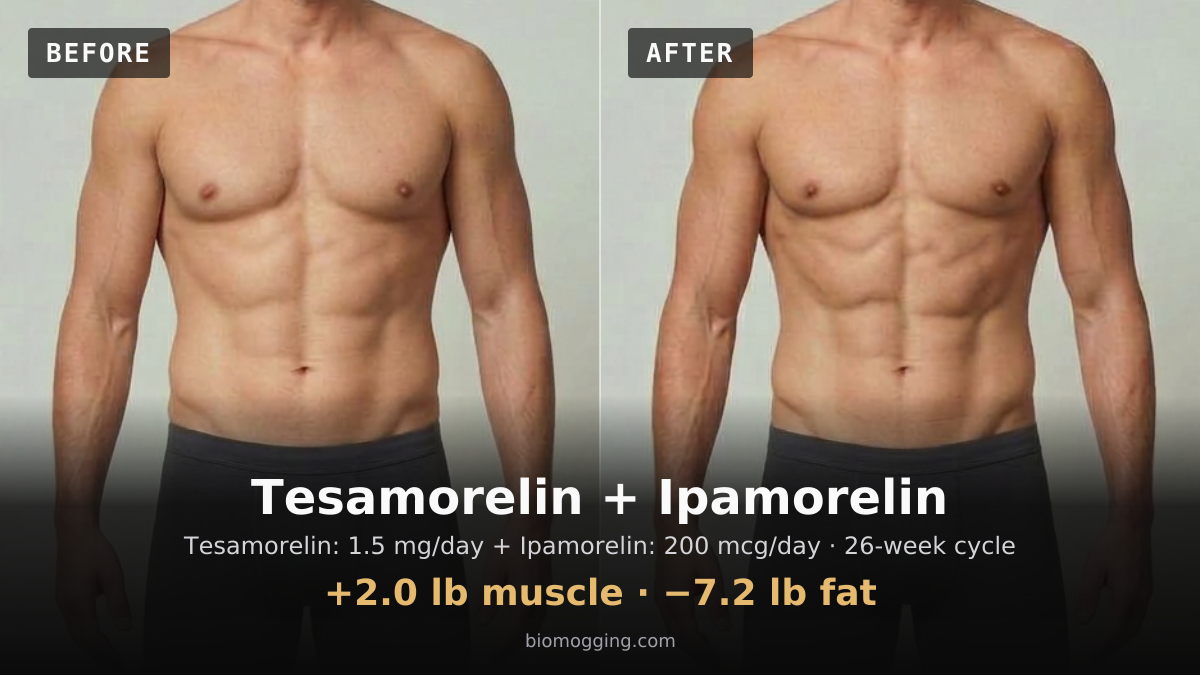
Tesamorelin + ipamorelin has quietly become the thinking person's GH-axis stack — the protocol physique-focused users reach for when the goal is visceral fat reduction, IGF-1 elevation, and recovery without the water retention, joint puffiness, and "GH gut" that higher-dose rhGH protocols produce. Tesamorelin is the only GHRH analog with a Phase III evidence base specifically showing preferential loss of visceral adipose tissue while sparing subcutaneous fat, and ipamorelin is the cleanest ghrelin-receptor agonist ever published — selective for GH release, with no meaningful elevation of cortisol, ACTH, or prolactin. Together they drive a larger, more physiologic GH pulse than either compound run alone.
The appeal cuts across several personas. Recomp-focused users run it for the VAT effect on top of a deficit. Bodybuilders and lifters add it on a TRT cruise or at the tail of a blast for joint, tendon, and sleep-quality support. Looksmaxxers and longevity-layer users pick it over rhGH for skin and connective-tissue benefits without the coarsened, fluid-retentive aesthetic. Guys stacking GLP-1 agonists like semaglutide or tirzepatide use it to preserve lean mass and bias fat loss toward the midsection. The shared logic: pulsatile endogenous GH release through two complementary receptors, at doses supported by actual pharmacology.
"Tesamorelin consistently reduced VAT and increased IGF-I concentrations over 26 weeks of treatment, with most adverse events being mild and related to injection sites." — Falutz et al., J Clin Endocrinol Metab (2010)
The sections below cover the mechanism of synergy between GHRH analogs and GHRPs, full dosing ladders for both compounds, the pre-bed fasted protocol that anchors the pulse, stacking logic with TRT and GLP-1s, reconstitution and storage (tesamorelin is notoriously finicky), side-effect management, IGF-1 monitoring targets, and how this stack compares to rhGH, CJC-1295/ipamorelin, and MK-677.
How Tesamorelin + Ipamorelin works
GHRH Receptor Activation (Tesamorelin)#
Tesamorelin is a stabilized analog of human growth-hormone-releasing hormone (GHRH 1-44). The trans-3-hexenoyl modification at the N-terminus blocks cleavage by dipeptidyl-peptidase IV (DPP-IV), the enzyme that degrades native GHRH within minutes in plasma. This gives tesamorelin a meaningfully longer residence time and a cleaner pituitary signal than endogenous GHRH.
Once it binds the GHRH receptor — a class B GPCR expressed on anterior-pituitary somatotrophs — it elevates intracellular cAMP via Gαs/adenylyl cyclase, activates PKA, and triggers vesicular GH exocytosis. The pulse is pulsatile, not tonic, so hypothalamic feedback and somatostatin tone remain intact.
"Tesamorelin displays a longer plasma half-life than native GHRH(1-44), owing to the N-terminal modification that confers resistance to dipeptidyl-peptidase IV." — Ishida J. et al., JCSM Rapid Communications, 2020
The practical downstream effect — the reason physique-focused users run it — is preferential visceral adipose tissue (VAT) reduction with subcutaneous fat preserved, driven by sustained IGF-1 elevation over 12–26 weeks.
"Tesamorelin treatment was associated with a significantly greater reduction in visceral adipose tissue (VAT) than placebo, while subcutaneous abdominal fat was preserved." — Falutz J. et al., New England Journal of Medicine, 2007
Ghrelin Receptor Agonism (Ipamorelin)#
Ipamorelin is a pentapeptide selective agonist of the growth-hormone-secretagogue receptor (GHS-R1a) — the endogenous receptor for ghrelin, also expressed on somatotrophs. Activation signals through Gq/phospholipase-C, liberating IP₃ and driving intracellular Ca²⁺ release, which triggers GH vesicle exocytosis through a mechanism distinct from GHRH's cAMP pathway.
The defining feature of ipamorelin — and the reason it displaced GHRP-2, GHRP-6, and hexarelin in long-term protocols — is its receptor selectivity. It releases GH without meaningfully activating the ACTH/cortisol or prolactin axes, even at high multiples of its GH-effective dose.
"Ipamorelin, in a dose up to 200 times its ED50 for GH release, had no effect on plasma ACTH or cortisol levels... thereby offering the first example of a truly selective GH secretagogue." — Raun K. et al., European Journal of Endocrinology, 1998
For the physique and looksmaxxing audience this matters directly: chronic GHRP use that elevates cortisol is counterproductive for body composition, sleep quality, and connective-tissue health. Ipamorelin sidesteps that problem.
GHRH + GHRP Synergy#
The clinical logic of pairing tesamorelin and ipamorelin rests on pharmacologic synergy, not additive dosing. The two compounds hit different receptors with different second-messenger systems (cAMP/PKA from the GHRH-R vs Ca²⁺/IP₃ from the GHS-R1a), and ghrelin-receptor agonism simultaneously suppresses somatostatin tone — the brake that normally blunts GHRH-driven pulses.
The result is a GH pulse substantially larger than either compound delivers alone.
"The peak GH response after simultaneous administration of GHRP and GHRH was markedly greater than that after either peptide alone, indicating strong synergy between these mechanisms." — Bowers CY. et al., Journal of Clinical Endocrinology & Metabolism, 1990
Practically, this means a combined pre-bed SC shot produces a larger, cleaner nocturnal GH pulse than a 2 mg tesamorelin monotherapy dose at the same price point for ipamorelin. It is the core reason the blend has displaced CJC-1295 + ipamorelin in informed community protocols.
Downstream IGF-1 and Body Composition Effects#
GH released from the pituitary pulse drives hepatic IGF-1 synthesis, which is the mediator of most of the physique-relevant downstream effects: lipolysis in visceral adipocytes, connective-tissue collagen turnover, dermal thickness, and anabolic support at the muscle level. IGF-1 rises progressively over the first 1–2 weeks of a protocol and reaches a new steady state that is then maintained across the cycle.
"Tesamorelin consistently reduced VAT and increased IGF-I concentrations over 26 weeks of treatment, with most adverse events being mild and related to injection sites." — Falutz J. et al., Journal of Clinical Endocrinology & Metabolism, 2010
The key design feature: because GH is released in discrete pulses that clear within 2–3 hours, the axis is never exposed to the continuous supraphysiologic GH levels produced by 4–6 IU rhGH protocols. This is why the stack produces VAT reduction and connective-tissue support without the classic "GH face," water retention, and carpal-tunnel complaints associated with higher-dose rhGH.
Preservation of Pulsatility and Sleep Architecture#
Native GH release is pulsatile, with the largest physiologic pulse occurring in early slow-wave sleep. Both compounds are timed pre-bed specifically to amplify the natural nocturnal pulse rather than replace it, which keeps hypothalamic–pituitary feedback loops intact and avoids the pituitary desensitization seen with continuous GHRP infusion.
Subjective improvements in deep-sleep quality and recovery — the most commonly reported effect among users running the stack — likely reflect this reinforced slow-wave GH pulse rather than a direct CNS action of either peptide. For lifters this translates into better overnight recovery; for the broader looksmaxxing audience it shows up as dermal collagen support, improved skin quality, and the slow VAT recomposition that defines this stack's niche.
Protocol
Tesamorelin + Ipamorelin contains 2 peptides.
| Peptide | Dose / administration | Frequency | Half-Life | Vial |
|---|---|---|---|---|
Tesamorelin Tesamorelin is a stabilized GHRH (growth hormone-releasing hormone) analog that binds to and activates GHRH receptors in the anterior pituitary, triggering a natural pulse of endog... | 1–2 mg | Once daily | ~30–40MIN | 2 mg |
Ipamorelin Ipamorelin is a selective ghrelin-receptor (GHS-R1a) agonist (GHRP) that stimulates the pituitary to release GH via distinct intracellular pathways from GHRH, with minimal impact o... | 100–300 mcg | Once daily | ~2HR | 2 mg |
Reconstituting a blend vial? Use the peptide calculator → — component names and known vial amounts are prefilled. Check your vial label and enter your dose.
Available at Real Peptides (US) — 20% off auto-applied
Cycle length & outcomes
Documented cycle
12–26 weeks
Plateau after
26 wks
Cycle Length & Protocol Design#
Unlike AAS or SARMs, the tesamorelin + ipamorelin stack isn't cycled for HPTA recovery — there is nothing to recover. It's cycled around IGF-1 saturation, receptor sensitivity, and the biological timeline of visceral fat loss. The Phase III tesamorelin data shows VAT response building steadily over 26 weeks, with IGF-1 plateauing by roughly week 2 and holding through the full treatment window.
"Tesamorelin consistently reduced VAT and increased IGF-I concentrations over 26 weeks of treatment, with most adverse events being mild and related to injection sites." — Falutz et al., J Clin Endocrinol Metab (2010)
That 26-week figure is the ceiling most protocols respect. Shorter blocks (8–12 weeks) are valid for recovery-focused or recomp-layer use; the full 16–26 week block is what the VAT literature actually supports.
Dose Ladder by Goal#
| Goal | Cycle Length | Tesamorelin | Ipamorelin | Timing |
|---|---|---|---|---|
| Recovery / connective tissue | 8–12 weeks | 1 mg | 200 mcg | Pre-bed, fasted ≥2 h |
| Sleep / longevity layer (40+) | 12–16 weeks, 5-on/2-off | 1 mg | 200 mcg | Pre-bed |
| Skin / collagen looksmaxxing | 12–16 weeks | 1 mg | 200 mcg | Pre-bed |
| VAT reduction (standard) | 16–26 weeks | 2 mg | 200–300 mcg | Pre-bed, fasted |
| VAT reduction (aggressive) | 16–26 weeks | 1 mg AM + 1 mg PM | 200–300 mcg × 2–3/day | Spaced ≥3 h, each fasted ≥2 h |
| GLP-1 co-run (recomp) | 12–20 weeks | 1–2 mg | 200 mcg | Pre-bed |
| TRT cruise bridge | 12–20 weeks | 1 mg | 200 mcg | Pre-bed |
The pre-bed fasted pulse is the non-negotiable slot across every protocol — it stacks the induced GH release on top of the endogenous nocturnal pulse and the deep-sleep window. Additional daytime ipamorelin pulses are layered on top of that anchor, never instead of it.
Loading, Tapering & Onset#
No loading phase is required. Both peptides reach effective plasma concentration within 15–30 minutes of a subcutaneous shot, and IGF-1 begins climbing from the first week. No taper is required at cycle end either — there is no suppression of endogenous GHRH or ghrelin signaling to reverse, and IGF-1 returns to baseline within 1–2 weeks of discontinuation.
Onset timeline by effect:
- Sleep depth / recovery: nights 3–10. Often the first thing users notice.
- Skin / nail quality: weeks 3–6.
- Joint and tendon comfort: weeks 4–8.
- IGF-1 plateau: ~week 2, per the Falutz pooled analysis.
- VAT / waist circumference reduction: measurable by week 12, still progressing through week 26.
Chasing visible midsection change at week 4 is the most common reason users quit the stack prematurely. The data is explicit: this is a 12-week read minimum, a 26-week read ideally.
Bloodwork Cadence#
This is one of the few GH-axis protocols where labs meaningfully guide dose titration. Skipping them means flying blind on a compound that has a specific target window.
| Marker | Baseline | Week 6–8 | End of cycle |
|---|---|---|---|
| IGF-1 | ✓ | ✓ | ✓ |
| Fasting glucose | ✓ | ✓ | ✓ |
| HbA1c | ✓ | — | ✓ |
| Fasting insulin (optional) | ✓ | ✓ | ✓ |
| Lipid panel | ✓ | — | ✓ |
IGF-1 target: upper tertile of the age-matched reference range — typically 220–280 ng/mL for a healthy adult male, not above. Elevations pushing past ~350 ng/mL indicate the dose is too high; drop tesamorelin by 0.5 mg or remove a daytime ipamorelin pulse. IGF-1 drifting in the mid-reference range on a 2 mg protocol usually means underdosed or degraded tesamorelin — a live in-vivo assay of peptide authenticity.
Glucose drift of 5–10 mg/dL on fasting glucose is expected and physiologic on any GH-elevating protocol. A jump of 15+ mg/dL, or HbA1c moving past 5.7, is a signal to lower the tesamorelin dose or layer low-dose metformin rather than push through.
Cycle-Off Strategy#
Between blocks, a 4-week washout is the standard reset for users who want to cycle. Longevity-oriented protocols at 1 mg + 200 mcg run continuously or on 5-on/2-off schedules without evidence of receptor desensitization at these doses — the selective, pulsatile pharmacology is specifically what allows long runs without tachyphylaxis, in contrast to continuous exogenous rhGH.
"Ipamorelin, in a dose up to 200 times its ED50 for GH release, had no effect on plasma ACTH or cortisol levels... thereby offering the first example of a truly selective GH secretagogue." — Raun et al., Eur J Endocrinol (1998)
That selectivity is what makes long protocols viable. Run the block, hit the IGF-1 target, let the VAT data build over 16–26 weeks, and retest labs before deciding whether the next block is a repeat, a dose reduction, or a rotation to a different recovery-layer stack.
Risks & mistakes
Common (most users)#
- Injection-site erythema, itching, or a small welt — the most reported effect in the tesamorelin Phase III data (Falutz 2010). Rotate abdominal SC sites, reconstitute fresh, use a 29–31g insulin pin, and let the solution reach room temperature in the syringe before injection.
- Head-rush, flushing, or mild head pressure 10–30 min post-injection — an ipamorelin signature, dose-dependent, and almost always fades over the first 1–2 weeks. If it doesn't settle, drop the ipamorelin dose from 300 µg to 200 µg.
- Transient hunger after the pre-bed shot — ghrelin-receptor agonism. Milder than GHRP-6/GHRP-2 but real. The ≥2 h fasted window before injection is non-negotiable; a small protein-only snack can be used if sleep is being wrecked.
- Vivid dreams and deeper sleep — not an adverse effect for most, but disorienting for some in week one. Usually welcomed; no mitigation needed.
- Mild water retention / ring-tight fingers in the first 2–3 weeks — a standard GH-axis adaptation as IGF-1 climbs. Self-resolves. If it persists past week 4, the tesamorelin dose is too high for the individual.
- Peripheral paresthesia (tingling in hands or feet) — documented in the tesamorelin label population. Mild and transient at 1–2 mg. Worsening tingling = signal to drop dose.
Uncommon (dose-dependent or individual)#
- Arthralgia / joint achiness — typically wrists and small joints, an IGF-1-driven fluid effect. Responds to a dose reduction (2 mg → 1 mg tesamorelin, or split AM/PM dosing) rather than stopping outright.
- Fasting glucose drift and HbA1c creep — physiologically expected from any GH-elevating protocol. Check fasting glucose, insulin, and HbA1c at baseline, ~8 weeks, and end-of-cycle. Low-dose metformin is the standard community layer if fasting glucose trends above ~100 mg/dL on protocol.
- Carpal-tunnel-type symptoms — numbness, weak grip, nocturnal wrist pain. Almost always signals IGF-1 sitting too high; pull a lab, drop the dose, symptoms reverse within 1–2 weeks.
- Peripheral edema — mostly ankles, more common in heavier subjects and at the 2 mg tesamorelin dose. Managed with dose reduction; no diuretic required.
- Injection-site lipohypertrophy with chronic single-site injection — rotate across at least 6–8 abdominal sites.
- Elevated IGF-1 above the age-matched upper reference limit — the target is upper-tertile, not over-range. Over-range IGF-1 is the single clearest signal to reduce dose regardless of how the subject feels.
"Tesamorelin consistently reduced VAT and increased IGF-I concentrations over 26 weeks of treatment, with most adverse events being mild and related to injection sites." — Falutz et al., JCEM 2010
Rare but serious#
- Clinically significant glucose intolerance or new-onset insulin resistance — rare at 1 mg, uncommon at 2 mg in metabolically healthy subjects, but the risk exists. Warning signs: fasting glucose climbing into the 110s, HbA1c moving >5.7%, escalating thirst/urination. Stop the protocol, reassess at 4 weeks off.
- Hypersensitivity / allergic reaction — hives, widespread urticaria, angioedema, or wheezing. Discontinue immediately.
- Acromegalic features (jaw thickening, hand/foot growth, skin coarsening) — not reported at protocol doses with pulsatile GH release, but mechanistically possible with chronic high-dose misuse stacked on top of rhGH. Any subject running the stack alongside exogenous GH should pull IGF-1 every 6–8 weeks.
- Fluid-driven worsening of pre-existing heart failure — GH-axis elevation expands plasma volume; anyone with compromised cardiac function does not run this stack.
- Accelerated growth of an undiagnosed tumor — IGF-1 is mitogenic. This is the single most important reason the stack is contraindicated in active malignancy; a full cancer history and age-appropriate screening matter before initiation.
Hard contraindications#
- Active malignancy — GH/IGF-1 elevation is mitogenic. Do not run this stack with any active or recently treated cancer. This is the hardest line.
- Pregnancy — per the tesamorelin label. Do not initiate; discontinue immediately if pregnancy is discovered.
- Disrupted hypothalamic–pituitary axis — pituitary tumor, history of pituitary surgery, or hypothalamic/pituitary irradiation. The stack requires an intact pituitary to function and is contraindicated where it is diseased.
- Proliferative or severe non-proliferative diabetic retinopathy — GH-axis activation can worsen retinopathy progression.
- Uncontrolled type 2 diabetes — the stack can be run cautiously on well-controlled T2D with monitoring and metformin, but it is not initiated on top of a disordered glucose baseline.
- Known hypersensitivity to mannitol (tesamorelin excipient) or to either peptide.
Gender, fertility, and PCT considerations#
The stack is HPTA-neutral — no testosterone suppression, no LH/FSH disruption, no estrogen conversion, no PCT required. It can be run indefinitely, during a cruise, through PCT itself, or layered on a natty base without affecting the androgen axis.
Both sexes respond well. Female protocols anchor on the lower end: tesamorelin 1 mg + ipamorelin 100–200 µg SC pre-bed, titrated by IGF-1 response rather than bodyweight. No virilization risk exists — this is not an androgenic compound. Pregnancy remains a hard contraindication, and the stack is discontinued in anyone attempting to conceive on the female side purely out of caution given limited reproductive data; there is no known impact on male fertility or semen quality.
For anyone running the stack long-term, the monitoring cadence is the practical safety layer: IGF-1, fasting glucose, and HbA1c at baseline, week 8, and end-of-cycle. These three labs catch essentially every meaningful issue before it becomes symptomatic, and they're the reason this stack has the safety reputation it does.
Stack & combine
Multipliers applied when these compounds run together. Values > 1 indicate a bonus on that axis. Tap a partner to expand the mechanism.
| Partner | Type | Lean | Fat loss | Recovery |
|---|---|---|---|---|
| synergistic | ×1.12 | ×1.12 | ×1.20 | |
| synergistic | ×1.15 | ×1.18 | ×1.10 | |
| additive | ×1.00 | ×1.08 | ×1.02 |
FAQ — Tesamorelin + Ipamorelin
Where to buy Tesamorelin + Ipamorelin

Real Peptides
Our pick20% off — auto-applied at checkout
- Buy Tesamorelin + Ipamorelin · 20% offTesamorelin + Ipamorelin Blend
You'll also need
- Bacteriostatic waterReal PeptidesBuy · 20% off
- Bacteriostatic waterNextGenPepsBuy · 10% offUse code at checkout
- Bacteriostatic waterSwiss ChemsBuy · 10% off
- Sterile waterSwiss ChemsBuy · 10% off
- Spray bottle 10 mlSwiss ChemsBuy · 10% off
- Acetic acid 0.6% solution 10 mlSwiss ChemsBuy · 10% off
See the full where-to-buy guide for Tesamorelin + Ipamorelin
Research & citations
5 studies cited on this page.
Conclusion
Tesamorelin + ipamorelin is a precision GH-axis stack designed for cleaner, more selective IGF-1 elevation and visceral fat loss than older peptide or rhGH protocols. When dosed pre-bed and fasted, synergy between the two pathways yields a maximized natural GH pulse, meaning superior VAT reduction and recovery support without the cortisol or prolactin baggage of legacy GHRPs.
Key takeaways:
- Standard dose: tesamorelin 1–2 mg + ipamorelin 200–300 µg SC, pre-bed, fasted ≥2 h
- Cycle duration: 12–26 weeks; effects on VAT and IGF-1 are clear by week 12 (Falutz et al., 2007)
- Route: SubQ abdominal injection is strongly preferred for consistent absorption
- Stacking: Pairs well with TRT, GLP-1 agonists (for aggressive recomposition), and tendon stacks like BPC-157/TB-500
- Hard contraindications: active malignancy, untreated diabetes, pregnancy, or pituitary disease
- IGF-1 labs guide titration; target upper-normal (age-matched) range, not supraphysiologic
- Main headline: best-in-class for reducing stubborn visceral fat while preserving or improving recovery, without harsh endocrine disruption
This stack is the community's gold standard for selective recomp, validated in both published VAT data and years of peptide-world refinement.
Similar compounds
Comparisons
Disclosures
Affiliate links — we may earn a commission at no cost to you.