Orforglipron
LY3502970 · OWL833
Last updated
Buying options
Available at Real Peptides (US) — 20% off auto-applied
At a glance
- Fat Loss
- 7/10
- Recovery
- 2/10
- Endurance
- 1/10
- Cognition
- 1/10
- Muscle Growth
- 0/10
- Strength
- 0/10
Overview
Orforglipron is the first orally bioavailable non-peptide GLP-1 receptor agonist to reach Phase 3, and for the physique and looksmaxxing community it solves the single biggest friction point of the incretin class: the injection. No cold chain, no subq rotation, no fasted-with-120-mL-water choreography that oral semaglutide demands — a daily tablet with ~79% oral bioavailability and a 48–68 hour steady-state half-life that tolerates a missed day without losing the appetite-suppression floor.
The efficacy slot sits below tirzepatide and retatrutide but well clear of the peptide oral options. In ATTAIN-1, the 36 mg arm produced a −11.2% mean body-weight reduction at 72 weeks against −2.8% on placebo, with cardiometabolic improvements (fasting glucose, lipids, systolic BP, waist circumference) tracking the rest of the class. The ACHIEVE-1 readout in early T2D showed HbA1c reductions of 1.24–1.48 percentage points with no severe hypoglycemia — consistent with partial-agonism pharmacology at GLP-1R.
"At 72 weeks, the mean percent change in body weight was −11.2% in the 36-mg orforglipron group as compared with −2.8% with placebo. The rate of treatment discontinuation due to gastrointestinal events was 10.3% in the orforglipron groups." — Wharton et al., NEJM 2025
Where orforglipron earns its place in a physique-focused protocol is the combination of oral convenience, flexible food-timing, and a forgiving PK profile — making it a clean fit for cut-phase appetite management, post-injectable maintenance after a tirzepatide or semaglutide run, or as the GLP-1 leg of a recomp stack with GH secretagogues. The sections below cover the documented titration ladder, side-effect management and contraindications, stacking patterns with injectable GLP-1s and GH peptides, lean-mass preservation during rapid weight loss, and the most common protocol mistakes reported in community practice.
How Orforglipron works
Non-Peptide Partial Agonism at GLP-1R#
Orforglipron is the first orally bioavailable non-peptide GLP-1 receptor agonist to reach late-stage trials. Unlike semaglutide, tirzepatide, and the rest of the peptide incretin class — which mimic the native GLP-1 peptide and occupy the full orthosteric binding pocket — orforglipron is a small molecule that binds the extracellular domain/transmembrane interface of GLP-1R at a site that overlaps but is not identical to the peptide pocket. This produces partial agonism with biased signalling, preferentially activating Gs → cAMP while recruiting comparatively less β-arrestin.
"LY3502970 (orforglipron) binds the extracellular domain/transmembrane interface of GLP-1R at a site overlapping but not identical to the peptide-binding site, resulting in partial agonism with biased signalling favouring cAMP production over β-arrestin recruitment." — Kawai T, Sun B, Yoshino H, et al. Proceedings of the National Academy of Sciences USA, 2020
The practical consequence: β-arrestin drives receptor internalization and desensitization, so biasing signalling away from it is hypothesized to preserve receptor responsiveness over long dosing campaigns. Partial agonism also softens the efficacy ceiling — orforglipron's peak weight loss trails tirzepatide and retatrutide — but flattens the tolerability curve that causes GI-driven discontinuation on full peptide agonists.
Glucose-Dependent Insulin Secretion and Glucagon Suppression#
Once GLP-1R is activated on pancreatic β-cells, cAMP rises, PKA and Epac2 signalling potentiate glucose-dependent insulin release. The "glucose-dependent" qualifier matters: insulin only releases when blood glucose is elevated, which is why monotherapy hypoglycaemia risk is effectively zero. On α-cells, the same pathway suppresses inappropriate glucagon output — reducing hepatic glucose production in the fed state.
"Orforglipron resulted in significant reductions in HbA1c (−1.24 to −1.48 percentage points) and body weight over 40 weeks in participants with type 2 diabetes, with a low incidence of severe hypoglycemia." — Rosenstock J, Hsia S, Nevarez Ruiz L, et al. New England Journal of Medicine, 2025
Relevance for physique-focused users: on-cycle insulin resistance from heavy orals, high-calorie bulks, or extended GH use shows up as creeping fasting glucose and HbA1c drift. A low maintenance dose (3–6 mg) pulls those markers back into range without forcing the caloric deficit that full-titration dosing imposes.
Central Appetite Suppression#
GLP-1R is densely expressed in the hypothalamic arcuate nucleus and the hindbrain area postrema / nucleus tractus solitarius — the circuits that integrate energy-balance and satiety signalling. Orforglipron crosses into these regions and activates POMC/CART neurons while inhibiting AgRP/NPY drive, producing the reduced hunger and earlier satiety that drive caloric intake down. This is the dominant mechanism behind the weight-loss phenotype — not lipolysis, not energy expenditure, but reduced spontaneous calorie intake.
"At 72 weeks, the mean percent change in body weight was −11.2% in the 36-mg orforglipron group as compared with −2.8% with placebo. The rate of treatment discontinuation due to gastrointestinal events was 10.3% in the orforglipron groups." — Wharton S, Aronne LJ, Stefanski A, et al. New England Journal of Medicine, 2025
Because the fat loss comes from reduced intake rather than a metabolic "burn" effect, lean-mass preservation is entirely protein-intake and resistance-training dependent. This is the single most important mechanistic point for a physique reader: orforglipron does not catabolize muscle, but it also doesn't protect it. A ≥1 g/lb LBM protein floor and a progressive-overload training block are non-negotiable on any GLP-1 cut.
Delayed Gastric Emptying#
GLP-1R activation slows gastric emptying via vagal afferent signalling, extending the post-meal satiety window and blunting post-prandial glucose excursions. On a cut, this translates into meals feeling larger than they are and fewer hunger-driven snacking events between meals. Two caveats carry forward from this mechanism:
- Peri-operative aspiration risk. Delayed emptying means residual gastric contents during anaesthesia induction. Standard clinical practice is holding GLP-1 dosing ≥1 week prior to general anaesthesia.
- Co-administered oral absorption. The kinetics of other oral agents — antibiotics, certain AAS orals, narrow-therapeutic-index drugs — shift when gastric emptying slows. Most of this is clinically minor, but it's a mechanism to be aware of when timing is tight.
Oral Bioavailability Without a Delivery Hack#
The structural advantage is worth flagging mechanistically. Peptide GLP-1s are destroyed by gastric acid and proteases, which is why injectables dominate the class and why oral semaglutide requires the SNAC absorption enhancer plus a fasted-stomach/≤120 mL water/30-minute fast regimen to land ~1% bioavailability. Orforglipron's non-peptide scaffold is acid- and protease-stable — it absorbs like a conventional oral small molecule.
"The absolute oral bioavailability of orforglipron was 79.1% (±16.8%), a remarkably high level of absorption compared to peptide-based GLP-1 receptor agonists." — Cui Y, et al. PubMed, 2025
"No clinically meaningful differences were observed in orforglipron pharmacokinetics or tolerability between fed and fasted states following administration, removing the need for water or meal timing restrictions." — Pratt E, Ma X, Liu R, et al. Clinical Pharmacology in Drug Development, 2024
Combined with a terminal half-life of 48–68 hours at steady state, the PK profile supports once-daily oral dosing at any time of day, in any fed state, with forgiving missed-dose behaviour — the operational reason orforglipron is a credible alternative to weekly injectable GLP-1s for users who want out of the syringe schedule.
Protocol
| Level | Dose | Frequency | Notes |
|---|---|---|---|
| Low | 1–3 mg | Once daily | Documented entry-level range |
| Mid | 6–12 mg | Once daily | Most commonly studied range |
| High | 18–36 mg | Once daily | Once-daily oral dosing, timing-flexible. Titration is mandatory to manage GI tolerability — typical schedule: 1mg (wk 1–4) → 3mg → 6mg → 12mg → 18mg → 24mg → 36mg, holding 4 weeks at each step. Steady state is reached in ~2 weeks at each level given the long terminal half-life. |
Available at Real Peptides (US) — 20% off auto-applied
Cycle length & outcomes
Documented cycle
16–72 weeks
Plateau after
72 wks
Cycle Notes#
Orforglipron is not cycled in the AAS sense — it is a chronic oral GLP-1R agonist where exposure is titrated up, held at a tolerable maintenance dose, and eventually tapered down rather than run in defined on/off blocks. The determinants of a successful protocol are (1) disciplined titration to manage GI load, (2) protein intake and resistance training to protect lean mass during rapid weight loss, and (3) a maintenance or exit plan to prevent post-discontinuation regain.
Orforglipron Titration Schedule#
Titration is mandatory — skipping steps reliably produces intolerable nausea. The ATTAIN-1 phase 3 schedule holds 4 weeks at each step, which community practice tends to mirror:
| Week | Daily Dose | Notes |
|---|---|---|
| 1–4 | 1 mg QD | Initiation — minimal appetite effect, GI habituation |
| 5–8 | 3 mg QD | Appetite suppression becomes noticeable |
| 9–12 | 6 mg QD | Common low-maintenance landing point |
| 13–16 | 12 mg QD | Mid-range target; matches ACHIEVE-1 middle arm |
| 17–20 | 18 mg QD | Optional step — only if further weight loss is required |
| 21–24 | 24 mg QD | Optional |
| 25+ | 36 mg QD | Maximum studied dose — ATTAIN-1 top arm, −11.2% body weight at 72 weeks |
Steady state at each step is reached in ~2 weeks given the 48–68 h terminal half-life at therapeutic dosing (Pratt et al., Diabetes, Obesity and Metabolism 2023).
"Mean terminal half-life ranged from 24.6–35.3 hours after a single dose (0.3–6 mg) and reached 48.1–67.5 hours at steady state with daily dosing up to 24 mg. These data support once-daily oral administration of orforglipron." — Pratt et al., Diabetes, Obesity and Metabolism (2023)
Cycle Length by Goal#
| Goal | Protocol Length | Target Maintenance Dose |
|---|---|---|
| Aggressive cut (maximum weight loss) | 52–72 weeks | 18–36 mg QD |
| Standard cut (−10 to −15% bodyweight) | 36–52 weeks | 12–18 mg QD |
| Appetite management on a deficit | 16–24 weeks | 3–6 mg QD |
| Glycemic/insulin-sensitivity support on cycle | 24–40 weeks | 3–12 mg QD |
| Post-injectable maintenance (off tirzepatide/sema) | ongoing | 6–12 mg QD |
The 72-week ATTAIN-1 data represent the longest published exposure in non-diabetic obese subjects and show weight loss still trending at week 72 — the dose–response has not fully plateaued by trial end, which is why the community treats 52–72 weeks as the realistic window for maximum compositional change.
"At 72 weeks, the mean percent change in body weight was −11.2% in the 36-mg orforglipron group as compared with −2.8% with placebo. The rate of treatment discontinuation due to gastrointestinal events was 10.3% in the orforglipron groups." — Wharton et al., New England Journal of Medicine (2025)
Onset Timing#
- Appetite suppression: noticeable within 5–10 days of initiating 1 mg dosing; strengthens at each titration step.
- Weight-loss trajectory: measurable by weeks 4–6; accelerates through weeks 12–24 as the maintenance dose locks in; tapers (but does not fully plateau) through week 72 in trial data.
- Glycemic effects: fasting glucose drops within 2–4 weeks; HbA1c reductions of 1.24–1.48 percentage points are documented over 40 weeks at 3–36 mg in early T2D (Rosenstock et al., NEJM 2025).
Administration#
Once-daily oral, timing-flexible. No food or water restriction — a critical practical advantage over oral semaglutide, which requires fasted dosing with ≤120 mL water and a 30-minute post-dose fast.
"No clinically meaningful differences were observed in orforglipron pharmacokinetics or tolerability between fed and fasted states following administration, removing the need for water or meal timing restrictions." — Pratt et al., Clinical Pharmacology in Drug Development (2024)
The pragmatic recommendation is to anchor dosing to a fixed daily cue (morning coffee, evening routine) to maintain adherence. The long half-life makes a missed day forgiving — a single skipped dose does not meaningfully disrupt steady-state exposure.
Bloodwork Cadence#
Standard community monitoring for any extended GLP-1 protocol:
| Timepoint | Panel |
|---|---|
| Baseline | Fasting glucose, HbA1c, lipid panel, CMP (liver/kidney), lipase, TSH |
| Week 12 | Fasting glucose, HbA1c, lipase if any abdominal symptoms |
| Week 24 | Full panel repeat + body composition (DEXA or BIA) |
| Every 3 months thereafter | Fasting glucose, HbA1c, lipid panel, CMP, lipase |
Lipase surveillance is the pancreatitis flag. Any persistent upper-abdominal pain radiating to the back warrants dose hold and lipase/imaging workup. RUQ pain gets gallbladder imaging — cholelithiasis risk is elevated across the GLP-1 class, particularly during rapid weight loss.
Tapering and Discontinuation#
There is no HPTA suppression and no PCT requirement — the compound is non-hormonal. The real discontinuation issue is weight regain, which is well documented across the GLP-1 class once appetite signaling returns to baseline.
Two exit strategies dominate community practice:
- Dose taper: step down every 4 weeks (36 → 18 → 12 → 6 → off) while deliberately locking in trained eating habits at each step. The long half-life smooths the transition.
- Indefinite low-dose maintenance: hold at 3–6 mg QD after hitting target weight. This is the pattern emerging for users who treated the cut as a one-way trip rather than a cycle.
Peri-operative hold: delayed gastric emptying raises aspiration risk under general anesthesia. Standard practice is to hold dosing ≥1 week before scheduled surgery and resume after full GI recovery.
Stacking Notes#
- GH secretagogues (tesamorelin, CJC-1295/ipamorelin) or low-dose HGH: common pairing for recomp — GLP-1 drives fat loss and appetite suppression, GH axis supports lean-mass partitioning. Oral orforglipron keeps the injection count low.
- Metformin or berberine: additive on insulin sensitivity; no meaningful interaction.
- AAS/orals with hepatic or glycemic load: low-dose orforglipron (3–12 mg) as a glucose-management adjunct is an emerging use case — the partial-agonism profile and glucose-dependent insulinotropy mean hypoglycemia risk as monotherapy is essentially nil.
- Injectable GLP-1/GIP/glucagon agonists (tirzepatide, retatrutide): do not co-administer — redundant mechanism, stacked GI toxicity. The logical sequence is injectable for the aggressive loss phase, orforglipron for oral maintenance.
- CYP3A4 interactions: strong inducers (rifampin, carbamazepine, St. John's Wort) reduce exposure; strong inhibitors (ketoconazole, clarithromycin, ritonavir) raise it. Dose-escalation steps should be taken cautiously in the presence of CYP3A4 inhibitors.
Lean-mass preservation is non-negotiable on any protocol over 12 weeks: ≥1 g protein per lb LBM and resistance training 3–5×/week. Without these inputs, 25–40% of the weight lost on a GLP-1 will be lean tissue — an outcome that defeats the entire point of running this compound in a physique context.
Risks & mistakes
Common (most users)#
GI symptoms dominate the side-effect profile of orforglipron, as they do across the GLP-1R class. Most are dose-dependent, concentrate in the titration phase, and resolve with time or a dose hold.
- Nausea — the single most common complaint, running ~25–35% at the 36mg dose during escalation in ATTAIN-1. Mitigation: slow the titration (hold 4+ weeks at the current step rather than advancing), administer in the evening so peak exposure aligns with sleep, and avoid high-fat meals at Tmax (~7 h post-dose).
- Vomiting, diarrhea, constipation, dyspepsia — typically mild-to-moderate. Constipation responds to hydration, soluble fiber (psyllium), and magnesium citrate at night. Diarrhea generally self-limits within 1–2 weeks at each new dose step.
- Decreased appetite — mechanism of action rather than adverse, but it becomes a problem when protein intake drops below the 1g/lb LBM threshold needed to preserve lean mass. Mitigation: structured meal timing, protein-forward meals eaten early in the day before appetite is fully suppressed, and liquid protein (shakes, Greek yogurt) when solid food feels unappealing.
- Fatigue, headache — transient during titration, usually resolving within the first 1–2 weeks at each step. Often driven by reduced caloric intake rather than the compound itself; electrolytes (sodium, potassium, magnesium) and adequate carbohydrate around training sessions address most cases.
- Early satiety / reflux — delayed gastric emptying is part of the mechanism. Smaller, more frequent meals and avoiding lying down within 2 h of eating help.
"At 72 weeks, the mean percent change in body weight was −11.2% in the 36-mg orforglipron group as compared with −2.8% with placebo. The rate of treatment discontinuation due to gastrointestinal events was 10.3% in the orforglipron groups." — Wharton et al., NEJM (2025)
Uncommon (dose-dependent or individual)#
- Sustained lean-mass loss — weight loss on any GLP-1R agonist runs roughly 25–40% lean mass in sedentary subjects. In resistance-trained subjects with ≥1g/lb LBM protein intake, that fraction drops substantially but does not vanish. Check: DEXA or bioimpedance every 8–12 weeks. If lean mass is dropping faster than body fat, back off the dose, raise protein, and push training volume.
- Gallbladder symptoms (cholelithiasis, biliary colic) — elevated across the class, particularly during rapid weight loss. RUQ pain after fatty meals warrants imaging. Slower weight-loss rates (≤1% body weight per week) reduce incidence.
- Elevated lipase / asymptomatic pancreatic enzyme bump — uncommon but documented. Check lipase at baseline and at 3 months. Persistent elevation or any epigastric pain radiating to the back is a stop signal.
- Hypoglycemia when stacked with insulin or sulfonylureas — orforglipron alone has essentially zero hypoglycemia risk (partial agonism, glucose-dependent insulin secretion), but adding it to exogenous insulin stacks a glucose-lowering effect on top of a glucose-independent one. Insulin users titrating on should reduce basal insulin 10–20% preemptively and monitor CGM or fingerstick closely.
- Worsening reflux or gastroparesis-like symptoms — in susceptible individuals the gastric-emptying delay compounds existing GI motility issues. Dose hold or discontinuation is appropriate if symptoms persist beyond the titration phase.
- Bradycardia / mild blood-pressure drop — small reductions in heart rate and systolic BP are class effects. Lifters already running PDE5 inhibitors and low-dose telmisartan on cycle should track resting HR and orthostatic BP; stack-induced lightheadedness usually resolves with slight telmisartan reduction.
Rare but serious#
- Acute pancreatitis — rare but documented across the GLP-1 class. Warning signs: severe, persistent epigastric pain radiating to the back, often with nausea and vomiting disproportionate to the usual titration GI profile. This is a stop-immediately, seek-imaging event — not a push-through-it event.
- Acute cholecystitis — escalation from asymptomatic gallstones. Fever, persistent RUQ pain, and Murphy's sign warrant emergency evaluation.
- Severe dehydration / acute kidney injury — secondary to prolonged vomiting or diarrhea during aggressive titration. Mitigation is boring and effective: don't skip titration steps, maintain electrolytes, pause the dose if GI symptoms prevent adequate fluid intake for >24 h.
- Hypersensitivity reactions — rare; urticaria, angioedema, anaphylaxis have been reported with the peptide GLP-1 class and are plausible (though less documented) with the non-peptide structure.
- Diabetic retinopathy progression — in diabetic subjects with pre-existing retinopathy, rapid glycemic correction on any GLP-1 agent can transiently worsen retinopathy. Non-diabetic physique users running orforglipron for weight loss do not face this risk in any meaningful form.
"Orforglipron resulted in significant reductions in HbA1c (−1.24 to −1.48 percentage points) and body weight over 40 weeks in participants with type 2 diabetes, with a low incidence of severe hypoglycemia." — Rosenstock et al., NEJM (2025)
Hard contraindications#
These lines do not get crossed:
- Personal or family history of medullary thyroid carcinoma (MTC) or MEN2 syndrome. Rodent C-cell tumor signal is a class effect and carries a boxed warning on every marketed GLP-1 analog. Non-negotiable.
- Prior pancreatitis of any etiology. The class re-challenge risk is unacceptable.
- Pregnancy or active attempts to conceive. Reproductive toxicology shows teratogenicity signal, and rapid weight loss during pregnancy is inappropriate regardless. Discontinue ≥2 months before planned conception given the 48–68 h steady-state half-life.
- Severe gastroparesis or active inflammatory bowel disease. Delayed gastric emptying will compound existing motility pathology.
- Pre-operative period. Hold the dose ≥1 week before general anesthesia — the delayed gastric emptying creates genuine aspiration risk during intubation, and ASA guidance on peri-operative GLP-1 hold exists for good reason.
- Type 1 diabetes as monotherapy (not a typical physique use case, but worth stating) — orforglipron does not replace insulin and cannot be used as insulin substitution.
Gender and HPTA considerations#
Orforglipron is non-hormonal, has no androgen-receptor activity, and no effect on the HPTA. No PCT is required and no virilization risk exists for female users — dosing, titration, and side-effect profile are identical across the subject pool. The one gender-relevant caution is pregnancy and pre-conception: female users planning pregnancy should discontinue ≥2 months in advance given the long terminal half-life, and should pair discontinuation with a structured weight-maintenance plan rather than abrupt cessation (rebound regain is well-documented across the class). For male fertility, no adverse signal has been reported.
FAQ — Orforglipron
Where to buy Orforglipron

Real Peptides
Our pick20% off — auto-applied at checkout
- Buy Orforglipron · 20% offOrforglipron Capsules

Swiss Chems
10% off — auto-applied at checkout
- Buy Orforglipron · 10% offOrforglipron 6mg / 90caps - SwissChems-Buy Best Quality Peptides, SARMS Online
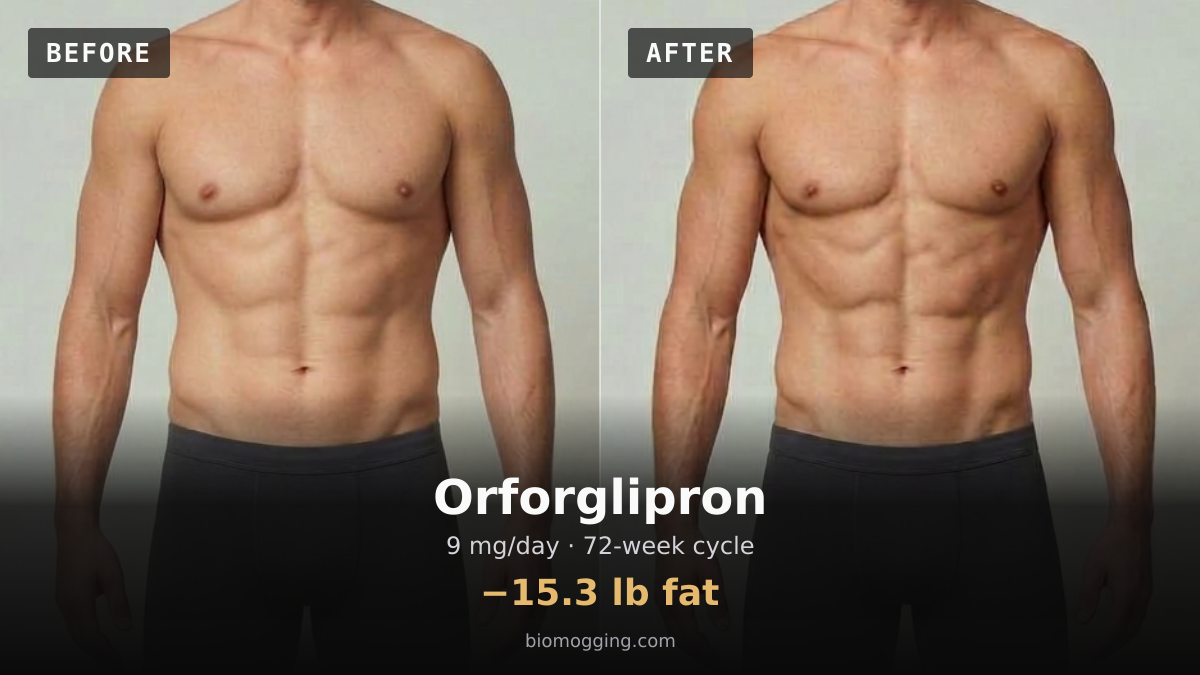
A 44-week protocol at 9 mg/day ≈ 6 bottles
Research & citations
6 studies cited on this page.
Conclusion
Orforglipron sets a new oral standard for protocol-driven physique enhancement — high bioavailability, no food or water choreography, and headlining data in long-haul weight loss.
Key takeaways:
- Typical daily dose: 1–36 mg oral, once daily, titrated in 4-week steps (1→3→6→12→18→24→36 mg)
- No reconstitution, no injection, and no fasting/water restrictions required
- Titration is essential — escalation over 12–24 weeks is standard to manage GI tolerability
- Maintenance protocol length: 16–72 weeks, with full clinical studies running to 72 weeks
- Stacking is common: orforglipron pairs cleanly with GH secretagogues, metformin, or as an oral off-ramp after semaglutide/tirzepatide
- Clinical fat loss: ~0.4 lb/week at 36 mg with −11% total body weight over 72 weeks (Wharton et al., NEJM 2025)
- Standard monitoring: baseline and 3-mo fasting glucose, HbA1c, lipids, CMP, and lipase
For research protocols focused on appetite suppression and sustained fat loss, orforglipron now delivers clinic-tier GLP-1 efficacy with true oral convenience.
Similar compounds
Comparisons
Disclosures
Affiliate links — we may earn a commission at no cost to you.