Mazdutide
IBI362 · LY3305677 · OXM-3
Last updated
Buying options
Available at Real Peptides (US) — 20% off auto-applied
At a glance
- Fat Loss
- 9/10
- Recovery
- 2/10
- Endurance
- 1/10
- Muscle Growth
- 0/10
- Strength
- 0/10
- Cognition
- 0/10
Overview
Why Mazdutide Earned Its Reputation#
Mazdutide is the first GLP-1/glucagon dual receptor agonist to reach approval, and it's the compound the physique and looksmaxxing community reaches for when pure GLP-1 mono-agonism (semaglutide) feels like it leaves efficiency on the table. The GLP-1 arm kills appetite and slows gastric emptying; the glucagon arm actively drives energy expenditure and pulls fat out of the liver. The net effect is a cleaner recomp tool than semaglutide at comparable doses, with a mechanistic bias toward fat mass over lean mass.
The headline numbers are strong. In the GLORY-1 phase 3 trial, 6 mg weekly produced a 14.01% mean weight reduction at 48 weeks, with roughly half of subjects losing ≥15% — territory that approaches tirzepatide and beats clinical semaglutide 2.4 mg. Users who hate the "fog" and lean-mass loss complaints of high-dose sema tend to prefer mazdutide because the glucagonergic component keeps resting expenditure elevated rather than relying purely on appetite suppression to do the work.
"After 48 weeks, subjects in the 6-mg mazdutide group achieved a mean weight reduction of 14.01% with 49.5% attaining at least 15% weight loss." — Ji et al., NEJM (2025)
There's also a secondary use case that's driving adoption independent of weight loss: hepatic fat clearance. The glucagon arm reduces liver fat fraction in a way pure GLP-1 agonists don't, making mazdutide the quiet favorite among users who've run heavy orals, long bulks, or show elevated liver enzymes on bloodwork. The sections below cover documented dose ladders, the GLORY-1 titration schedule that keeps nausea survivable, stacking options (solo cut, TRT-range AAS pairing, GLP-1 cross-tapers), side-effect management at the 6 mg ceiling, and the monitoring cadence experienced users actually run.
How Mazdutide works
Dual Receptor Agonism: The OXM Scaffold#
Mazdutide is a synthetic analogue of oxyntomodulin (OXM), a native 37-amino-acid gut hormone that co-activates both the GLP-1 receptor (GLP-1R) and the glucagon receptor (GCGR). Unlike pure GLP-1 monoagonists (semaglutide) or GLP-1/GIP coagonists (tirzepatide), mazdutide layers a controlled glucagonergic signal on top of GLP-1 tone — the same pharmacology the body uses endogenously to coordinate fed-state satiety with hepatic substrate mobilization.
The molecule is lipidated with a C20 fatty-diacid chain that drives albumin binding, extending the half-life enough to support weekly subcutaneous dosing.
"Oxyntomodulin activates both GLP-1 and glucagon receptors, offering a balanced approach to appetite suppression and increased energy expenditure in anti-obesity therapies." — Kueh MTW, Chong MC, Miras AD, le Roux CW. Journal of Physiology, 2025
GLP-1R Arm: Appetite Suppression and Glycemic Control#
The GLP-1R signal is the familiar half of the pharmacology. Agonism at hypothalamic POMC neurons in the arcuate nucleus reduces hunger drive and increases satiety. Peripherally, gastric emptying is delayed, insulin secretion is enhanced in a glucose-dependent manner, and postprandial glucagon is suppressed in the fed state.
The practical outcome for a recomp- or cut-focused user: running a meaningful caloric deficit stops feeling like a willpower exercise. Food noise drops, portion sizes self-regulate, and the deficit maintains itself without the metabolic adaptation spiral that derails conventional dieting.
GCGR Arm: Energy Expenditure and Hepatic Fat Mobilization#
This is where mazdutide separates from pure GLP-1 compounds. Glucagon receptor agonism drives resting energy expenditure upward, activates hepatic lipolysis, and accelerates fatty-acid oxidation in the liver. It also mobilizes stored triglycerides for oxidation rather than leaving them parked in adipose and hepatic depots.
Glucagon's classical downside — hyperglycemia — is largely neutralized by the concurrent GLP-1R signal, which restores insulin secretion and β-cell function. The net metabolic phenotype is greater fat-mass loss, stronger reductions in hepatic steatosis, and improvements in lipid profile than a GLP-1 monoagonist at equivalent appetite-suppressive tone.
"Dual GLP-1/glucagon receptor agonists show greater body weight loss and increased energy expenditure compared with pure GLP-1 agonists, largely ascribable to the glucagon component." — Winther JB, Holst JJ. Diabetes, Obesity and Metabolism, 2024
Hepatic Fat Clearance (MASLD-Relevant Mechanism)#
The glucagonergic arm drives hepatic fat fraction down independently of weight loss. GCGR activation increases mitochondrial β-oxidation in hepatocytes and reduces de novo lipogenesis — mechanisms that directly address the metabolic-associated steatotic liver disease (MASLD) pathway. This is mechanistically relevant for users running heavy orals, long bulks, or carrying a history of elevated liver enzymes on bloodwork.
"Mazdutide (IBI362) demonstrated significant reductions in hepatic fat fraction, highlighting its potential in the treatment of MASLD." — Prikhodko VA, Okovityi SV. Biomedicines, 2025
The clinical translation: subjects in the GLORY-1 6 mg arm reached −14.01% body weight at 48 weeks, with ~50% achieving ≥15% reduction — numbers driven by the additive effect of appetite suppression plus elevated expenditure, not by appetite suppression alone.
Pharmacokinetic Architecture#
The C20 diacid anchor is the pharmacokinetic handle. Albumin binding slows proteolytic degradation and renal clearance, producing a 5–7 day effective half-life. Steady-state plasma concentrations are reached after four to five weekly doses, which is why community titration protocols hold each dose step for four weeks before escalating.
"The estimated elimination half-life of mazdutide supports once-weekly dosing with steady-state levels observed after four to five doses." — Bhattachar SN, Tham LS, Li Y, et al. Diabetes, Obesity and Metabolism, 2025
Subcutaneous bioavailability is high (~80–90%, typical of acylated GLP-1-class peptides), Tmax sits in the 24–72 hour window, and clearance is via standard peptide proteolysis — no cytochrome interactions, no hepatic metabolism concerns for users stacking oral AAS, finasteride, or isotretinoin. The cycle is set by the receptor pharmacology and the titration schedule, not by drug-drug interaction math.
Protocol
| Level | Dose | Frequency | Notes |
|---|---|---|---|
| Low | 1.5–3 mg | Weekly | Documented entry-level range |
| Mid | 3–4.5 mg | Weekly | Most commonly studied range |
| High | 4.5–6 mg | Weekly | Once-weekly SC injection. Standard titration follows the GLORY-1 schedule: 1.5 mg wk 1–4 → 3 mg wk 5–8 → 4.5 mg wk 9–12 → 6 mg wk 13+. Conservative 4 mg maintenance protocols titrate 1.5 → 3 → 4 mg in 4-week blocks. Steady state reached after ~4–5 weekly doses. |
Available at Real Peptides (US) — 20% off auto-applied
Cycle length & outcomes
Documented cycle
16–48 weeks
Plateau after
48 wks
Cycle Notes#
Mazdutide is not a "cycle" compound in the steroid sense — it's a once-weekly titrated peptide where the limiting factor is GI tolerance, not HPG suppression or hepatotoxicity. The protocol is dictated by two things: the 4–5 week time to steady state, and the nausea ramp at each dose step. Every published schedule — and every sensible community protocol — respects those two constraints.
Mazdutide Dosage by Goal#
The GLORY-1 trial established the two titration schedules that dominate physique-focused use: a conservative 4 mg maintenance protocol for recomp, and the full 6 mg protocol for aggressive fat loss.
| Goal | Cycle Length | Titration & Maintenance |
|---|---|---|
| Post-bulk reverse / recomp | 12–16 weeks | 1.5 mg wk 1–4 → 3 mg wk 5+ |
| Standard cut (semaglutide equivalent) | 16–24 weeks | 1.5 → 3 → 4 mg, 4 wk per step; 4 mg maintenance |
| Aggressive cut / photoshoot deadline | 32–48 weeks | 1.5 → 3 → 4.5 → 6 mg, 4 wk per step; 6 mg maintenance |
| MASLD / fatty liver focus | 24–48 weeks | 1.5 → 3 → 4 mg; held at 4 mg |
| Cross-taper from sema/tirz plateau | 16–24 weeks | 3 mg × 4 wk → 4–6 mg as tolerated |
| Maintenance after cut | Indefinite | 1.5–3 mg weekly |
Mazdutide Protocol and Titration#
The titration schedule is the protocol. Skipping steps or compressing the ramp is the single most common reason cycles get abandoned at week 3 from uncontrollable nausea.
Standard 4 mg protocol (conservative):
- Weeks 1–4: 1.5 mg once weekly
- Weeks 5–8: 3 mg once weekly
- Weeks 9+: 4 mg once weekly (maintenance)
Full 6 mg protocol (GLORY-1):
- Weeks 1–4: 1.5 mg
- Weeks 5–8: 3 mg
- Weeks 9–12: 4.5 mg
- Weeks 13+: 6 mg (maintenance)
Each 4-week block exists because steady state is reached after roughly 4–5 weekly doses — moving up before that point stacks a rising plasma concentration on top of a rising dose.
"The estimated elimination half-life of mazdutide supports once-weekly dosing with steady-state levels observed after four to five doses." — Bhattachar et al., Diabetes, Obesity and Metabolism (2025)
Onset Timing and Expected Fat Loss#
Appetite suppression typically shows up within 24–48 hours of the first 1.5 mg injection. Measurable scale movement usually begins in weeks 2–3, accelerates through the 3 mg step, and hits its stride at the 4.5–6 mg maintenance doses once steady state is locked in.
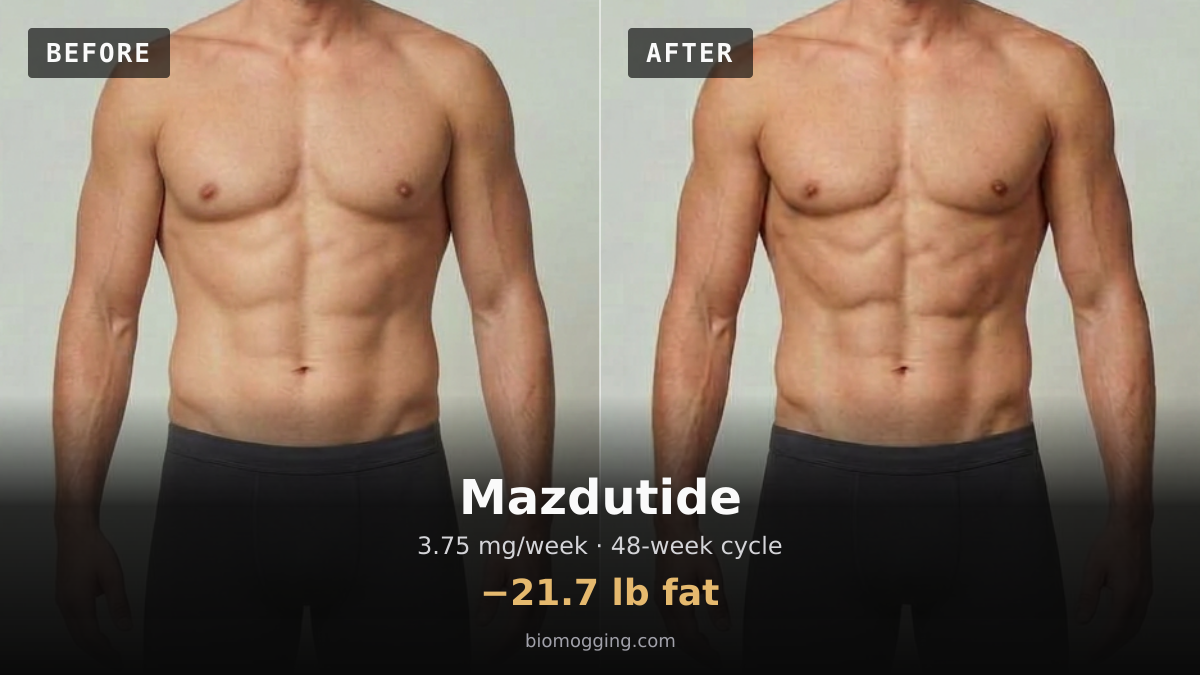
Realistic weekly fat-loss rates from the phase 3 data work out to roughly 0.5–0.8 lb/week averaged across a 48-week cycle, front-loaded — early weeks on maintenance dose tend to outpace late weeks as the body adapts.
"After 48 weeks, subjects in the 6-mg mazdutide group achieved a mean weight reduction of 14.01% with 49.5% attaining at least 15% weight loss." — Ji L et al., New England Journal of Medicine (2025)
The glucagon arm is what makes the rate curve hold up past week 24 where pure GLP-1 mono-agonism tends to plateau:
"Dual GLP-1/glucagon receptor agonists show greater body weight loss and increased energy expenditure compared with pure GLP-1 agonists, largely ascribable to the glucagon component." — Winther & Holst, Diabetes, Obesity and Metabolism (2024)
Bloodwork Cadence#
Because mazdutide activates the glucagon receptor in addition to GLP-1, the bloodwork panel is slightly broader than a pure GLP-1 agonist protocol — fasting glucose and liver enzymes are the fields that matter most.
| Timepoint | Panel |
|---|---|
| Baseline | CBC, CMP, fasting insulin, HbA1c, lipid panel, ALT/AST/GGT, resting HR, BP |
| Week 8 | CMP, liver panel, HbA1c, resting HR |
| Week 16 | CMP, liver panel, lipid panel, HbA1c |
| Week 24+ (if extended) | Full panel every 12 weeks |
Transient fasting glucose elevations in the first 4–8 weeks are expected — the glucagon signal hits before the GLP-1 signal normalises it — and resolve as titration progresses.
"Mazdutide (IBI362) demonstrated significant reductions in hepatic fat fraction, highlighting its potential in the treatment of MASLD." — Prikhodko & Okovityi, Biomedicines (2025)
Tapering and Discontinuation#
There is no hormonal taper requirement — mazdutide does not touch the HPG axis and no PCT is needed. The real discontinuation issue is weight rebound. The community standard after a successful cut is not to quit cold but to drop to a maintenance dose of 1.5–3 mg weekly indefinitely, or to structure a disciplined high-protein maintenance diet before the final injection. Abrupt discontinuation at 6 mg after a 48-week run typically produces meaningful regain within 6–12 months unless one of those two strategies is in place.
Stack Notes on Cycle#
- Creatine (3–5 g/day) and electrolytes are non-negotiable at 4.5–6 mg — slowed GI motility plus reduced intake makes dehydration the #1 failure mode.
- Protein intake ≥2.0 g/kg lean mass, tracked, not estimated. Appetite suppression is strong enough that intuitive eating will under-hit protein by 30–50 g/day.
- Low-dose testosterone (TRT range, 150–200 mg/week) is the most common AAS pairing for recomp-focused users who want to protect lean mass during the deficit.
- Resistance training volume held constant — the fat-loss mechanism doesn't care about training status, but lean-mass preservation does.
- Alcohol is effectively incompatible with the 4.5–6 mg dose levels; nausea and dehydration stack disproportionately.
Mazdutide rewards patience. The users who run the full 48-week protocol at 6 mg — titrated properly, bloodwork monitored, protein protected — are the ones hitting the ≥15% loss numbers from GLORY-1. Compressing the timeline is the single fastest way to abandon the cycle.
Risks & mistakes
Common (most users)#
Mazdutide's side-effect profile is dominated by GI effects — the same class signature seen across GLP-1 agonists, with the glucagon arm adding a small cardiovascular layer on top. In GLORY-1, >90% of subjects in the 6 mg arm reported at least one GI event, but the overwhelming majority were mild-to-moderate and resolved within the first 2–4 weeks of each titration step.
- Nausea — the headline effect, worst in the 48–72 hours after a titration step. Mitigation: respect the 4-week escalation blocks (1.5 → 3 → 4.5 → 6 mg), split calories into smaller meals, keep fat and fibre modest on injection day, and front-load protein earlier in the day before appetite tanks. Dose can be held at the current step for an extra 2–4 weeks if tolerance is poor before advancing.
- Decreased appetite / early satiety — this is the mechanism, not a bug. The practical failure mode is under-eating protein. Protocols call for ≥2.0 g/kg protein and deliberate calorie floors (typically not below ~22 kcal/kg) to protect lean mass.
- Diarrhoea or constipation — opposite ends of the GI-motility spectrum, dose-dependent. Hydration (3–4 L/day at the 4.5–6 mg ceiling), electrolytes (sodium, potassium, magnesium), and 25–35 g/day fibre handle most cases. Stubborn constipation at 6 mg responds to magnesium citrate.
- Injection-site erythema or itching — mild, self-resolving. Site rotation across abdomen, thigh, and upper arm, with alcohol-swabbed skin and fresh needles per injection, keeps incidence low.
- Fatigue / reduced training capacity — typical in the first 1–2 weeks of each titration step as caloric intake crashes. Creatine (3–5 g/day), adequate carbohydrates around training, and sodium pre-workout restore most of the lost output.
- Resting heart rate increase of ~2–5 bpm — the glucagon signature. Usually unremarkable but worth tracking.
- Transient fasting glucose elevation — early in titration the glucagon arm can nudge fasting glucose up before GLP-1 tone dominates. Normalises by week 8–12.
Uncommon (dose-dependent or individual)#
- Vomiting — almost exclusively after aggressive titration or a missed dose followed by a double-up. The correct response is to hold the current dose for an additional 2–4 weeks rather than push to the next step. Missed doses are administered up to 72 hours late or skipped entirely — doubling up is not done.
- Dehydration and electrolyte disturbance — a direct consequence of reduced intake plus altered motility. Warning signs: orthostatic dizziness, dark urine, muscle cramps, persistent headache. Bloodwork at week 8 and 16 should include a CMP to catch sodium/potassium drift.
- Gallbladder events (cholelithiasis, biliary colic) — a class effect tied to rapid weight loss rather than to mazdutide specifically. Risk rises with loss rates above ~1.5% body weight per week. Right-upper-quadrant pain after fatty meals warrants an ultrasound.
- Resting blood pressure changes — net systolic BP typically falls with weight loss, but the glucagon arm can transiently raise BP at the 6 mg ceiling. Users already on AAS with unmanaged hypertension should get BP controlled prior to initiating a cycle, not during.
- Hair shedding — not drug-specific; the telogen-effluvium signal that tracks any rapid weight-loss protocol. Protein intake, ferritin, vitamin D, and zinc should be kept in range.
- Hypoglycaemia — rare in non-diabetic subjects on mazdutide alone. Risk rises sharply when combined with exogenous insulin or sulfonylureas; doses of those agents require downward adjustment under medical supervision.
Rare but serious#
- Acute pancreatitis — a documented low-incidence class signal across GLP-1 agonists. Warning signs: severe, persistent upper-abdominal pain radiating to the back, often with vomiting. Discontinue immediately and seek evaluation (lipase, amylase, imaging). Do not resume.
- Severe gastroparesis — the motility-slowing effect can escalate into functional obstruction in susceptible individuals, particularly at 6 mg. Warning signs: persistent vomiting, inability to keep fluids down, abdominal distension. Discontinuation and GI evaluation are warranted.
- Anaphylaxis / serious hypersensitivity — rare but reported for the acylated-peptide class. Warning signs: facial swelling, urticaria, wheeze within hours of injection. Discontinue permanently.
- Acute kidney injury — almost always secondary to prolonged vomiting/diarrhoea and dehydration rather than a direct nephrotoxic effect. Aggressive rehydration and a CMP are the first response; persistent oliguria warrants evaluation.
- Medullary thyroid carcinoma signal — rodent C-cell tumour findings underlie the class contraindication. No confirmed human signal to date, but the contraindication below is absolute.
Hard contraindications#
These are not negotiable:
- Personal or family history of medullary thyroid carcinoma.
- Multiple endocrine neoplasia syndrome type 2 (MEN2).
- Prior pancreatitis of any aetiology.
- Pregnancy or planned pregnancy. Discontinuation is timed well in advance of attempted conception, accounting for the 5–7 day half-life and steady-state washout (≥6 weeks).
- Severe gastroparesis or active GI obstruction.
- Bariatric surgery within the prior 12 months — not studied, and the motility effects compound unpredictably with altered anatomy.
- Concurrent high-dose insulin or sulfonylurea therapy without downward dose adjustment — hypoglycaemia risk is real and predictable.
Sex-specific and PCT considerations#
Mazdutide is non-hormonal and does not interact with the HPG axis — no PCT is required and the compound is equally appropriate for male and female research subjects. Dosing is not sex- or weight-adjusted; the same GLORY-1 titration applies across subjects.
The one sex-specific concern is pregnancy, which is an absolute contraindication. Teratogenicity data for mazdutide specifically are limited, and the class is contraindicated in pregnancy across the board. Female subjects of reproductive potential use reliable contraception for the duration of the cycle and for at least 6 weeks after the final dose to account for full washout.
The post-cycle issue that does matter is weight rebound: abrupt discontinuation after a 48-week 6 mg protocol typically produces 40–60% regain within 12 months without a maintenance strategy. Two standard approaches are documented — a low maintenance dose (1.5–3 mg/week indefinitely) or a deliberate dietary protocol with continued resistance training, protein discipline, and periodic re-titration if regain exceeds ~5% of lost mass.
Stack & combine
Multipliers applied when these compounds run together. Values > 1 indicate a bonus on that axis. Tap a partner to expand the mechanism.
| Partner | Type | Lean | Fat loss | Recovery |
|---|---|---|---|---|
| synergistic | ×1.15 | ×1.20 | ×1.10 | |
| synergistic | ×1.00 | ×1.03 | ×1.18 | |
| synergistic | ×1.15 | ×1.08 | ×1.10 | |
| additive | ×1.00 | ×1.08 | ×1.00 |
FAQ — Mazdutide
Where to buy Mazdutide

Real Peptides
Our pick20% off — auto-applied at checkout
- Buy Mazdutide · 20% offMazdutide Peptide

NextGenPeps
10% off — use code at checkout
- Buy Mazdutide · 10% offMazdutide
You'll also need
- Bacteriostatic waterReal PeptidesBuy · 20% off
- Bacteriostatic waterNextGenPepsBuy · 10% offUse code at checkout
- Bacteriostatic waterSwiss ChemsBuy · 10% off
- Sterile waterSwiss ChemsBuy · 10% off
- Spray bottle 10 mlSwiss ChemsBuy · 10% off
- Acetic acid 0.6% solution 10 mlSwiss ChemsBuy · 10% off
Research & citations
6 studies cited on this page.
Conclusion
Mazdutide stands out as a high-impact metabolic peptide for physique-focused research, especially where aggressive fat loss, liver health, and adherence to a calorie-restricted protocol are primary endpoints.
Key takeaways:
- Standard protocol: once-weekly SC injection, titrated 1.5 mg → 3 mg → 4–6 mg per GLORY-1; most users plateau at 4–6 mg
- Typical cycle: 16–48 weeks, with 0.6–0.7 lb/week fat loss at the 6 mg ceiling (Ji et al., 2025, NEJM)
- Mechanism: dual GLP-1/glucagon agonism suppresses appetite and elevates energy expenditure for superior recomposition (Winther & Holst, 2024)
- Fatty liver clearance: meaningful reductions in hepatic fat fraction observed (Prikhodko & Okovityi, 2025)
- Stacks: typically run solo or with TRT-range AAS, creatine, and electrolytes to preserve lean mass and mitigate GI side effects
- Main risks: dose-dependent GI symptoms, elevated resting HR, and dehydration — titration and high-protein intake are the levers for adherence
With a balanced profile and robust clinical backing, mazdutide is the dual-agonist choice for anyone seeking next-level results beyond standard GLP-1s.
Similar compounds
Comparisons
Rankings
Disclosures
Affiliate links — we may earn a commission at no cost to you.