Eloralintide
LY3841136
Last updated
At a glance
Eloralintide (LY3841136) is an investigational peptide that mimics amylin, a hormone involved in satiety. In a 48-week randomized trial, adults receiving eloralintide lost an average of about 9% to 20% of their starting weight across treatment groups, compared with 0.4% on placebo. Nausea and fatigue were the most common adverse events. Phase 3 trials are studying the drug in adults with and without type 2 diabetes.
Available at Real Peptides (US) — 20% off auto-applied
- Fat Loss
- 7/10
- Muscle Growth
- 0/10
- Strength
- 0/10
- Endurance
- 0/10
- Recovery
- 0/10
- Cognition
- 0/10
Overview
Eli Lilly is developing eloralintide for weight management. Early studies tested how long it stays in the body and whether participants tolerated repeated doses. A later study followed 263 adults for 48 weeks and measured the percentage change from each participant’s starting weight. That distinction matters when interpreting the results. A change on the scale can reflect changes in fat, lean tissue and water. Phase 1 study · Phase 2 study
How Eloralintide works
Which receptor does eloralintide activate?#
In cells expressing human receptors, eloralintide activated the amylin 1 receptor (AMY1) at a lower concentration than either of two related receptors. Its potency was about 11 times greater at AMY1 than at AMY3 and 12 times greater than at the calcitonin receptor. In rats with diet-induced obesity, food intake fell and most of the lost weight came from fat mass. The body-composition finding was specific to that animal model. Briere and colleagues
How long does it stay in the body?#
The phase 1 investigators describe slow absorption after subcutaneous administration and a half-life of roughly two weeks. Half-life is the time it takes the circulating concentration to fall by half. The study team measured drug exposure across the weekly interval. Bhattachar and colleagues
“The pharmacokinetic profile of eloralintide supports once-weekly dosing.” — Briere and colleagues
Protocol
The phase 2 trial assigned adults to placebo or to eloralintide under investigator supervision. The results below are group averages at week 48 from the published efficacy analysis. Each estimate applies to the study population under those conditions. Phase 2 study
| Randomized study group | Mean body-weight change |
|---|---|
| Placebo | −0.4% |
| Fixed-dose groups | About −9% to −20% |
| Dose-escalation groups | About −16% to −20% |
The trial enrolled adults with obesity, or overweight and a weight-related condition, and excluded type 2 diabetes. Its results cannot establish an effective dose for a lean athlete or a bodybuilding population.
Available at Real Peptides (US) — 20% off auto-applied
Cycle length & outcomes
Documented cycle
24–48 weeks
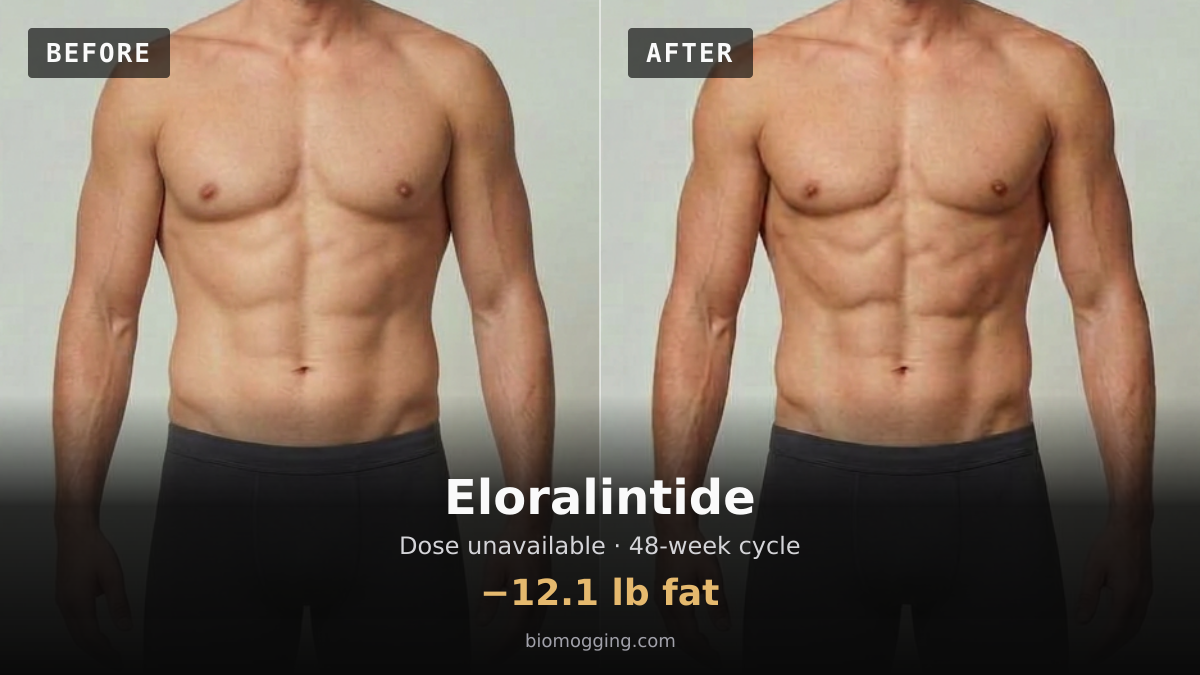
The 24–48 week range covers the two body-composition scans in the phase 2 trial. Investigators measured body fat with DXA (dual-energy X-ray absorptiometry). The illustration uses the lowest fixed-dose group as one example. These weeks describe the study observation window.
| Milestone | Week | Approximate change from baseline |
|---|---|---|
| First DXA readout | 24 | ~3.4 kg (7.5 lb) fat mass reduction in the 1 mg arm |
| Final DXA readout | 48 | ~5.5 kg (12.1 lb) fat mass reduction in the 1 mg arm |
The substudy included 135 participants across groups at week 24 and 122 at week 48. Lean mass also declined. DXA lean mass includes tissues besides skeletal muscle, so the illustration models fat loss only. Placebo participants also lost some fat. ObesityWeek 2025 symposium, slide 17
Both avatar settings use the same mixed-sex group estimate. The slider interpolates between the two scan results. The study did not measure weekly fat loss or establish an individual dosing cycle.
Risks & mistakes
In phase 2, nausea affected 11% to 64% of participants across eloralintide groups and 14% on placebo. Fatigue ranged from 0% to 46% across active groups and occurred in 12% on placebo. Rates varied by assigned group, and several groups enrolled fewer than 30 people. The estimates are therefore imprecise. An earlier 12-week trial also recorded decreased appetite, headache, diarrhoea and vomiting. These trials provide limited information about rare or long-term harms. Phase 2 results · Phase 1 results
FAQ — Eloralintide
Where to buy Eloralintide

Real Peptides
Our pick20% off — auto-applied at checkout
- Buy Eloralintide · 20% offEloralintide (5 mg or 10 mg vial)
You'll also need
- Bacteriostatic waterReal PeptidesBuy · 20% off
- Bacteriostatic waterSwiss ChemsBuy · 10% off
- Sterile waterSwiss ChemsBuy · 10% off
- Spray bottle 10 mlSwiss ChemsBuy · 10% off
- Acetic acid 0.6% solution 10 mlSwiss ChemsBuy · 10% off
Research & citations
3 studies cited on this page.
Conclusion
The 48-week trial provides evidence that eloralintide can reduce body weight in adults with obesity or overweight. Nausea and fatigue varied across treatment groups. The ongoing ENLIGHTEN trials study larger populations, including people with type 2 diabetes, and will help clarify the balance of benefits and harms. Phase 2 publication · ENLIGHTEN-2
Similar compounds
Disclosures
Affiliate links — we may earn a commission at no cost to you.