Cetilistat
ATL-962 · Oblean · Cetislim
Last updated
At a glance
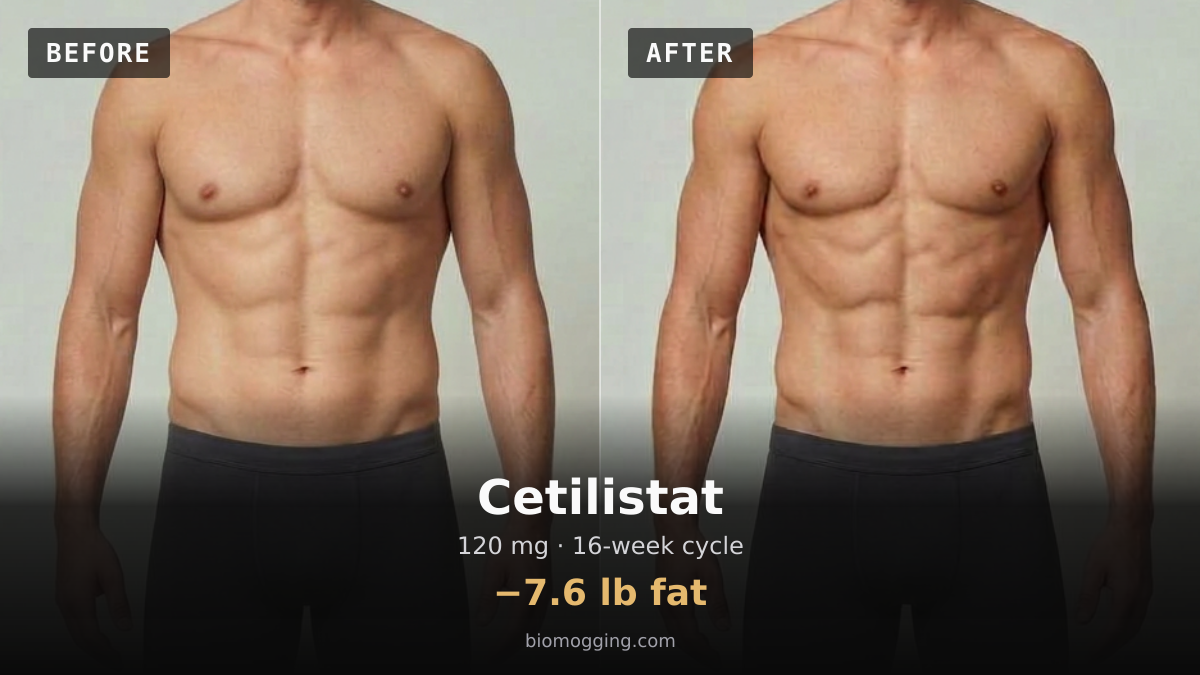
- Fat Loss
- 4/10
- Recovery
- 1/10
- Muscle Growth
- 0/10
- Strength
- 0/10
- Endurance
- 0/10
- Cognition
- 0/10
Overview
Why Cetilistat Has a Place in the Cutting Toolkit#
Cetilistat is the cleaner cousin of orlistat — a gastrointestinal lipase inhibitor that blocks roughly 30% of dietary fat from absorption without ever entering systemic circulation. Same mechanism as Xenical, materially better GI tolerability, and approved in Japan as Oblean® for obesity in T2DM patients. Physique-focused users have adopted it for what it does best: a small but real daily deficit on cuts, and meal-targeted "damage control" around off-plan high-fat eating.
The appeal is mechanistic honesty. There's no central appetite effect, no HPTA interaction, no rebound, no PCT — just a luminal enzyme block that pushes a fraction of ingested triglyceride out fecally. At 120 mg with each fat-containing meal, the Phase II data show ~3.5–4.3 kg loss over 12 weeks versus placebo, alongside modest improvements in LDL, total cholesterol, and HbA1c (Kopelman 2007; Kawai 2009). Modest numbers — but mechanistically additive to anything else in a cut stack.
"Cetilistat appears to produce weight loss and metabolic benefit comparable to orlistat, but with better gastrointestinal tolerability." — Padwal, Current Opinion in Investigational Drugs (2008)
Where it earns its keep in the bodybuilding and looksmaxxing community is as a layer, not a centerpiece: stacked under a GLP-1 agonist during contest prep, dosed sporadically around restaurant nights and refeeds, or run alongside oral AAS cycles where dietary fat restriction is part of a broader lipid-management strategy. Anyone expecting semaglutide-scale results will be disappointed; anyone using it for what it actually does — block ~30% of dietary fat with a clean side-effect profile — finds it reliable.
The sections below cover documented cetilistat dosing (60–240 mg ranges and the 120 mg t.i.d. label dose), use-case protocols for cuts and cheat-meal damage control, stacking with GLP-1 agonists and on-cycle lipid strategies, GI side effects and how they compare to orlistat, and the absorption-timing pitfalls that quietly undercut the protocol when fat-soluble vitamins and lipophilic orals aren't separated correctly.
How Cetilistat works
Selective Inhibition of Gastric and Pancreatic Lipase#
Cetilistat is a benzoxazinone-class lipase inhibitor that binds the catalytic serine residue of gastric and pancreatic lipase in the gut lumen. With lipase activity blocked, dietary triglycerides cannot be hydrolyzed into the free fatty acids and monoglycerides required for intestinal absorption — the intact triglyceride is shunted into the stool. The mechanism is functionally identical to orlistat, but the benzoxazinone scaffold appears to produce a cleaner GI tolerability profile than orlistat's β-lactone.
In vitro, cetilistat hits human pancreatic lipase with an IC₅₀ of ~5.95 nmol/L, roughly an order of magnitude more potent than against the rodent enzyme — a useful detail when interpreting preclinical-to-clinical scaling.
"Cetilistat was shown to be a novel, potent, and orally active inhibitor of pancreatic lipase that suppressed an increase in body weight and improved plasma lipid profiles in high-fat diet-induced obese rats." — Yamada Y. et al., Hormone and Metabolic Research, 2008
Quantitative Fat Malabsorption#
At the standard 120 mg t.i.d. dose, cetilistat blocks roughly 30% of ingested dietary fat from absorption — the same blockade ceiling orlistat hits at an equivalent dose. For a physique-focused user consuming 80 g of fat per day, that translates to ~215 kcal/day not crossing the intestinal barrier, which is the entire fat-loss contribution of the compound.
"Cetilistat 120 mg TID reduced dietary fat absorption by approximately 30%, comparable to orlistat at the same dose." — Bryson A. et al., British Journal of Clinical Pharmacology, 2009
This is why cetilistat is mechanistically pointless on a very-low-fat diet and mechanistically pointless on an empty stomach — without dietary triglyceride in the lumen at the same time as the drug, there is nothing for the inhibited lipase to fail at.
No Systemic Absorption, No Central Effect#
Cetilistat is gut-localized by design. Systemic bioavailability is negligible; the drug is recovered largely unchanged in feces alongside the triglyceride load it bound. There is no central appetite suppression, no GLP-1 or leptin axis involvement, no sympathomimetic activity, and no HPTA interaction. This is why the compound stacks cleanly with essentially every fat-loss agent in the community toolkit — GLP-1/GIP agonists, clenbuterol, yohimbine, T3, metformin — and why it requires no PCT and applies equally across the full subject pool.
The practical translation: cetilistat does not touch hunger, cravings, satiety, or energy expenditure. It is a digestive-absorption block, not a metabolic accelerator. Protocols that confuse it for an appetite suppressant underperform every time.
Indirect Lipid Profile Improvement#
Because absorbed dietary fat is reduced — including saturated fat — postprandial chylomicron formation drops, which in turn lowers the absorbed lipid load reaching the liver. The Phase II data showed 3–11% reductions in total and LDL cholesterol across all studied doses, independent of the weight-loss effect.
"After 12 weeks, the mean weight loss in the 120 mg t.i.d. cetilistat group was 3.5 kg, which was statistically significantly greater than with placebo (1.9 kg). All active groups showed improvements in lipid parameters." — Kopelman P. et al., International Journal of Obesity, 2007
For the lifter running oral AAS, this is the secondary mechanism worth knowing about: layered onto a broader lipid-management strategy (omega-3, citrus bergamot, cardio), it provides one additional indirect lever on the LDL/HDL ratio that orals dose-dependently degrade.
Fat-Soluble Vitamin and Lipophilic Drug Interaction#
The same mechanism that blocks dietary triglyceride absorption also blocks the absorption of anything that piggybacks on the fat-absorption pathway: vitamins A, D, E, K, carotenoids, and lipophilic orals (cyclosporine, levothyroxine, oral AAS, isotretinoin). This is not a side effect — it is the mechanism applied to molecules other than triglyceride.
The protocol consequence is straightforward: fat-soluble vitamin supplementation is dosed ≥2 hours away from cetilistat, and lipophilic orals are separated by ≥3–4 hours. 25-OH vitamin D is the most commonly depleted marker on extended protocols and is the one worth tracking on bloodwork at 8–12 week intervals.
Tolerability Advantage Over Orlistat#
Head-to-head trial data put cetilistat and orlistat at functionally identical efficacy with materially fewer GI-driven dropouts on cetilistat — the practical reason the compound has a niche at all.
"Cetilistat 80 and 120 mg TID produced significant reductions in body weight (−3.85 kg and −4.32 kg, respectively) and HbA1c, with fewer GI adverse events compared to orlistat." — Kopelman P. et al., Obesity, 2010
The mechanistic interpretation: the benzoxazinone binds lipase reversibly and is less prone to producing the free-oil pooling in the colon that drives orlistat's signature steatorrhea and oily incontinence events. Same lipase blockade, gentler downstream stool consequences — which is why orlistat-intolerant users typically migrate to cetilistat at the same 120 mg t.i.d. schedule and stay there.
Protocol
| Level | Dose | Frequency | Notes |
|---|---|---|---|
| Low | 60–80 mg | 3× daily | Documented entry-level range |
| Mid | 120–120 mg | 3× daily | Most commonly studied range |
| High | 120–240 mg | 3× daily | Administered immediately after each fat-containing meal. As-needed single-dose protocols around specific high-fat meals are equally documented. Dosing without dietary fat is pharmacologically pointless. |
Cycle length & outcomes
Documented cycle
8–16 weeks
Plateau after
16 wks
Cycle Notes#
Cetilistat doesn't behave like a hormonal compound — there's no HPTA suppression, no receptor downregulation, no rebound mechanism, and no PCT. Cycle length is dictated entirely by the dietary context it's supporting: the cut, the contest prep, the cheat-meal calendar, or the lipid-management window on an oral AAS run. When the dietary fat load goes away, the compound has nothing left to do.
Cetilistat Dosage by Goal#
| Goal | Cycle Length | Dose | Frequency |
|---|---|---|---|
| Cheat-meal damage control | As-needed | 120mg | With the offending meal only |
| Standard cut adjunct | 8–12 weeks | 120mg | With each fat-containing meal (t.i.d.) |
| Contest prep / aggressive cut | 12–16 weeks | 120mg | t.i.d. with meals |
| Lipid management on oral AAS | Matched to oral cycle (4–8 weeks) | 120mg | t.i.d. with meals |
| GI-sensitive / "micro-dose" use | 8–12 weeks | 60–80mg | t.i.d. with meals |
The 120mg t.i.d. schedule is the approved Japanese label dose and the dose at which the Phase II efficacy data was generated. 240mg per meal has been studied and produces marginal additional weight loss (~0.6 kg over 12 weeks vs 120mg) at the cost of disproportionately worse GI tolerability — the dose-response curve plateaus hard above 120mg.
Onset and Realistic Timelines#
Fecal fat excretion is detectable within 24–48 hours of the first dose — this is a mechanically immediate compound, not one that requires receptor saturation or tissue loading. Scale-weight changes lag the underlying fat blockade by 1–2 weeks (water, glycogen, GI transit noise) but the deficit is operating from day one.
Across the Phase II dataset, expect:
"After 12 weeks, the mean weight loss in the 120 mg t.i.d. cetilistat group was 3.5 kg, which was statistically significantly greater than with placebo (1.9 kg). All active groups showed improvements in lipid parameters." — Kopelman et al., International Journal of Obesity (2007)
That works out to roughly 0.4–0.5 lb/week of additional fat loss beyond whatever the underlying diet is producing — modest in absolute terms, meaningful as a stacking layer, and the lipid improvements (3–11% reductions in total and LDL cholesterol) arrive on the same timeline.
Loading, Tapering, and Discontinuation#
There is no loading phase. There is no taper. The compound can be started and stopped on any day without metabolic consequence — discontinuation simply restores normal dietary fat absorption from the next meal forward. This makes it uniquely well-suited to intermittent, meal-targeted dosing rather than chronic scheduled administration: a single 120mg dose tied to a specific high-fat meal is a valid protocol on its own.
For chronic protocols beyond 12 weeks, the practical cycle ceiling is set by fat-soluble vitamin depletion (particularly 25-OH vitamin D) rather than by any tolerance or tachyphylaxis at the lipase target. The literature supports continuous dosing at least through 12 weeks with a clean tolerability profile:
"Cetilistat 80 and 120 mg TID produced significant reductions in body weight (−3.85 kg and −4.32 kg, respectively) and HbA1c, with fewer GI adverse events compared to orlistat." — Kopelman et al., Obesity (2010)
On-Cycle Bloodwork Cadence#
Cetilistat is a low-bloodwork compound, but extended protocols (>8 weeks) warrant a short checklist:
- Baseline: Lipid panel, comprehensive metabolic panel, 25-OH vitamin D, ALT/AST.
- Week 8: Repeat lipid panel (expect improvement) and ALT/AST. A small post-marketing hepatic signal exists and is worth monitoring even though the trial-database LFT data was clean.
- Week 12–16: Recheck 25-OH vitamin D. This is the single most commonly depleted marker on extended protocols and the one most likely to require active repletion.
- If running concurrent warfarin: INR monitoring is non-negotiable — reduced vitamin K absorption can shift the therapeutic window.
Stack Timing on Cycle#
The non-negotiable timing rule on any cetilistat cycle: lipophilic compounds dose ≥3–4 hours away from cetilistat. This includes oral AAS, isotretinoin, levothyroxine, cyclosporine, and the fat-soluble vitamin stack itself (A, D, E, K). The clean approach is to anchor cetilistat to meals and anchor lipophilic orals/vitamins to a separate fasted or low-fat window — typically morning oral AAS / vitamins, then cetilistat with lunch, dinner, and the last meal of the day.
"Cetilistat 120 mg TID reduced dietary fat absorption by approximately 30%, comparable to orlistat at the same dose." — Bryson et al., British Journal of Clinical Pharmacology (2009)
A 30% block of dietary fat absorption is mechanically real but modest in caloric terms — the cycle should be framed as one layer in a multi-mechanism cut (GLP-1 agonist, training volume, cardio, deficit), not as a primary fat-loss driver. Used that way, it earns its place reliably across 8–16 week cuts and indefinitely as a meal-by-meal damage-control tool.
Risks & mistakes
Common (most users)#
The side-effect profile of cetilistat is almost entirely gastrointestinal and dose-coupled to dietary fat intake — the more fat consumed at a given meal, the more pronounced the local GI effect. None of these are systemic; all resolve on discontinuation or dose adjustment.
- Oily or loose stools — the signature effect. Reported in roughly 1.8–2.8% of subjects at 120 mg t.i.d. in the Kopelman 2007 dataset, materially lower than the orlistat comparator arm. Mitigated by keeping per-meal dietary fat under ~30 g; cap any single meal that is paired with a dose.
- Oily spotting / soft stools — typically appears within the first week and attenuates as the gut adapts. Reducing the dose to 60–80 mg per meal during the adaptation window is the standard adjustment.
- Flatus with discharge — disproportionately triggered by single very-high-fat meals (pizza, fried food, heavy cream sauces). The community fix is meal composition, not premedication.
- Fecal urgency, increased bowel-movement frequency — usually a one-to-two-week adaptation phenomenon at 120 mg t.i.d. Stable thereafter.
- Reduced absorption of fat-soluble vitamins (A, D, E, K) and carotenoids — a real, predictable effect on extended protocols. A standard fat-soluble multivitamin dosed ≥2 hours away from cetilistat offsets it.
"Cetilistat appears to produce weight loss and metabolic benefit comparable to orlistat, but with better gastrointestinal tolerability." — Padwal, Current Opinion in Investigational Drugs (2008)
Uncommon (dose-dependent or individual)#
- Steatorrhea on very-high-fat meals — frank fatty stool, distinct from oily spotting. Indicates the meal's fat load exceeded what the protocol can manage cleanly. Reduce per-meal fat or drop that meal's dose to 60 mg.
- 240 mg per-meal GI ceiling — the 240 mg t.i.d. arm in the Kopelman 2007 trial added only marginal weight loss (~0.6 kg over 12 weeks vs the 120 mg arm) while disproportionately increasing GI events. The literature does not support exceeding 120 mg per meal.
- 25-OH vitamin D depletion — the most commonly affected fat-soluble vitamin on extended protocols (>12 weeks), compounded by the indoor-training population already running low at baseline. Check at baseline and at 8–12 weeks; supplement at least 2 hours away from any cetilistat dose.
- Altered INR on warfarin therapy — reduced vitamin K absorption can shift coagulation parameters. Frequent INR monitoring is required if both are run concurrently.
- Reduced absorption of co-administered lipophilic compounds — oral AAS, isotretinoin, levothyroxine, cyclosporine, and other lipid-soluble orals all show or are expected to show reduced absorption when dosed near cetilistat. Separate by ≥3–4 hours.
Rare but serious#
- Hepatotoxicity — a small number of post-marketing case reports exist for cetilistat-associated liver injury, paralleling the rare orlistat hepatic signal. The clinical-trial database did not show meaningful LFT derangement, but baseline and 8–12 week ALT/AST checks are prudent on extended protocols. Discontinue on persistent RUQ pain, jaundice, dark urine, or ALT/AST elevations >3× ULN.
- Oxalate nephropathy — a class-effect concern with GI lipase inhibitors (unabsorbed fatty acids bind calcium in the gut, leaving free oxalate to be absorbed and excreted). Documented more clearly with orlistat than cetilistat, but mechanistically applicable. Subjects with a history of calcium-oxalate stones should avoid the protocol.
- Cholelithiasis — any rapid-weight-loss intervention raises gallstone risk; cetilistat-driven loss is modest enough that this is a minor concern, but RUQ pain warrants imaging.
Hard contraindications#
- Chronic malabsorption syndromes — Crohn's, celiac, cholestasis, short-bowel — do not layer a lipase inhibitor on top of pre-existing fat malabsorption.
- Cyclosporine therapy — significant reduction in cyclosporine absorption is documented for orlistat and expected as a class effect. Avoid.
- Warfarin therapy without active INR monitoring — vitamin K absorption is reduced; INR will shift.
- Pregnancy — fat-soluble vitamin (A, D, K) malabsorption raises teratogenicity-adjacent concerns. Not used.
- Very-low-fat diets (<30 g/day) — not dangerous, but pharmacologically pointless; the absolute calories blocked are trivial.
Gender, PCT, and population notes#
Cetilistat has no hormonal activity — no estrogenic, androgenic, progestogenic, or HPTA effect. The mechanism is fully gut-localized, with negligible systemic exposure. No PCT is required, and the protocol is equally applicable across the full subject pool — the Kopelman and Kawai trials enrolled both male and female subjects with no gender-specific tolerability signal. The single population-level caution outside the contraindications above is pregnancy, where fat-soluble vitamin depletion is the limiting factor rather than any direct compound effect.
"Cetilistat 80 and 120 mg TID produced significant reductions in body weight (−3.85 kg and −4.32 kg, respectively) and HbA1c, with fewer GI adverse events compared to orlistat." — Kawai et al., Obesity (2010)
Used within the dose ceiling, paired with reasonable per-meal fat caps, and supported by a fat-soluble vitamin layer dosed away from administration, the protocol is one of the cleaner adjuncts available in the metabolic toolkit — well-characterized side effects, all mitigable, none that compromise the rest of a cycle.
Stack & combine
Multipliers applied when these compounds run together. Values > 1 indicate a bonus on that axis. Tap a partner to expand the mechanism.
| Partner | Type | Lean | Fat loss | Recovery |
|---|---|---|---|---|
| synergistic | ×1.00 | ×1.15 | ×1.00 |
FAQ — Cetilistat
PCT & ancillaries
These are separate products from our affiliate partners, not Cetilistat offers. Their inclusion does not mean they are required or recommended for use.

Real Peptides
Our pick20% off — auto-applied at checkout
- Buy Kisspeptin · 20% offKisspeptin· Kisspeptin-10
A 4-week protocol at 150 mcg twice daily ≈ 1 vial

NextChems
10% off — auto-applied at checkout
- Buy Anastrozole · 10% offAnastrozole· Anastrozole (Arimidex), 0.5mg – 60 Capsules - NextChems
A 10-week protocol at 0.38 mg twice weekly ≈ 1 bottle
- Buy Clomiphene Citrate · 10% offClomiphene Citrate· Clomid (Clomifene / Clomiphene), 25mg – 60 Capsules - NextChems
A 5-week protocol at 37.5 mg/day ≈ 1 bottle
- Buy Enclomiphene Citrate · 10% offEnclomiphene Citrate· Enclomiphene 12.5mg, 60 Capsules - NextChems
A 10-week protocol at 12.5 mg/day ≈ 2 bottles
- Buy Ezetimibe · 10% offEzetimibe· Ezetimibe, 10mg – 60 Capsules - NextChems
A 28-week protocol at 10 mg/day ≈ 4 bottles
- Buy Hydrochlorothiazide · 10% offHydrochlorothiazide· Hydrochlorothiazide (HCTZ), 12.5mg – 60 Capsules - NextChems
A 7-week protocol at 18.75 mg/day ≈ 2 bottles
- Buy Nebivolol · 10% offNebivolol· Nebivolol, 5mg – 60 Capsules - NextChems
A 28-week protocol at 7.5 mg/day ≈ 5 bottles
- Buy Nolvadex · 10% offNolvadex· Tamoxifen (Nolvadex), 20mg – 60 Capsules - NextChems
A 5-week protocol at 30 mg/day ≈ 1 bottle
- Buy Pramipexole · 10% offPramipexole· Pramipexole (Prami), 0.2mg – 60 Capsules - NextChems
A 10-week protocol at 0.19 mg/day ≈ 2 bottles
- Buy Propranolol · 10% offPropranolol· Propranolol, 10mg – 60 Capsules - NextChems
- Buy Raloxifene · 10% offRaloxifene· Raloxifene, 20mg – 60 Capsules - NextChems
A 10-week protocol at 60 mg/day ≈ 4 bottles
- Buy Rosuvastatin · 10% offRosuvastatin· Rosuvastatin, 5mg – 60 Capsules - NextChems
A 28-week protocol at 15 mg/day ≈ 10 bottles
- Buy Telmisartan · 10% offTelmisartan· Telmisartan, 40mg – 60 Capsules - NextChems
A 28-week protocol at 60 mg/day ≈ 5 bottles

Swiss Chems
10% off — auto-applied at checkout
- Buy Anastrozole · 10% offAnastrozole· Anastrozole (0.5mg/capsule), 60 Capsules - SwissChems-Buy Best Quality Peptides, SARMS Online
A 10-week protocol at 0.38 mg twice weekly ≈ 1 bottle
- Buy Clomiphene Citrate · 10% offClomiphene Citrate· Clomiphene, 1500mg (25mg/capsule) - SwissChems-Buy Best Quality Peptides, SARMS Online
A 5-week protocol at 37.5 mg/day ≈ 1 bottle
- Buy Enclomiphene Citrate · 10% offEnclomiphene Citrate· Enclomiphene (12.5mg/capsule), 60 Capsules - SwissChems-Buy Best Quality Peptides, SARMS Online
A 10-week protocol at 12.5 mg/day ≈ 2 bottles
- Buy Gonadorelin · 10% offGonadorelin· Gonadorelin 2mg - SwissChems-Buy Best Quality Peptides, SARMS Online
A 28-week protocol at 150 mcg/day ≈ 15 vials
- Buy HMG (Human Menopausal Gonadotropin) · 10% offHMG (Human Menopausal Gonadotropin)· HMG 75 IU - SwissChems-Buy Best Quality Peptides, SARMS Online
- Buy Human Chorionic Gonadotropin · 10% offHuman Chorionic Gonadotropin· HCG 5000 IU - SwissChems
- Buy Kisspeptin · 10% offKisspeptin· Kisspeptin-10 10mg - SwissChems-Buy Best Quality Peptides, SARMS Online
A 4-week protocol at 150 mcg twice daily ≈ 1 vial
- Buy Letrozole · 10% offLetrozole· Letrozole (1mg/capsule), 60 Capsules - SwissChems-Buy Best Quality Peptides, SARMS Online
A 7-week protocol at 0.88 mg twice weekly ≈ 1 bottle
- Buy Nebivolol · 10% offNebivolol· Nebivolol 300 mg (5 mg / 60 capsules) - SwissChems-Buy Best Quality Peptides, SARMS Online
A 28-week protocol at 7.5 mg/day ≈ 5 bottles
- Buy Nolvadex · 10% offNolvadex· Tamoxifen (20mg/capsule), 60 Capsules - SwissChems-Buy Best Quality Peptides, SARMS Online
A 5-week protocol at 30 mg/day ≈ 1 bottle
- Buy Pramipexole · 10% offPramipexole· Pramipexole (Prami), 12 mg (0.2 mg/60 capsules) - SwissChems-Buy Best Quality Peptides, SARMS Online
A 10-week protocol at 0.19 mg/day ≈ 2 bottles
- Buy Raloxifene · 10% offRaloxifene· Raloxifene (20mg/capsule), 60 Capsules - SwissChems-Buy Best Quality Peptides, SARMS Online
A 10-week protocol at 60 mg/day ≈ 4 bottles
- Buy Telmisartan · 10% offTelmisartan· Telmisartan, 2400mg (40mg/capsule) - SwissChems-Buy Best Quality Peptides, SARMS Online
A 28-week protocol at 60 mg/day ≈ 5 bottles
- Buy Triptorelin · 10% offTriptorelin· GnRH (Triptorelin) 2mg - SwissChems-Buy Best Quality Peptides, SARMS Online

NextGenPeps
10% off — use code at checkout
Research & citations
5 studies cited on this page.
Conclusion
Cetilistat is the go-to gastrointestinal lipase inhibitor in the community for clean, GI-tolerable fat blockade — especially when orlistat's side effect profile is a dealbreaker. Its practical value is in targeted fat absorption reduction, whether used during a long cut, post-high-fat meal, or as part of a multi-agent stack.
Key takeaways:
- Typical dose is 120 mg oral, administered with each fat-containing meal (three-times-daily)
- Meal-timing is critical — dosing without dietary fat offers no effect
- Cycle duration aligns with cut phases: 8–16 weeks is standard in aggressive protocols
- The effective fat absorption block is ~30%, mirroring orlistat but with generally better GI tolerability (Kopelman et al., 2010; Bryson et al., 2009)
- Stacking with GLP-1 agonists, metformin, or oral AAS is well-documented; ancillaries include fat-soluble vitamin support (A, D, E, K) separated by ≥2 hours from dosing
- Headline benefit: reliable, modest extra deficit (~0.5 lb fat loss per week), most impactful for cheat-meal control or as a frictionless secondary layer in a smart cut
For any user needing a no-nonsense fat-blockade intervention with less GI collateral than orlistat, cetilistat stands out as a practical, user-friendly tool in the metabolic peptide toolkit.
Similar compounds
Comparisons
Disclosures
Affiliate links — we may earn a commission at no cost to you.