LGD-4033
Ligandrol · VK5211 · Anabolicum · LGD4033
Last updated
At a glance
- Muscle Growth
- 7/10
- Strength
- 6/10
- Recovery
- 5/10
- Fat Loss
- 2/10
- Endurance
- 2/10
- Cognition
- 1/10
500
Testosterone = 100
1
Testosterone = 100
Overview
LGD-4033 (Ligandrol) is the SARM most bodybuilders and recomp-focused users reach for when they want AAS-adjacent lean mass without the injections, aromatization, or water. It binds the androgen receptor with high affinity and tissue selectivity — strong anabolic signaling in muscle and bone, minimal action on prostate and sebaceous tissue — which is why even the original Phase 1 trial saw meaningful lean-mass gains at doses as low as 1 mg/day with a clean side-effect profile over 21 days.
Community dosing sits well above that clinical range — typically 5–10 mg/day for 8 weeks — and at those doses LGD consistently delivers 4–8 lb of lean tissue in a trained natural, solid strength retention in a cut, and a predictability that ostarine doesn't quite match and RAD-140 undercuts with harsher sides. The trade-off is real HPTA suppression and a meaningful HDL drop, both of which are manageable with a proper mini-PCT, bloodwork on both ends of the cycle, and not stretching the run past 8 weeks.
"LGD-4033 administered for 21 days was safe, well tolerated, and had a favorable pharmacokinetic profile. LGD-4033 significantly increased lean body mass from baseline to day 22 even at the lowest 0.1-mg dose." — Basaria et al., Journals of Gerontology (2013)
The rest of this page covers the practical protocol — dosage ladder from beginner to advanced, cycle length and structure, PCT with enclomiphene or nolvadex, side effects and how to mitigate them, realistic results expectations, proven stacks (MK-677, cardarine, TRT base), and how to position LGD for cutting versus bulking phases.
How LGD-4033 works
Selective Androgen Receptor Binding#
LGD-4033 is a non-steroidal small molecule that binds the androgen receptor (AR) with high affinity (Ki ≈ 1 nM) and — critically — binds it selectively in anabolic tissues. In skeletal muscle and bone, LGD behaves as a full AR agonist, driving transcription of the same anabolic target genes that testosterone drives: IGF-1, MyoD, myogenin, and downstream myofibrillar protein synthesis machinery. In prostate and sebaceous tissue, it recruits a different cofactor set and behaves as a weak partial agonist. This is the entire pharmacological premise of a SARM: muscle and bone growth without the prostatic hypertrophy, oily skin, and androgenic hair loss that come with exogenous testosterone or DHT.
"LGD-4033 is a nonsteroidal SARM that binds the androgen receptor with high affinity, displaying substantial anabolic and functional activity in skeletal muscle and bone, while minimally stimulating the prostate." — Efimenko IV et al., Andrologia, 2021
Practically, this is why users on 10 mg/day get meaningful lean-mass gains without the acne and aggression profile of a dbol or anadrol run. The androgenic load is genuinely low — the anabolic:androgenic ratio in animal models sits around 500:1 versus testosterone's ~1:1.
No Aromatization, No 5α-Reduction#
Unlike testosterone, LGD-4033 is not a substrate for aromatase or 5α-reductase. It does not convert to estradiol and it does not convert to DHT. This has two practical consequences the reader needs to understand before cycling:
- No estrogenic water retention, no gyno risk from the compound itself. Gains look drier than a comparable test cycle.
- Endogenous estradiol crashes along with testosterone. Because LGD suppresses your natural T (see below), and because LGD itself does not aromatize to replace that lost E2, users frequently end a cycle with symptomatically low estrogen — joint dryness, flat libido, poor mood, dead lifts feeling heavy.
This is the single most misunderstood part of the LGD experience. It is not a "dry gyno-free test" — it is a compound that occupies the AR while simultaneously starving you of the E2 your joints, libido, and CNS need.
HPTA Suppression via Hypothalamic AR Agonism#
LGD-4033 crosses the blood-brain barrier and activates AR in the hypothalamus. The hypothalamus reads this as "androgen levels are high" and shuts down GnRH → LH/FSH → endogenous testosterone production via standard negative feedback. Suppression is dose-dependent and shows up even at clinical microdoses.
"LGD-4033 administered for 21 days was safe, well tolerated, and had a favorable pharmacokinetic profile. LGD-4033 significantly increased lean body mass from baseline to day 22 even at the lowest 0.1-mg dose." — Basaria S et al., Journals of Gerontology Series A, 2013
In that same trial, 1 mg/day — one tenth of the standard community dose — already suppressed total testosterone, free testosterone, SHBG, and HDL. At 10 mg/day × 8 weeks, expect total T to drop 40–60%. This is why PCT is non-negotiable on a real LGD cycle, regardless of what older SARM-era marketing claimed.
Pharmacokinetics That Enable Once-Daily Dosing#
LGD-4033 is orally bioavailable (~90%), reaches Tmax within 1–4 hours, and has a plasma half-life of roughly 24–36 hours. Steady-state accumulation is reached within about five days of daily dosing.
"Oral administration of 10 mg LGD-4033 to a healthy volunteer revealed a long plasma half-life (approximately 24–36 hours), with phase I and phase II metabolites detected in urine up to 22 days post-administration." — Fragkaki AG et al., Drug Testing and Analysis, 2018
Two practical takeaways: dose timing doesn't matter — once-daily at whatever time you'll actually remember is fine — and tested athletes need to stay far away. Metabolites are detectable in urine for weeks after the last dose.
Hepatic Metabolism and the Lipid/LFT Picture#
LGD is not C17-alpha alkylated, so it does not carry the same direct hepatotoxic mechanism as oral AAS like anadrol or superdrol. It is, however, hepatically metabolized via CYP-mediated oxidation followed by glucuronidation, and isolated case reports of drug-induced liver injury exist.
"We describe the first reported case of drug-induced liver injury attributed to Ligandrol, confirmed by liver biopsy, which resolved upon discontinuation." — Barbara M et al., ACG Case Reports Journal, 2020
The lipid signature is more consistent than the LFT signature: AR agonism in hepatocytes reliably suppresses HDL and often raises LDL, an effect seen at all clinical doses and more pronounced at 10+ mg/day. This is the mechanistic reason the standard protocol includes mid-cycle and post-cycle bloodwork, cardio throughout, and a hard stop at 8 weeks — not vibes, but a predictable pharmacology you can plan around.
Protocol
| Level | Dose | Frequency | Notes |
|---|---|---|---|
| Low | 5–5 mg | Once daily | Documented entry-level range |
| Mid | 5–10 mg | Once daily | Most commonly studied range |
| High | 10–20 mg | Once daily | Taken once daily, any time of day, with or without food. The 24–36 h half-life makes timing irrelevant — consistency day-to-day matters more than clock time. |
Cycle length & outcomes
Documented cycle
6–8 weeks
Plateau after
8 wks
Cycle Length & Structure#
LGD-4033 cycles are short and standardized. The 24–36 h half-life means steady-state is reached within ~5 days of daily dosing, so there's no loading phase and no benefit to pulse protocols. The same dose is taken once a day, every day, for the duration of the cycle.
"Oral administration of 10 mg LGD-4033 to a healthy volunteer revealed a long plasma half-life (approximately 24–36 hours), with phase I and phase II metabolites detected in urine up to 22 days post-administration." — Fragkaki 2018
8 weeks is the community ceiling for a single block. Past that, suppression deepens, HDL continues to slide, and lean-mass gains flatten — the dose-response is logarithmic, and the clock is working against you by week 9.
Dose Ladder by Goal#
| Goal | Cycle Length | Daily Dose | Notes |
|---|---|---|---|
| First SARM cycle / assess response | 8 weeks | 5 mg | Beginner default — real gains, gentlest suppression |
| Lean bulk | 8 weeks | 5 mg wk 1–2 → 10 mg wk 3–8 | Most-run protocol in the community |
| Recomp | 8 weeks | 10 mg | Often paired with MK-677 or cardarine |
| Cut / lean-mass preservation | 6–8 weeks | 5–10 mg | Deficit ~20%, strength retention is the headline effect |
| Bridge between AAS blasts (advanced) | 6–8 weeks | 5–10 mg | On a TRT base, not stacked onto a blast |
| Advanced bulk | 8 weeks | 10–15 mg | Diminishing returns above 10 mg; suppression climbs faster than gains |
Doses above ~15 mg/day are not where the data or community experience supports better outcomes — you get disproportionate HPTA shutdown and lipid damage for marginal extra lean mass.
Onset Timing#
- Week 1: noticeable pumps, fuller muscle bellies, slight strength uptick. Largely glycogen and intracellular water.
- Week 2–3: strength gains become measurable on main lifts (~1%/week trained natural).
- Week 3–4: lean mass visibly accumulating; libido may start to dip as endogenous T falls.
- Week 5–8: peak anabolic window. Expect ~0.5–1 lb lean mass/week in a surplus with trained lifters at the low end.
- Week 8+: gains plateau sharply while sides compound. This is the exit point.
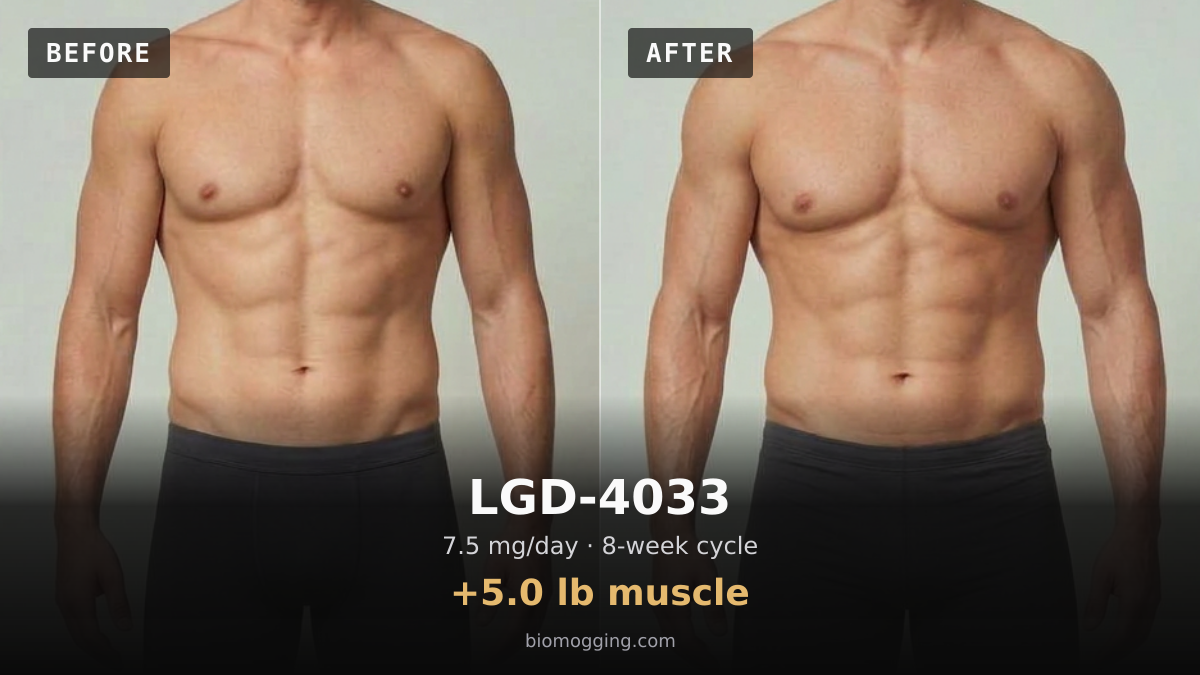
Realistic total lean gain on a standard 10 mg × 8-week cycle for a trained natural lifter eating above maintenance: 4–8 lb, with strength numbers moving faster than scale weight.
Bloodwork Cadence#
Non-negotiable on LGD. LGD is a compound that reliably suppresses testosterone 40–60% and meaningfully shifts lipids at community doses.
| Timepoint | Panel |
|---|---|
| Baseline (2 weeks pre-cycle) | CBC, CMP (incl. LFTs), lipid panel, total T, free T, E2 (sensitive), LH, FSH, SHBG, PSA |
| Mid-cycle (week 4) | LFTs, lipids, total T |
| End of cycle (week 8) | Full baseline panel |
| Post-PCT (4–6 weeks after PCT ends) | Total T, free T, LH, FSH, E2 — confirm recovery |
If LFTs trend notably above baseline mid-cycle, stop — LGD-induced liver injury is rare but documented and resolves on discontinuation.
"We describe the first reported case of drug-induced liver injury attributed to Ligandrol, confirmed by liver biopsy, which resolved upon discontinuation." — Barbara 2020
Tapering & PCT#
No taper on the LGD itself — stop cold on day 56. Begin mini-PCT 24 hours after last dose:
- Enclomiphene 12.5 mg/day × 4 weeks (preferred), or
- Nolvadex 20/20/10/10 mg × 4 weeks
Ancillaries through the cycle that actually matter: omega-3 (3–4 g EPA/DHA daily), steady-state cardio 3×/week for HDL support, and a clean diet — lipids are the canary on LGD, not the liver.
Time Off Between Cycles#
Minimum time off = time on + PCT length. So an 8-week cycle with 4-week PCT = 12 weeks off before the next SARM or AAS block. Confirm HPTA recovery on bloodwork before restarting — not on how you feel. Back-to-back LGD cycles without recovery is how guys end up needing TRT in their early 30s.
Risks & mistakes
Common (most users)#
- HPTA suppression — expect total testosterone to drop 40–60% on a standard 10 mg × 8-week run, with LH/FSH and SHBG following. This is the expected effect, not a side effect. Mitigate with a proper mini-PCT (enclomiphene 12.5 mg/day × 4 weeks, or nolvadex 20/20/10/10) starting 24 h after the last dose, and cap cycle length at 8 weeks.
"LGD-4033 administered for 21 days was safe, well tolerated, and had a favorable pharmacokinetic profile... dose-dependent suppression of total testosterone, sex hormone–binding globulin, high-density lipoprotein cholesterol, and triglycerides was observed." — Basaria et al., 2013
- HDL drop / lipid shift — HDL falls, LDL often creeps up. Run daily cardio (zone 2, 20–30 min), 3–4 g/day EPA+DHA, keep saturated fat moderate, and pull bloods mid-cycle. Lipids normalize within weeks of cessation in most users.
- Mild water retention / fullness — muscles look fuller within 7–10 days; some users report a small scale jump from intracellular water. Not estrogenic — LGD doesn't aromatize. No mitigation needed.
- Low-E2 symptoms paradoxically — because endogenous T crashes, estradiol crashes with it. Dry joints, flat libido, mood blunting in weeks 4–8 are typical. An experienced fix is a low-dose testosterone base (TRT dose, 100–150 mg/week) or accepting the trough and letting PCT restore things.
- Lethargy — shows up mid-cycle in a minority, usually tracks suppression. Caffeine tolerance often rises. Not a reason to stop.
Uncommon (dose-dependent or individual)#
- Elevated blood pressure — more likely at 15–20 mg/day. Check BP weekly on cycle; if systolic creeps above 140, drop dose or add telmisartan/cialis per a physician. Don't run LGD on top of untreated hypertension.
- Mild LFT elevation (AST/ALT) — not a C17-aa compound, but transaminase bumps show up on mid-cycle bloods in some users, especially stacked with other orals or heavy alcohol. Pull LFTs at week 4. Trending up → stop.
- Testicular shrinkage / libido crash — standard signs of suppression. Cosmetic only; reverses with PCT. HCG 250–500 IU 2×/week on cycle prevents the visual change if it bothers you.
- Hair shedding in genetically predisposed users — LGD is not 5α-reduced, but AR agonism in the scalp is still AR agonism. Topical finasteride or RU58841 as part of a hair stack for anyone with MPB history.
- Virilization signs (women) — voice deepening, clitoral enlargement, acne, hair-pattern changes. Reported anecdotally above ~2 mg/day and potentially irreversible. Women wanting a SARM should use low-dose ostarine instead.
Rare but serious#
- Drug-induced liver injury (cholestatic) — documented case reports, usually resolving on discontinuation. Warning signs: jaundice, dark urine, pale stool, RUQ pain, pruritus. Stop immediately, get LFTs and a bilirubin panel.
"We describe the first reported case of drug-induced liver injury attributed to Ligandrol, confirmed by liver biopsy, which resolved upon discontinuation." — Barbara et al., 2020
- Severe lipid derangement — HDL below 20 mg/dL or LDL above 160 mg/dL on cycle warrants stopping. The Cardaci 2022 LGD+MK-677 case report documented meaningful HDL suppression alongside gains — the trade-off is real.
- Prolonged HPTA shutdown — rare, but recovery can stretch past 12 weeks in users who ran 20+ mg doses, long cycles, or stacked with suppressive compounds and skipped PCT. If bloods at week 6 post-PCT still show LH/FSH bottom-of-range and total T under 300, escalate to a proper SERM restart protocol.
- Cardiac symptoms — chest tightness, exertional dyspnea, resting tachycardia. Not common at reasonable doses, but the combination of low HDL + elevated BP + stimulant pre-workouts is a bad setup. Stop and investigate.
Hard contraindications#
- Pregnancy or active attempts to conceive — androgenic exposure is teratogenic; LGD suppresses spermatogenesis.
- Lactation.
- Concurrent C17-alpha-alkylated orals (anadrol, superdrol, dbol, winstrol) — stacking hepatotoxic pressure for zero anabolic synergy.
- Untreated hypertension or dyslipidemia — fix these first. LGD will make both worse.
- Active liver disease — any baseline hepatic issue, including recent DILI from another compound.
- Tested athletes — WADA-banned; metabolites are detectable in urine for up to ~22 days post-administration per Fragkaki 2018, and realistically longer with the long terminal half-life.
- Running without a PCT plan — the "SARMs don't need PCT" line is wrong at community doses. Enclomiphene or nolvadex, non-negotiable.
Gender-specific and PCT considerations#
Women: LGD is not the SARM to pick. The anabolic:androgenic ratio looks clean on paper (~500:1) but real-world virilization at anything above 1–2 mg/day is reported consistently enough that the conservative play is low-dose ostarine (5–10 mg/day) instead. Voice changes are the irreversible one — if you notice them, stop immediately.
Men running a hair stack: add topical fin 0.1% or RU58841 50 mg/day throughout cycle if you're MPB-predisposed. Oral finasteride does not block LGD at the AR — LGD isn't a 5-AR substrate — so topical AR antagonism is the right tool.
PCT: mini-PCT with enclomiphene 12.5 mg/day × 4 weeks is the cleanest protocol for a 5–10 mg cycle; bump to nolvadex 20/20/10/10 for 10–20 mg cycles or anyone who felt strongly suppressed mid-cycle. Start 24 h after the last dose — LGD's 24–36 h half-life means there's no clearance gap to wait out. Pull a full hormone panel 4–6 weeks post-PCT to confirm LH, FSH, and total T are back in range before considering the next cycle.
Stack & combine
Multipliers applied when these compounds run together. Values > 1 indicate a bonus on that axis. Tap a partner to expand the mechanism.
| Partner | Type | Lean | Fat loss | Recovery |
|---|---|---|---|---|
| synergistic | ×1.15 | ×1.00 | ×1.25 | |
| synergistic | ×1.15 | ×1.00 | ×1.22 | |
| synergistic | ×1.20 | ×1.05 | ×1.22 | |
| synergistic | ×1.10 | ×1.00 | ×1.08 |
Featured in stacks1 curated protocol include LGD-4033
FAQ — LGD-4033
PCT & ancillaries
These are separate products from our affiliate partners, not LGD-4033 offers. Their inclusion does not mean they are required or recommended for use.

Real Peptides
Our pick20% off — auto-applied at checkout
- Buy Kisspeptin · 20% offKisspeptin· Kisspeptin-10
A 4-week protocol at 150 mcg twice daily ≈ 1 vial

NextChems
10% off — auto-applied at checkout
- Buy Anastrozole · 10% offAnastrozole· Anastrozole (Arimidex), 0.5mg – 60 Capsules - NextChems
A 10-week protocol at 0.38 mg twice weekly ≈ 1 bottle
- Buy Clomiphene Citrate · 10% offClomiphene Citrate· Clomid (Clomifene / Clomiphene), 25mg – 60 Capsules - NextChems
A 5-week protocol at 37.5 mg/day ≈ 1 bottle
- Buy Enclomiphene Citrate · 10% offEnclomiphene Citrate· Enclomiphene 12.5mg, 60 Capsules - NextChems
A 10-week protocol at 12.5 mg/day ≈ 2 bottles
- Buy Ezetimibe · 10% offEzetimibe· Ezetimibe, 10mg – 60 Capsules - NextChems
A 28-week protocol at 10 mg/day ≈ 4 bottles
- Buy Hydrochlorothiazide · 10% offHydrochlorothiazide· Hydrochlorothiazide (HCTZ), 12.5mg – 60 Capsules - NextChems
A 7-week protocol at 18.75 mg/day ≈ 2 bottles
- Buy Nebivolol · 10% offNebivolol· Nebivolol, 5mg – 60 Capsules - NextChems
A 28-week protocol at 7.5 mg/day ≈ 5 bottles
- Buy Nolvadex · 10% offNolvadex· Tamoxifen (Nolvadex), 20mg – 60 Capsules - NextChems
A 5-week protocol at 30 mg/day ≈ 1 bottle
- Buy Pramipexole · 10% offPramipexole· Pramipexole (Prami), 0.2mg – 60 Capsules - NextChems
A 10-week protocol at 0.19 mg/day ≈ 2 bottles
- Buy Propranolol · 10% offPropranolol· Propranolol, 10mg – 60 Capsules - NextChems
- Buy Raloxifene · 10% offRaloxifene· Raloxifene, 20mg – 60 Capsules - NextChems
A 10-week protocol at 60 mg/day ≈ 4 bottles
- Buy Rosuvastatin · 10% offRosuvastatin· Rosuvastatin, 5mg – 60 Capsules - NextChems
A 28-week protocol at 15 mg/day ≈ 10 bottles
- Buy Telmisartan · 10% offTelmisartan· Telmisartan, 40mg – 60 Capsules - NextChems
A 28-week protocol at 60 mg/day ≈ 5 bottles

Swiss Chems
10% off — auto-applied at checkout
- Buy Anastrozole · 10% offAnastrozole· Anastrozole (0.5mg/capsule), 60 Capsules - SwissChems-Buy Best Quality Peptides, SARMS Online
A 10-week protocol at 0.38 mg twice weekly ≈ 1 bottle
- Buy Clomiphene Citrate · 10% offClomiphene Citrate· Clomiphene, 1500mg (25mg/capsule) - SwissChems-Buy Best Quality Peptides, SARMS Online
A 5-week protocol at 37.5 mg/day ≈ 1 bottle
- Buy Enclomiphene Citrate · 10% offEnclomiphene Citrate· Enclomiphene (12.5mg/capsule), 60 Capsules - SwissChems-Buy Best Quality Peptides, SARMS Online
A 10-week protocol at 12.5 mg/day ≈ 2 bottles
- Buy Gonadorelin · 10% offGonadorelin· Gonadorelin 2mg - SwissChems-Buy Best Quality Peptides, SARMS Online
A 28-week protocol at 150 mcg/day ≈ 15 vials
- Buy HMG (Human Menopausal Gonadotropin) · 10% offHMG (Human Menopausal Gonadotropin)· HMG 75 IU - SwissChems-Buy Best Quality Peptides, SARMS Online
- Buy Human Chorionic Gonadotropin · 10% offHuman Chorionic Gonadotropin· HCG 5000 IU - SwissChems
- Buy Kisspeptin · 10% offKisspeptin· Kisspeptin-10 10mg - SwissChems-Buy Best Quality Peptides, SARMS Online
A 4-week protocol at 150 mcg twice daily ≈ 1 vial
- Buy Letrozole · 10% offLetrozole· Letrozole (1mg/capsule), 60 Capsules - SwissChems-Buy Best Quality Peptides, SARMS Online
A 7-week protocol at 0.88 mg twice weekly ≈ 1 bottle
- Buy Nebivolol · 10% offNebivolol· Nebivolol 300 mg (5 mg / 60 capsules) - SwissChems-Buy Best Quality Peptides, SARMS Online
A 28-week protocol at 7.5 mg/day ≈ 5 bottles
- Buy Nolvadex · 10% offNolvadex· Tamoxifen (20mg/capsule), 60 Capsules - SwissChems-Buy Best Quality Peptides, SARMS Online
A 5-week protocol at 30 mg/day ≈ 1 bottle
- Buy Pramipexole · 10% offPramipexole· Pramipexole (Prami), 12 mg (0.2 mg/60 capsules) - SwissChems-Buy Best Quality Peptides, SARMS Online
A 10-week protocol at 0.19 mg/day ≈ 2 bottles
- Buy Raloxifene · 10% offRaloxifene· Raloxifene (20mg/capsule), 60 Capsules - SwissChems-Buy Best Quality Peptides, SARMS Online
A 10-week protocol at 60 mg/day ≈ 4 bottles
- Buy Telmisartan · 10% offTelmisartan· Telmisartan, 2400mg (40mg/capsule) - SwissChems-Buy Best Quality Peptides, SARMS Online
A 28-week protocol at 60 mg/day ≈ 5 bottles
- Buy Triptorelin · 10% offTriptorelin· GnRH (Triptorelin) 2mg - SwissChems-Buy Best Quality Peptides, SARMS Online

NextGenPeps
10% off — use code at checkout
Research & citations
5 studies cited on this page.
Conclusion
LGD-4033 is a go-to oral SARM for real, visible lean mass with a minimal androgenic profile and predictable protocol. Run smart, it delivers reliable results for both lean bulk and recomposition phases with manageable suppression.
Key takeaways:
- Standard community dose: 5–10 mg/day, once daily, orally
- Cycle length: 6–8 weeks — don't push longer, as suppression and lipid changes ramp up
- PCT is required: enclomiphene 12.5 mg/day × 4 weeks or nolvadex 20/20/10/10, starting 24 h post-last dose
- Expect 4–8 lb lean mass gain on a surplus, plus strength retention in deficit
- Popular stacks: MK-677 for recovery and sleep, or cardarine for endurance/cutting
- Bloodwork: always run pre, mid, post, and after PCT to monitor T, lipids, LFTs
LGD-4033 is a workhorse non-AAS oral anabolic with muscle selectivity, strong oral bioavailability, and straightforward logistics. If you respect suppression and keep cycles tight, it ranks among the best SARMs for consistent, visible progress.
"LGD-4033 significantly increased lean body mass from baseline to day 22 even at the lowest 0.1-mg dose." — Basaria 2013
"A 6‐week regimen of LGD‐4033 (10 mg/day) and MK‐677 (20 mg/day) produced a marked increase in lean body mass (+5.0 kg)... testosterone, HDL, and SHBG were significantly reduced." — Cardaci 2022
Similar compounds
Comparisons
Rankings
Disclosures
Affiliate links — we may earn a commission at no cost to you.