HGH (Somatropin)
Human Growth Hormone · somatropin · somatotropin · rHGH · Genotropin · Humatrope · Norditropin · Saizen · Omnitrope · Serostim · Hygetropin · Jintropin · Ansomone
Last updated
At a glance
- Recovery
- 8/10
- Fat Loss
- 7/10
- Muscle Growth
- 4/10
- Endurance
- 3/10
- Cognition
- 3/10
- Strength
- 2/10
Overview
Why HGH Still Sits at the Top of the Shelf#
Few compounds have earned their reputation across as many use cases as recombinant human growth hormone. Bodybuilders run it for the slow, durable body recomposition no AAS stack quite replicates. Looksmaxxers run it for skin thickness, facial fat redistribution, and sleep quality. Aesthetics-focused users in their 30s and 40s run it because 1–2 IU a night changes how they look in the mirror over six months in a way that topical skincare and training never will. The common thread: HGH is one of the few tools that meaningfully moves visceral fat, subcutaneous fat, dermal collagen, tendon quality, and sleep architecture all at once, and it does so without suppressing the HPG axis or requiring PCT.
The mechanism is worth understanding because it shapes every protocol decision downstream. GH itself drives the lipolytic and glucose-partitioning effects directly — that's why fasted AM shots hit hardest for fat loss. The muscle, skin, and connective tissue effects are largely downstream of IGF-1, which rises hours after a shot and stays elevated for a full day, which is why once-daily SC dosing works and why short three-month "cycles" are a waste of money.
"GH administration resulted in a mean increase in lean body mass of 2.1 kg and a mean decrease in fat mass of 2.1 kg compared with placebo; adverse events included soft tissue edema, arthralgia, and carpal tunnel syndrome." — Liu et al. 2008, Annals of Internal Medicine
The rest of this page covers what actually matters in practice: the dose ladder from 1 IU anti-aging runs up to 8 IU contest prep, how to time shots around natural GH pulses and training, the IGF-1 targets you should be hitting on bloodwork (and how to use them to verify gray-market kits), how HGH stacks with TRT, T3, and slin, the side effect profile and how to titrate around water retention and carpal tunnel, and the reconstitution and storage details that separate users who get results from users who waste money on degraded peptide.
How HGH (Somatropin) works
GHR Binding and JAK2/STAT5 Signaling#
Recombinant HGH is bioidentical to endogenous 191-amino-acid somatropin. A single GH molecule binds two growth hormone receptors (GHR) on the cell surface, forcing a conformational shift that brings two intracellular JAK2 kinases into proximity. JAK2 autophosphorylates and then phosphorylates STAT5b, which translocates to the nucleus and drives transcription of IGF-1, IGFBP-3, and ALS. Parallel MAPK and PI3K/Akt arms handle the acute metabolic effects (lipolysis, glucose handling, protein synthesis).
This is the master switch — everything downstream, from your IGF-1 bloodwork to fingertip edema, starts here.
"Binding of one molecule of GH induces a conformational change in two growth hormone receptor (GHR) molecules, leading to JAK2 activation and downstream signaling including activation of the STAT, MAPK, and PI3K/Akt pathways, which mediate both IGF-1-dependent and -independent effects." — Brooks AJ, Waters MJ. Nature Reviews Endocrinology, 2010
Hepatic IGF-1 Production — the Anabolic Arm#
Most of what users associate with "GH results" — slow lean tissue accrual, chondrocyte and tenocyte activity, skin thickness, nail/hair quality — is actually IGF-1 doing the work. Hepatic STAT5b activation drives IGF-1 synthesis, which is then stabilized in circulation by IGFBP-3 and ALS as a ternary complex (this is why IGF-1 has a ~15-hour half-life while GH itself is cleared in a workday).
Practically, this is why once-daily SC dosing works for chronic elevation, why it takes 6–8 weeks for bloodwork to stabilize after a dose change, and why the IGF-1 number is the metric that actually matters for kit verification and dialing in dose. A 2 IU/day protocol typically lifts IGF-1 from a baseline ~150 ng/mL into the 220–280 ng/mL range; recomp dosing targets 300–400; bodybuilder ranges push 500+.
Direct Lipolytic and Diabetogenic Effects#
Here's where GH and IGF-1 diverge. The fat-loss effects are GH-direct, not IGF-1-mediated. GH upregulates hormone-sensitive lipase (HSL) and adipose triglyceride lipase (ATGL) in adipocytes, mobilizing free fatty acids and shifting whole-body substrate use toward fat oxidation. The same mechanism produces peripheral insulin resistance — FFAs flood muscle and liver, post-receptor insulin signaling degrades, and fasting glucose drifts up.
"In healthy subjects, GH induces insulin resistance, increases lipolysis by upregulating HSL and ATGL, and stimulates fat oxidation, while concurrently promoting protein accretion via indirect IGF-1 production." — Møller N, Jørgensen JOL. Endocrine Reviews, 2009
This is why fasted morning shots maximize the lipolytic pulse (no insulin around to blunt HSL), why glucose management becomes non-optional above ~4 IU/day, and why slin-stacking protocols exist — exogenous insulin offsets the diabetogenic effect while exploiting the nutrient-partitioning window.
Collagen and Connective Tissue Remodeling#
GH/IGF-1 is uniquely potent on type I collagen synthesis in tendon, ligament, fascia, and skin — far more than on myofibrillar protein synthesis. This is the mechanism behind the "beat-up joints feel better on GH" reports, the skin-quality improvements looksmaxxers chase, and the slow tendon remodeling that makes GH genuinely useful for chronic tendinopathy rehab.
"GH administration resulted in a 2- to 3-fold increase in collagen synthesis in tendon and skeletal muscle tissue, which may contribute to beneficial effects on connective tissue remodeling in response to loading or injury." — Doessing S, Heinemeier KM, Holm L, et al. Journal of Physiology, 2010
It's also why GH is often paired with BPC-157 and TB-500 for injury protocols — complementary pathways, same target tissue. The downside of the same mechanism: soft-tissue edema, carpal tunnel syndrome from peripheral nerve compression, and at chronic high doses, the organ hypertrophy (heart, gut) that defines acromegalic physiology.
Pulsatile vs Exogenous Kinetics#
Endogenous GH is released in pulses — 5–8 per day, with the largest burst in early slow-wave sleep. Recombinant HGH, injected SC, produces a single broad 3–5 hour peak that doesn't mimic pulsatility at all. The body doesn't seem to care much for chronic dosing — the IGF-1 response is driven by 24-hour AUC, not pulse pattern — but it's why:
- Pre-bed dosing stacks reasonably well onto the natural nocturnal pulse and tends to feel best for sleep/recovery.
- Fasted AM dosing exploits the lipolytic window before the day's first insulin spike.
- Split 2×/day at higher doses gives a smoother IGF-1 curve and reduces acute side-effect severity.
- GHRH/GHRP secretagogues (CJC-1295, ipamorelin, tesamorelin) are a different tool entirely — they amplify your own pulses rather than overriding the axis, which is a meaningful distinction for users who want modest IGF-1 elevation without the exogenous footprint.
For the goals most readers here actually have — body composition, skin, sleep, connective tissue — what matters is getting IGF-1 into the right chronic range and keeping it there for months, not chasing the "perfect" pulse.
Protocol
| Level | Dose | Frequency | Notes |
|---|---|---|---|
| Low | 1–2 IU | Once daily | Documented entry-level range |
| Mid | 2–4 IU | Once daily | Most commonly studied range |
| High | 4–8 IU | Once daily | Low doses (1–2 IU) best pre-bed to mimic nocturnal pulse or fasted AM for lipolysis. Doses above 3 IU typically split 2× daily (AM + PM) for smoother IGF-1 curve. 24h IGF-1 AUC matters more than timing at cruise doses. |
Cycle length & outcomes
Documented cycle
16–104 weeks
Plateau after
52 wks
Cycle Length & Protocol#
HGH is not a compound you "cycle" in the AAS sense. There's no HPG suppression, no PCT, and no meaningful receptor downregulation at sane doses. The relevant question isn't "how long until I come off" — it's "how long until the results I want actually show up." The answer is almost always longer than you think.
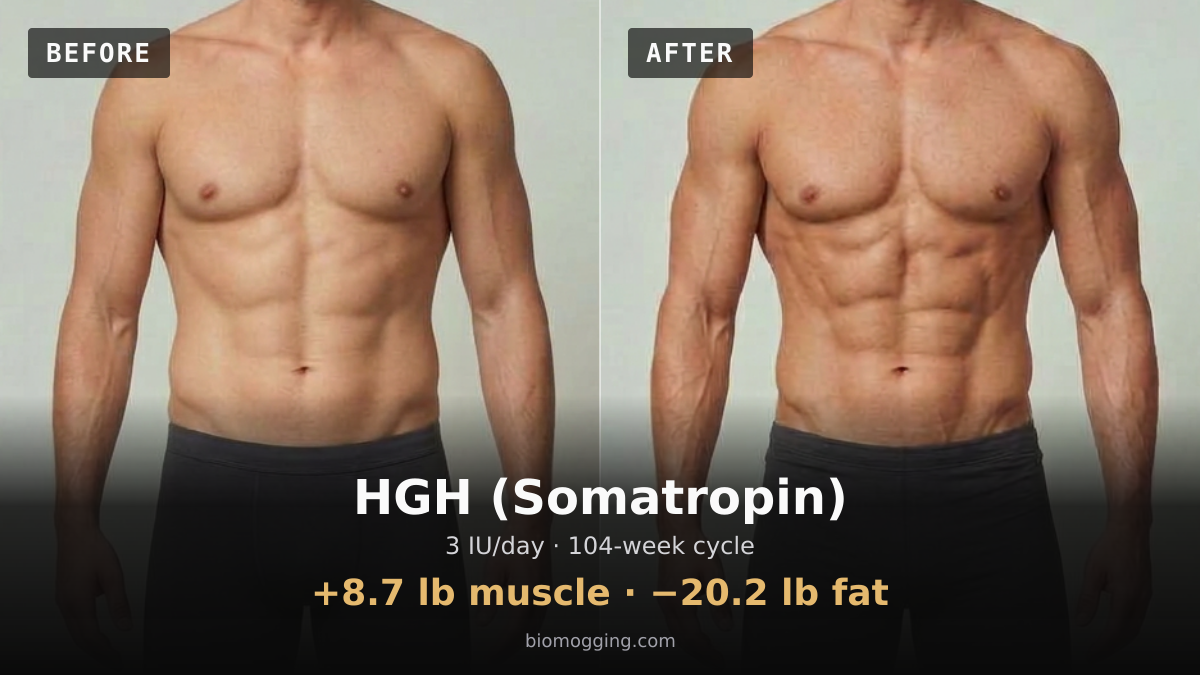
Short runs under 3 months are largely wasted money for body composition. Collagen remodeling, visceral fat loss, skin thickening, and the slow lean-mass accrual all require sustained IGF-1 elevation over months. Most experienced users run HGH continuously for 6 months to multiple years, adjusting dose by goal phase rather than cycling on and off.
Dose Ladder by Goal#
| Goal | Cycle Length | Daily Dose | Timing |
|---|---|---|---|
| Anti-aging, skin, sleep, recovery | 6–24 months continuous | 1–2 IU | Single shot pre-bed |
| Looksmaxxing (facial fat, skin quality) | 6–12 months minimum | 1.5–2 IU | Pre-bed |
| Tendon/joint repair | 3–6 months | 2 IU | Pre-bed, often stacked with BPC-157/TB-500 |
| Body recomposition (cruise) | 6–12+ months | 2–4 IU | Fasted AM, or split AM/PM |
| Bodybuilding offseason | 4–12+ months | 4–6 IU | Split 2× daily |
| Contest prep / lipolysis stack | 12–20 weeks into prep | 4–8 IU | Fasted AM + post-workout, stacked with slin/T3 |
| Advanced / pro bodybuilding | Long-term | 8–15 IU | Split 2–3× daily, slin-paired |
Onset Timing — What to Expect and When#
- Weeks 1–3: Water retention, puffy hands, deeper sleep, more vivid dreams. Possible numbness/tingling in fingers if dose is too high too fast.
- Weeks 4–8: Water settles. Improved recovery between sessions becomes obvious. Subtle skin changes (thickness, hydration).
- Months 2–4: Visceral fat reduction begins, especially subcutaneous fat on the face and lower abdomen. Nail/hair quality improves. Tendon pain from heavy training starts resolving.
- Months 4–6: The "HGH look" — tighter skin, reduced facial adiposity, fuller muscle bellies from improved hydration and glycogen storage. Slow lean mass accrual becomes measurable.
- Months 6–12+: Compounding effects. This is where the aesthetic payoff actually lives.
"GH administration resulted in a mean increase in lean body mass of 2.1 kg and a mean decrease in fat mass of 2.1 kg compared with placebo; adverse events included soft tissue edema, arthralgia, and carpal tunnel syndrome." — Liu et al., Annals of Internal Medicine (2008)
Loading, Tapering, and Titration#
There is no loading phase. There is no taper on discontinuation — HGH has a 2–4 hour SC half-life and is cleared within a day, with IGF-1 normalizing over roughly a week.
What you should do is titrate up, not start at your goal dose. Water retention and carpal tunnel scale hard with how fast you ramp. Standard approach:
- Start at 1 IU/day for 2 weeks
- Increase by 0.5–1 IU every 1–2 weeks as sides tolerate
- Hold at the dose that delivers the IGF-1 number you're targeting without unmanageable water/CTS
Users who ignore this and start at 4–5 IU cold almost always drop the compound within a month citing side effects that would have been trivial had they ramped.
Bloodwork Cadence#
HGH is one of the few compounds where bloodwork isn't optional — it's the only way to verify your kit is real and your dose is doing what you think it's doing. Grey-market generics vary wildly in potency, and IGF-1 is the proxy.
Baseline (pre-cycle):
- IGF-1
- Fasting glucose, HbA1c, fasting insulin
- Lipid panel
- TSH, free T4, free T3
Week 6–8 after starting or any dose change:
- IGF-1 — drawn fasted, 10–14 days minimum into a stable dose
- Fasting glucose, HbA1c
Every 3–6 months on long runs:
- Full panel above, plus blood pressure monitoring
IGF-1 targets by goal:
| Goal | Target IGF-1 (ng/mL) |
|---|---|
| Anti-aging / looksmaxxing | 220–280 |
| Recomp / cruise | 280–380 |
| Aggressive bodybuilding | 400–550 |
| Pro / contest (higher risk) | 550+ |
A 2 IU/day dose should push IGF-1 by roughly 100–150 ng/mL over your personal baseline. If it doesn't, your kit is underdosed or fake.
"After intravenous administration, the metabolic half-life of GH was approximately 15–20 minutes, whereas following subcutaneous administration, the terminal half-life was 2–4 hours due to delayed absorption from the injection depot." — Laursen et al., J Clin Endocrinol Metab (1993)
When to Adjust or Pull Back#
- Fasting glucose creeping above 100 mg/dL or HbA1c trending past 5.7: drop dose by 1–2 IU, tighten diet, consider adding metformin
- Persistent CTS past week 4: dose is too high; drop by 1 IU
- Free T3 drops into the lower quartile: add 12.5–25 mcg T3
- Gut distension at high doses: pull back — this is early acromegalic remodeling and it's not reversible once established
At cruise doses (1–4 IU), HGH is something you can run continuously for years with quarterly bloodwork. Above 5 IU long-term, you're trading aesthetic and longevity benefits for real cardiac and metabolic cost — run those ranges with a plan, not a vibe.
Risks & mistakes
Common (most users)#
Most of these show up in the first 2–4 weeks and fade as the body adapts. If they don't fade, back the dose down by 0.5–1 IU and hold.
- Water retention / puffy hands and face — the classic "GH bloat." Most noticeable on waking. Usually resolves within 3–4 weeks as receptors downregulate. Mitigation: start low (1 IU), titrate up weekly, reduce sodium, don't pin immediately pre-photoshoot or weigh-in.
- Carpal tunnel symptoms — tingling, numbness, or aching in the hands and wrists from peripheral nerve edema. The #1 reason users drop dose. Mitigation: split doses (AM + PM) instead of a single large shot, drop 0.5–1 IU, sleep with wrists neutral (wrist braces help). Resolves within 1–2 weeks of dose reduction.
- Arthralgia — achy fingers, knees, jaw. Same mechanism as CTS (tissue edema) plus connective tissue turnover. Fades with continued use or dose reduction.
- Injection site lipoatrophy or bruising — rotate sites across abdomen/flanks, use 27–31g insulin pins, inject slowly.
- Mild daytime drowsiness or deeper sleep — common with pre-bed dosing. Most users consider this a feature, not a bug.
- Elevated fasting glucose — expected; GH is counter-regulatory to insulin. At ≤3 IU/day this usually stays within normal range. Mitigation: check fasting glucose at week 6, keep carbs clean, don't pair GH with a dirty bulk.
"GH administration resulted in a mean increase in lean body mass of 2.1 kg and a mean decrease in fat mass of 2.1 kg compared with placebo; adverse events included soft tissue edema, arthralgia, and carpal tunnel syndrome." — Liu et al. 2008, Annals of Internal Medicine
Uncommon (dose-dependent or individual)#
These scale with dose and duration. Most appear above 4 IU/day or on long multi-year runs.
- Insulin resistance / rising HbA1c — GH impairs post-receptor insulin signaling and drives FFA oxidation. Reversible at cruise doses; can progress to clinical pre-diabetes at 5+ IU/day long-term, especially stacked with orals and a surplus. Check fasting glucose + HbA1c every 3 months. If HbA1c climbs above 5.7%, drop dose or add metformin 500–1000 mg/day.
- Reduced T4→T3 conversion — GH shifts thyroid economy peripherally. Symptoms: cold intolerance, flat energy, stalled fat loss despite good compliance. Mitigation: add 12.5–25 mcg T3 daily. Check TSH + free T3/T4 at week 8.
- Persistent CTS at moderate doses — some users are genetically susceptible regardless of dose. If splitting and titrating doesn't resolve it after 4 weeks, you're one of the people who caps out at 2–3 IU/day.
- Gynecomastia flare — GH drives IGF-1-mediated breast tissue proliferation and can aggravate existing gyno. Manage estrogen on cycle; don't run high-dose GH with dirty estrogen control.
- Elevated blood pressure — via fluid retention. Check cuff monthly. Mitigation: dose reduction, telmisartan if stacked with AAS.
- Tunnel vision / benign intracranial pressure symptoms — rare at community doses, more common on 6+ IU/day. Persistent headaches with visual disturbance = stop and investigate.
"In healthy subjects, GH induces insulin resistance, increases lipolysis by upregulating HSL and ATGL, and stimulates fat oxidation, while concurrently promoting protein accretion via indirect IGF-1 production." — Møller & Jørgensen 2009, Endocrine Reviews
Rare but serious#
Low incidence, but these are the ones that decide long-term outcomes. Most show up only on multi-year high-dose runs (6+ IU/day) — the "pro bodybuilder" territory.
- Acromegalic features — jaw growth, brow-ridge thickening, enlarged hands/feet/nose, tooth spacing. Irreversible. Almost exclusively seen in users who run 8+ IU/day for years. If you notice ring/shoe size creeping up, you're already in it — pull back.
- Cardiac hypertrophy / LVH — chronic supraphysiologic IGF-1 drives cardiomyocyte growth. Warning signs: dropping exercise tolerance, resting HR climbing, arrhythmia. Echocardiogram every 12–18 months on long high-dose runs.
- Visceral organ hypertrophy ("GH gut") — distended abdomen from enlarged intestines and liver. Cosmetic disaster on stage, and the intestinal piece is not fully reversible.
- Accelerated growth of pre-existing neoplasms — GH/IGF-1 does not appear to cause cancer in the available data, but it can feed tumors that already exist. Baseline dermatology check, age-appropriate screening, and do not run GH through an undiagnosed mass.
- Benign intracranial hypertension — severe persistent headache + papilledema. Stop immediately and get imaged.
- Slipped capital femoral epiphysis / pancreatitis — documented in pediatric/clinical populations, essentially non-issues for adults at community doses, but worth knowing.
Hard contraindications#
These are not "talk to your doctor" suggestions — these are the lines.
- Active malignancy of any kind. GH/IGF-1 is a mitogen. Do not run it with an active cancer diagnosis, and do not run it through an undiagnosed lump or lesion.
- Proliferative diabetic retinopathy. GH worsens retinal neovascularization and can precipitate vision loss.
- Uncontrolled type 2 diabetes. Get glucose control sorted first. GH on top of existing hyperglycemia pushes HbA1c into dangerous range fast.
- Acute critical illness (post-op, ICU, severe trauma, sepsis). Increased mortality in RCTs of critically ill patients on high-dose GH.
- Known hypersensitivity to benzyl alcohol — switch to a sterile-water reconstitution protocol (24 h use window) or a pharma formulation without the preservative.
- GH + insulin fasted or with a skipped carb meal. If you're running the post-workout slin stack, dextrose and a protein+carb meal are non-negotiable. Hypoglycemia on this stack has killed people. Keep fast sugar in arm's reach, not another room.
Gender considerations and PCT#
GH does not suppress the HPG axis — no PCT is required, and there is no testosterone/LH rebound to manage on cessation. You can stop abruptly or taper; the main post-cycle change is a return of IGF-1 to baseline over 1–2 weeks and loss of the extracellular water.
Women tolerate GH well and do not need aggressive dose reduction vs men — 1–2 IU/day is the sweet spot for skin, recomp, and sleep. Side effect profile (CTS, edema, arthralgia) is identical to men and dose-dependent the same way. GH is not virilizing and can be run alongside female-friendly AAS or solo without voice/clitoral concerns. Pregnancy: human data are limited; community practice is to pause GH if actively trying to conceive or pregnant.
Stack & combine
FAQ — HGH (Somatropin)
Research & citations
5 studies cited on this page.
Conclusion
HGH is the backbone of serious physique and looksmaxxing stacks: it drives collagen synthesis, steady IGF-1 elevation, and fat loss over multi-month runs if you get the dose and timing right.
Key takeaways:
- Effective daily dose: 1–2 IU (looksmaxxing/skin/sleep) up to 4–6 IU (recomp/bodybuilding)
- Preferred route: subcutaneous, with gentle vial reconstitution using bac water
- Cycle length: minimum 16 weeks — real results compound at 6+ months
- Injection timing: fasted AM for lipolysis, pre-bed for sleep/recovery (timing matters less below 4 IU/day)
- Stacking: add TRT for muscle, optional low-dose T3 (12.5–25 µg) and slin/T3 at higher doses
- Sides are dose-dependent and manageable (water retention, CTS, glucose) under 4 IU/day
If you give it time, monitor IGF-1 and glucose, and titrate up slowly, HGH delivers on recovery, fat loss, connective tissue remodeling, and the overall "glow" that sets dedicated users apart.