Dihydroboldenone
DHB · 1-Testosterone · 1-Testo · 1-T · δ1-DHT · 1-Test Cypionate · 1-Test Cyp · 1-Test Acetate
Last updated
At a glance
- Muscle Growth
- 7/10
- Strength
- 7/10
- Fat Loss
- 5/10
- Endurance
- 4/10
- Recovery
- 4/10
- Cognition
- 2/10
200
Testosterone = 100
100
Testosterone = 100
Overview
Why DHB Has a Cult Following#
Dihydroboldenone — sold as 1-Test Cypionate or 1-Test Acetate — is the 5α-reduced analog of boldenone, structurally a DHT molecule with a 1(2)-double bond replacing test's 4(5)-double bond. Translation: it binds the androgen receptor with potency comparable to testosterone but cannot aromatize to estrogen and cannot be further reduced by 5α-reductase. You get clean, AR-driven tissue growth without the water, the gyno risk, or the E2 management headache.
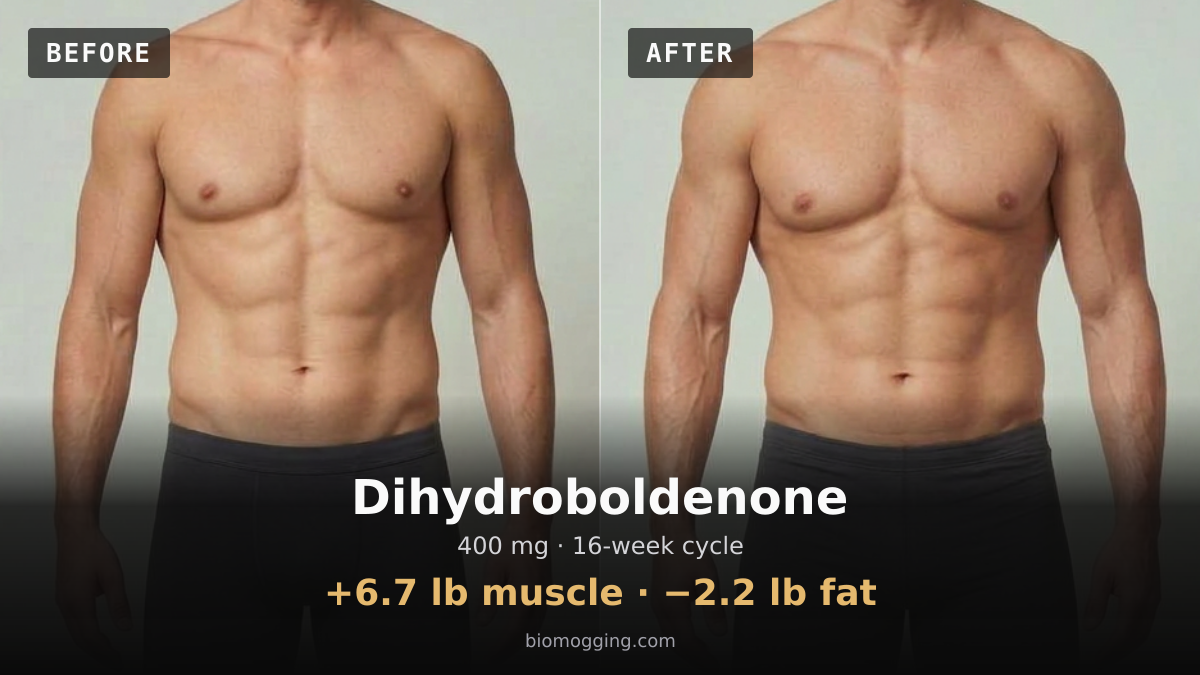
That pharmacology is exactly why the bodybuilding and looksmaxxing community keeps coming back to it. Users running 400–500 mg/week on a test base consistently describe dry, hard, vascular recomp — slow-quality gains with the aesthetic signature that made primobolan famous. With pharma-grade primo supply collapsing and the counterfeit rate climbing, DHB has quietly become the go-to "poor man's primo" for experienced users who want that dry phenotype without gambling on vendor authenticity.
"1-testosterone exhibited a high AR binding affinity and androgenic activity in vivo similar to testosterone but without estrogenic effects due to lack of aromatization." — Friedel et al., Toxicology Letters (2006)
The trade-offs are real and worth naming up front: notorious PIP (especially with the acetate ester), elevated CRP and occasional flu-like malaise in a subset of responders, and no scalp protection from finasteride since DHB is already 5α-reduced. It's also not a beginner compound — not because it's harsh relative to test, but because newer users can't distinguish its signal from just running more testosterone, and they end up eating injection-site pain for nothing.
This guide covers the full protocol: mechanism and pharmacokinetics, beginner through advanced dosing for 1-Test Cyp vs. 1-Test Ace, stacking logic for recomp / lean bulk / prep / strength blocks, side-effect mitigation (PIP, CRP, lipids, BP, hair), bloodwork cadence, and the SERM PCT timing that matches DHB's long-ester kinetics.
How Dihydroboldenone works
AR Binding and Transactivation#
DHB is structurally 5α-androst-1-en-17β-ol-3-one — a DHT skeleton with a 1(2)-double bond in the A-ring instead of DHT's saturated A-ring, or equivalently, boldenone with the 4,5-double bond shifted to 1,2 and a 5α-hydrogen in place. That single structural move makes it a potent, selective androgen receptor agonist with affinity comparable to testosterone and DHT, but with a radically different metabolic profile.
In the classic Hershberger-style orchiectomized rat bioassay, 1-T drove levator ani (skeletal muscle) and ventral prostate growth to a degree comparable to testosterone at equimolar dose — but without the estrogenic fingerprint that testosterone leaves in uterine tissue.
"1-testosterone exhibited a high AR binding affinity and androgenic activity in vivo similar to testosterone but without estrogenic effects due to lack of aromatization." — Friedel, A. et al., Toxicology Letters, 2006
Practically: AR activation in muscle upregulates myofibrillar protein synthesis, satellite cell recruitment, and local IGF-1 expression. This is the engine behind the slow, dry, high-quality tissue accrual users describe on DHB runs.
No Aromatization, No Estrogen#
The Δ1 double bond means the A-ring is not a viable substrate for aromatase (CYP19A1). DHB cannot be converted to an estrogen. Not weakly — not at all.
"As a 5α-reduced DHT derivative with a 1(2)-double bond, 1-testosterone (DHB) cannot be metabolized by aromatase into estrogen, or further reduced by 5α-reductase." — Wikipedia contributors, Wikipedia, 2024
This explains the dry, vascular, gyno-proof phenotype that defines DHB's reputation. It also explains the downside that less experienced users miss: estrogen does real work on cycle — joint lubrication, HDL maintenance, vasodilation, libido, mood, neuroprotection, and appetite. DHB provides none of it. This is why running DHB without a co-administered aromatizing testosterone base is a mistake: you end up in a functionally low-E2 state with dry joints, flat libido, and an ugly lipid panel, regardless of how well the compound itself is "working."
Not a 5α-Reductase Substrate#
DHB is already 5α-reduced. There is no further reduction pathway available to it — unlike testosterone, which is amplified 3–10× at AR in androgen-sensitive tissues (scalp, prostate, skin) via local 5α-reductase conversion to DHT.
"1-Testosterone is a synthetic anabolic steroid and a 5-alpha reduced derivative of boldenone, exhibiting significant anabolic and androgenic activity, and is not a substrate for aromatase or 5α-reductase." — DrugBank, DrugBank Online, 2024
Two practical consequences:
- Finasteride and dutasteride do nothing against DHB at the scalp. There is no DHT conversion step to block — DHB itself is the androgen hitting the follicle. Users predisposed to androgenic alopecia who want to run DHB need topical AR antagonists (RU58841, pyrilutamide) or they need to accept the hair cost. Oral 5-ARIs are irrelevant here.
- The muscle-to-androgenic-tissue ratio is more favorable than testosterone's in tissues that rely on 5-AR amplification, but less favorable than testosterone's in tissues that don't. DHB's often-quoted 200:100 anabolic:androgenic ratio reflects this — good AR drive in muscle, meaningful but not amplified androgenic load at skin and scalp.
Downstream Anabolic Signaling#
Once AR is activated and translocates to the nucleus, DHB drives the same transcriptional program as other potent 5α-reduced AR agonists:
"The compound binds specifically to the androgen receptor and induces strong androgenic as well as anabolic effects in the rat bioassay, paralleling observations for other 5α-reduced anabolic steroids such as DHB." — Diel, P. et al., Toxicology Letters, 2007
That program includes upregulation of myofibrillar protein synthesis, inhibition of myostatin signaling, increased erythropoietin output (hence the hematocrit creep at higher doses), and enhanced nutrient partitioning — the reason DHB has a reputation for producing visible recomp even at maintenance calories. Users cruising on test + DHB consistently report the same phenotype: leaner, drier, more vascular at the same bodyweight.
Why the "Sickness" Happens#
The less-discussed mechanism: DHB has a reproducible subset of users reporting elevated CRP, flu-like malaise, acid reflux, and creeping lethargy 2–4 weeks into a run. The exact pathway isn't characterized in the literature — no human clinical data exists on DHB inflammatory markers — but the pattern is consistent enough across community reports that it's treated as a real pharmacological effect rather than placebo or contamination.
"Most users report that DHB really turns on closer to 400mg; above 500–700mg the sides (notably PIP and creeping lethargy) can start to outpace the benefits." — MESO-Rx Community, MESO-Rx Forums, 2024
Working hypothesis in the community is a combination of strong AR-mediated inflammatory signaling in a subset of responders plus the fact that the oily 1-T ester is often carried in heavy BB/BA solvent systems that themselves produce local and systemic inflammatory signal. If CRP spikes or the malaise shows up, it usually doesn't adapt away — the correct response is to drop the compound, not push through. That's a mechanism-level reason DHB isn't a "run it and forget it" compound the way testosterone is.
Protocol
| Level | Dose | Frequency | Notes |
|---|---|---|---|
| Low | 200–300 mg | Twice weekly | Documented entry-level range |
| Mid | 300–500 mg | Twice weekly | Most commonly studied range |
| High | 500–700 mg | Twice weekly | 1-Test Cypionate: split weekly dose E3.5D (twice weekly) to keep blood levels stable. 1-Test Acetate requires EOD or daily injections and carries significant PIP — not recommended for first exposure. |
Cycle length & outcomes
Documented cycle
10–16 weeks
Plateau after
14 wks
Cycle Length & Onset#
DHB is a slow, accumulating compound. Unlike tren or superdrol, you do not feel it in the first week — plasma levels of 1-Test Cypionate need 4–5 weeks to fully saturate, and most users report the compound "turning on" around weeks 5–6 with noticeable dry tissue gain, vascularity, and strength creep continuing through week 12+.
"Most users report that DHB really turns on closer to 400mg; above 500–700mg the sides (notably PIP and creeping lethargy) can start to outpace the benefits." — MESO-Rx Community, 2024
Because the onset is slow and sides scale with duration (CRP, lipids, BP), 12–16 weeks is the sweet spot. Shorter than 10 weeks and you haven't given the long ester time to express. Longer than 16 weeks and most users start collecting inflammatory baggage without proportional gains — the efficacy curve flattens after week 14.
Dose Ladder by Goal#
| Goal | Cycle Length | Weekly Dose (1-Test Cyp) | Test Base |
|---|---|---|---|
| First DHB run / recomp | 10–12 weeks | 200–300 mg | 150–200 mg/wk |
| Lean bulk | 12–14 weeks | 400–500 mg | 200–300 mg/wk |
| Contest prep (hardening) | 8–10 weeks (final block) | 400 mg | 150–200 mg/wk + mast/tren |
| Advanced recomp / primo substitute | 14–16 weeks | 500–700 mg | 200 mg/wk |
| Enhanced cruise | Ongoing | 200–300 mg | 150 mg/wk |
Split the weekly dose E3.5D (twice weekly) — Monday/Thursday or Tuesday/Friday. Do not try to cram a full week's 1-Test Cyp into one shot; the oil volume and PIP will punish you.
Tapering & Loading#
No frontload, no taper. Frontloading DHB is a common rookie mistake — the CRP and PIP penalty arrives faster than the anabolic benefit, and you end up miserable in weeks 2–3 without gaining any onset advantage. Start at your target dose from pin one and let the ester accumulate on its own schedule.
On the back end, just stop and begin PCT timing from the last pin. No tapering down — it serves no purpose with a long-ester non-aromatizing AAS.
Onset Timing (What to Expect, Week by Week)#
- Weeks 1–3: Not much. Mild strength uptick from the test base. If you feel flu-ish, elevated CRP, or acid reflux in this window, that's the DHB response some users get — evaluate whether to continue.
- Weeks 4–6: Compound turns on. Vascularity increases, pumps get denser, scale moves slowly but visibly leaner. Strength in compound lifts starts climbing ~1% per week.
- Weeks 7–12: Prime window. Dry, hard tissue gain; nutrient partitioning is obvious (recomp-focused users often see scale weight stable while waist drops and arms/shoulders fill in).
- Weeks 13–16: Diminishing returns. Gains continue but more slowly; this is where sides (BP, hematocrit, lipids) are worth weighing against additional tissue.
Bloodwork Cadence#
DHB demands more bloodwork discipline than test-only cycles because it gives you no estrogen safety net and because CRP is a compound-specific watch item.
| Timepoint | Panel |
|---|---|
| Pre-cycle (baseline) | CBC, CMP, lipid panel (HDL/LDL/ApoB), hs-CRP, total/free T, E2, SHBG, prolactin |
| Week 6 | CBC, lipid panel, hs-CRP, liver panel, E2, hematocrit |
| Week 12 (if extending) | CBC, lipid panel, hs-CRP, BP check, liver panel |
| 3 weeks post-cycle | CBC, CMP, lipids, LH, FSH, total T (pre-PCT checkpoint) |
| 6 weeks post-PCT | Total/free T, LH, FSH, E2 (recovery verification) |
Track BP daily at home — a $30 cuff is non-negotiable. If systolic creeps past 140 or hs-CRP doubles baseline, dose down or cut the run short. These are the two numbers that end DHB cycles early in experienced users.
PCT Timing#
For 1-Test Cypionate, begin PCT ~2.5–3 weeks after the final pin (ester clearance window). Standard SERM protocol:
- Nolvadex 40/40/20/20 mg over 4 weeks, or
- Clomid 50/50/25/25 mg over 4 weeks
If cruising on a TRT dose of test rather than coming off, no PCT is needed — just drop DHB and let the test base carry you.
Run DHB with the understanding that the first 4 weeks are an investment, the middle 8 are the payoff, and the back end is where discipline on bloods separates the users who run it cleanly from the ones who regret it.
Risks & mistakes
Common (most users)#
- Injection site pain (PIP) — the defining nuisance of DHB. 1-Test Cyp is manageable; 1-Test Ace is notorious and has ended cycles on the first pin. Mitigate with a reputable vendor (solvent formulation matters more than potency here), thin 25g pins, warming the oil pre-injection, large muscles (glute/ventroglute over quad/delt), and diligent site rotation. If PIP is debilitating across multiple vials from the same source, switch vendors rather than toughing it out.
- Androgenic skin effects — acne on back/shoulders/chest, oily skin. Manage with a benzoyl peroxide wash, topical adapalene, and pillowcase hygiene. Flares hard above 500 mg/week.
- Libido swings — usually fine on a proper test base; erratic or crashed if you're under-dosing test, over-AI'ing, or running DHB-only. Keep test ≥150–200 mg/week and don't touch an AI unless bloods justify it.
- Aggression / short fuse — typical androgenic edge, more pronounced than test at equivalent doses. Channel it into training; lower the dose if it's affecting relationships or driving.
- Mild AST/ALT elevation — not classically hepatotoxic (not 17α-alkylated), but routine on any injectable AAS run. Don't stack with orals and daily alcohol if you want clean liver bloods.
Uncommon (dose-dependent or individual)#
-
Creeping lethargy / malaise — the most-reported DHB-specific complaint. Users describe a flu-like, dragging fatigue that sets in 2–3 weeks into the cycle.
"Most users report that DHB really turns on closer to 400mg; above 500–700mg the sides (notably PIP and creeping lethargy) can start to outpace the benefits." — MESO-Rx Community (2024)
If it doesn't resolve within a week of dropping the dose, drop the compound — this one tends not to desensitize.
-
Elevated CRP / systemic inflammation — a recurring DHB-specific signal in community bloodwork. Check CRP at week 4–6. If it's significantly above baseline with no other explanation, DHB is the likely driver and the cycle should end.
-
Blood pressure creep — common above 500 mg/week. Measure daily at home. Telmisartan 40–80 mg or cialis 5 mg daily are the usual first-line adds; drop dose if BP stays >140/90 on management.
-
Lipid shift — HDL suppression and LDL/ApoB elevation, in line with other non-aromatizing injectables, and without the mild E2 buffering test alone provides. Run a lipid panel mid-cycle. Citrus bergamot, a controlled-carb approach, and cardio help; ezetimibe or a low-dose statin are on the table for users running back-to-back cycles.
-
Hematocrit climb — AR-driven erythropoiesis. Check CBC mid-cycle; donate blood if HCT >52%.
-
Acid reflux — reported by a subset of users on DHB specifically. Famotidine 20–40 mg works; if it doesn't, back off dose.
-
Scalp hair shedding — DHB is already 5α-reduced, so finasteride and dutasteride do nothing for it. Topical AR antagonists (RU58841, pyrilutamide) are the only pharmacological protection; minoxidil + microneedling supports the scalp but won't block the androgenic signal. If you're actively losing hair, this is not your compound.
Rare but serious#
- Severe persistent inflammation / sickness response — a minority of users simply don't tolerate DHB and get a sustained flu-like reaction that doesn't clear with dose reduction. Stop and don't re-challenge.
- Cardiac strain — sustained high BP, elevated hematocrit, and suppressed HDL/elevated ApoB over multi-cycle timelines raise LVH and atherosclerotic risk. Warning signs: exertional chest tightness, new arrhythmia, BP uncontrolled on two agents. Stop the cycle.
- Tendon injury — strength gains can outrun connective-tissue adaptation faster than the muscle feedback suggests. Warm thoroughly, avoid max singles early, and ramp load conservatively. Sharp localized pain in tendon (not muscle belly) is a stop signal.
- Cholestatic jaundice — rare with injectable-only AAS but possible. Yellowing of sclera, dark urine, pale stool, right-upper-quadrant pain → stop, pull a full liver panel.
Hard contraindications#
- Female use. DHB's androgenic load is comparable to testosterone and virilization (voice deepening, clitoromegaly, hirsutism) is high-probability and often irreversible. There is no viable female dose.
- Pregnancy or pregnancy potential. AAS-class teratogenicity and virilization of a female fetus.
- Untreated hypertension. DHB has no estrogenic vasoprotective offset. Control BP first or pick another compound.
- Established dyslipidemia or ApoB significantly above target. DHB will make this materially worse with no E2 buffer.
- Active cardiovascular disease, recent cardiac event, or cardiomyopathy.
- Active or suspected androgen-dependent malignancy (prostate, certain breast cancers).
- Active significant hair loss without acceptance or topical AR-antagonist plan — you cannot 5-AR-inhibit your way out of DHB.
Gender and PCT considerations#
Women: not a viable compound. The clean, estrogen-free profile that makes DHB attractive to men is precisely what makes it aggressive in women — pure AR activation at DHT-analog affinity with no estrogenic softening. Virilization risk dominates.
Men — PCT: full HPTA shutdown is expected. If you're not cruising on a TRT dose afterward, standard SERM protocol starts ~2.5–3 weeks after the final 1-Test Cyp pin (the ester's ~8-day half-life means you're still clearing it at 2 weeks out). Nolvadex 40/40/20/20 or clomid 50/50/25/25 over 4 weeks, with HCG 500 IU E3.5D during the last 2–3 weeks of the cycle if testicular atrophy is significant. Re-test total test, free test, LH, FSH, and E2 at 6–8 weeks post-PCT to confirm recovery.
Fertility: shutdown is dose- and duration-dependent. Men planning near-term conception should cruise on TRT-dose test + HCG, or avoid long DHB runs entirely.
Stack & combine
Multipliers applied when these compounds run together. Values > 1 indicate a bonus on that axis. Tap a partner to expand the mechanism.
| Partner | Type | Lean | Fat loss | Recovery |
|---|---|---|---|---|
| synergistic | ×1.18 | ×1.05 | ×1.12 | |
| synergistic | ×1.12 | ×1.05 | ×1.08 |
FAQ — Dihydroboldenone
PCT & ancillaries
These are separate products from our affiliate partners, not Dihydroboldenone offers. Their inclusion does not mean they are required or recommended for use.

Real Peptides
Our pick20% off — auto-applied at checkout
- Buy Kisspeptin · 20% offKisspeptin· Kisspeptin-10
A 4-week protocol at 150 mcg twice daily ≈ 1 vial

NextChems
10% off — auto-applied at checkout
- Buy Anastrozole · 10% offAnastrozole· Anastrozole (Arimidex), 0.5mg – 60 Capsules - NextChems
A 10-week protocol at 0.38 mg twice weekly ≈ 1 bottle
- Buy Clomiphene Citrate · 10% offClomiphene Citrate· Clomid (Clomifene / Clomiphene), 25mg – 60 Capsules - NextChems
A 5-week protocol at 37.5 mg/day ≈ 1 bottle
- Buy Enclomiphene Citrate · 10% offEnclomiphene Citrate· Enclomiphene 12.5mg, 60 Capsules - NextChems
A 10-week protocol at 12.5 mg/day ≈ 2 bottles
- Buy Ezetimibe · 10% offEzetimibe· Ezetimibe, 10mg – 60 Capsules - NextChems
A 28-week protocol at 10 mg/day ≈ 4 bottles
- Buy Hydrochlorothiazide · 10% offHydrochlorothiazide· Hydrochlorothiazide (HCTZ), 12.5mg – 60 Capsules - NextChems
A 7-week protocol at 18.75 mg/day ≈ 2 bottles
- Buy Nebivolol · 10% offNebivolol· Nebivolol, 5mg – 60 Capsules - NextChems
A 28-week protocol at 7.5 mg/day ≈ 5 bottles
- Buy Nolvadex · 10% offNolvadex· Tamoxifen (Nolvadex), 20mg – 60 Capsules - NextChems
A 5-week protocol at 30 mg/day ≈ 1 bottle
- Buy Pramipexole · 10% offPramipexole· Pramipexole (Prami), 0.2mg – 60 Capsules - NextChems
A 10-week protocol at 0.19 mg/day ≈ 2 bottles
- Buy Propranolol · 10% offPropranolol· Propranolol, 10mg – 60 Capsules - NextChems
- Buy Raloxifene · 10% offRaloxifene· Raloxifene, 20mg – 60 Capsules - NextChems
A 10-week protocol at 60 mg/day ≈ 4 bottles
- Buy Rosuvastatin · 10% offRosuvastatin· Rosuvastatin, 5mg – 60 Capsules - NextChems
A 28-week protocol at 15 mg/day ≈ 10 bottles
- Buy Telmisartan · 10% offTelmisartan· Telmisartan, 40mg – 60 Capsules - NextChems
A 28-week protocol at 60 mg/day ≈ 5 bottles

Swiss Chems
10% off — auto-applied at checkout
- Buy Anastrozole · 10% offAnastrozole· Anastrozole (0.5mg/capsule), 60 Capsules - SwissChems-Buy Best Quality Peptides, SARMS Online
A 10-week protocol at 0.38 mg twice weekly ≈ 1 bottle
- Buy Clomiphene Citrate · 10% offClomiphene Citrate· Clomiphene, 1500mg (25mg/capsule) - SwissChems-Buy Best Quality Peptides, SARMS Online
A 5-week protocol at 37.5 mg/day ≈ 1 bottle
- Buy Enclomiphene Citrate · 10% offEnclomiphene Citrate· Enclomiphene (12.5mg/capsule), 60 Capsules - SwissChems-Buy Best Quality Peptides, SARMS Online
A 10-week protocol at 12.5 mg/day ≈ 2 bottles
- Buy Gonadorelin · 10% offGonadorelin· Gonadorelin 2mg - SwissChems-Buy Best Quality Peptides, SARMS Online
A 28-week protocol at 150 mcg/day ≈ 15 vials
- Buy HMG (Human Menopausal Gonadotropin) · 10% offHMG (Human Menopausal Gonadotropin)· HMG 75 IU - SwissChems-Buy Best Quality Peptides, SARMS Online
- Buy Human Chorionic Gonadotropin · 10% offHuman Chorionic Gonadotropin· HCG 5000 IU - SwissChems
- Buy Kisspeptin · 10% offKisspeptin· Kisspeptin-10 10mg - SwissChems-Buy Best Quality Peptides, SARMS Online
A 4-week protocol at 150 mcg twice daily ≈ 1 vial
- Buy Letrozole · 10% offLetrozole· Letrozole (1mg/capsule), 60 Capsules - SwissChems-Buy Best Quality Peptides, SARMS Online
A 7-week protocol at 0.88 mg twice weekly ≈ 1 bottle
- Buy Nebivolol · 10% offNebivolol· Nebivolol 300 mg (5 mg / 60 capsules) - SwissChems-Buy Best Quality Peptides, SARMS Online
A 28-week protocol at 7.5 mg/day ≈ 5 bottles
- Buy Nolvadex · 10% offNolvadex· Tamoxifen (20mg/capsule), 60 Capsules - SwissChems-Buy Best Quality Peptides, SARMS Online
A 5-week protocol at 30 mg/day ≈ 1 bottle
- Buy Pramipexole · 10% offPramipexole· Pramipexole (Prami), 12 mg (0.2 mg/60 capsules) - SwissChems-Buy Best Quality Peptides, SARMS Online
A 10-week protocol at 0.19 mg/day ≈ 2 bottles
- Buy Raloxifene · 10% offRaloxifene· Raloxifene (20mg/capsule), 60 Capsules - SwissChems-Buy Best Quality Peptides, SARMS Online
A 10-week protocol at 60 mg/day ≈ 4 bottles
- Buy Telmisartan · 10% offTelmisartan· Telmisartan, 2400mg (40mg/capsule) - SwissChems-Buy Best Quality Peptides, SARMS Online
A 28-week protocol at 60 mg/day ≈ 5 bottles
- Buy Triptorelin · 10% offTriptorelin· GnRH (Triptorelin) 2mg - SwissChems-Buy Best Quality Peptides, SARMS Online

NextGenPeps
10% off — use code at checkout
Research & citations
6 studies cited on this page.
Conclusion
DHB is a potent, dry-lean AAS that rewards experienced users with true anabolic drive and almost zero estrogenic baggage — but only if you respect its quirks and stacking requirements.
Key takeaways:
- Standard dose: 300–500 mg/week (1-Test Cyp), split twice weekly; start at 200–300 mg if new to DHB
- Always run on top of a test base (150–200 mg/week); DHB alone will not cover libido, joint, or cardiovascular needs
- Full SERM PCT (nolvadex/clomid) is required if not cruising; start 2.5–3 weeks after the last pin
- Lean recomp and "dry bulk" are the classic use-cases — users consistently report visual hardening, pumps, and vascularity without water or gyno
- PIP is real (especially with the acetate); vet your source and expect to rotate sites
- Stacks cleanly with mast, tren, EQ, and other cutting/leaning AAS; does not aromatize and is not a progestin
- Strong androgenic profile: expect hair risk, acne, and lipid hit; no protection from finasteride (already 5α-reduced)
If you want the classic "hard, dry muscle" effect at a test+primo price point — and can tolerate injectable cycles and some site soreness — DHB absolutely delivers for the experienced physique-focused user.
Similar compounds
Comparisons
Disclosures
Affiliate links — we may earn a commission at no cost to you.